
10. Taking Back the EPA & Florida’s Shorelines - Superman's Not Coming: Our National Water Emergency and What We the People Can Do About It
By Erin Brockovich
10. TAKING BACK THE EPA & FLORIDA’S SHORELINES
Gutted. It’s the best word I can think of to describe the current state of affairs at the U.S. Environmental Protection Agency (EPA) in the second year of the Trump administration. Tasked with protecting the water we drink and the air we breathe, our No. 1 eco-agency is made up of many well-intentioned scientists, researchers, and administrators who have what many call an impossible job.
When Congress passes a law such as the Clean Water Act, the EPA must work to enforce and maintain it. That means finding solutions to some of our biggest problems, including water pollution and toxic waste. They use all available science and spearhead new research efforts, especially when it comes to studying emerging contaminants of concern. Each year, the list of potential toxic chemicals gets longer, right next to the backlog of thousands of unstudied and unregulated chemicals. We live in a triage situation where thousands of heavily polluted sites across the country sit untouched because they are too large, too expensive, and too complicated to tackle. These include many urban waterways.
What we need is a well-funded, robust agency full of our best and brightest. What we have is an underfunded, understaffed, overstretched federal department. This agency can’t keep up with all the pollution and corruption happening across the country. Making laws and policies is already a slow, delicate dance between proposals, negotiations, implementation, and enforcement. These policies are based on the scientific research available and the funding to continue studying how pollution affects our daily lives.
These days, the EPA is more focused on cutting programs and killing regulations than on protecting us from toxic chemicals. Regulations without proper enforcement and oversight are moot. If we don’t shift gears soon, we may never pull out of this mess.
“It’s not wrong for Americans who care about the EPA to be concerned right now,” climate change writer Robison Meyer wrote in The Atlantic in 2017. “Many Republicans want to see its powers diminished or removed altogether. But Congress will not attempt to curb the EPA’s influence by closing it outright. Instead, it will wage war on the agency through a thousand little cuts—through bills, through joint resolutions, and through budget riders.”
It might sound like I’m taking a political side here. I’m not. I hate politics being involved with our water, since we should all support this essential need. For years, I’ve watched as environmental tragedies have unfolded under both Republican and Democratic leadership. The EPA is not a perfect agency, but the situation has grown much worse since the election of Donald Trump in 2016, when he vowed to reduce the EPA’s finances to “little tidbits,” proposing a budget not seen since 1976. He called for a 25 percent reduction in staff and made plans to eliminate significant regional water quality programs such as the Great Lakes Restoration Initiative and the Chesapeake Bay program, which work to help keep our local waterways safe. He’s also proposed to significantly cut the Superfund program, which works to clean up hazardous waste sites, and to slash funding for federal enforcement of environmental protection regulations. Cutting staff and budgets means fewer inspectors monitoring the laws we have on the books, fewer resources to study the impact of toxins, and more companies contravening environmental regulations.
When you take a closer look at the numbers, you will find that the EPA’s budget and number of employees has been slowly shrinking for decades, according to a report from the Environmental Data & Governance Initiative (EDGI), an organization made up of academics and nonprofit employees that promotes open and accessible government data and information along with evidence-based policy making. In 1999 the EPA’s staff size peaked with more than eighteen thousand employees. Staff numbers have dwindled since then for a variety of reasons including retirements, pushing out good people, and many employees feeling too fed up to stay and watch the agency crumble. The EPA now works with an estimated fifteen thousand employees on a budget of about $8 billion to ensure that Americans have clean air, land, and water. Consider the fact that studying one toxic chemical can cost an estimated $1 million and it becomes easy to see why the agency is operating at a snail’s pace. The current administration has further snapped an already broken system.
“The Trump administration currently poses the greatest threat to the U.S. Environmental Protection Agency (EPA) in its entire 47-year history,” reads the first sentence of an EDGI report titled “The EPA Under Siege.”
The report also points to how the EPA, in its early days, had bipartisan support from Republican and Democratic presidents alike. All that changed during the first Reagan administration in the early ’80s when he appointed EPA administrators with deep corporate ties, known for complaining about government overreach. Anne Gorsuch Burford, the first female EPA administrator serving from 1981 to 1983, resigned less than two years into the job amid a scandal concerning her mismanagement of the Superfund program. Many experts now refer to this conservative former state legislator as the original overthrower of the EPA. She proposed deep budget cuts to the agency and rolled back clean water and air protections while touting an industry-friendly agenda. In the first year of the Reagan administration, the number of enforcement cases filed from regional offices to the U.S. EPA dropped by 79 percent, while cases filed from the U.S. EPA to the Department of Justice dropped 69 percent. Most national environmental laws did survive that time and the agency did regain resources, but it never fully recovered. Even with good laws on the books, the agency has been hamstrung by enforcement issues and outdated science.
But we did gain one new law from Anne Burford’s attempts to weaken the agency and that’s the doctrine of Chevron deference. It’s named for the 1984 Supreme Court case Chevron U.S.A., Inc. v. Natural Resources Defense Council, which worked to address a rule that the EPA created under Burford called “bubbling.” It refers to a piece of the Clean Air Act (CAA) that puts stricter limits on new emission sources than older ones, since cleaning up old factories is harder than building new, cleaner facilities. The law essentially says new power plants, oil refineries, and other sources of toxic emissions need to meet the stricter standards. “Bubbling” was an interpretation of that law saying that as long as a new part of the facility did not cause any increases in emissions for the whole facility, the new section could pollute more than the CAA regulations allowed. The court disagreed with this logic, but ultimately decided that ambiguous language in any law should go back to the expert agency for interpretation. Despite the judges favoring a different interpretation of this law, Chevron established that federal agencies have the power to interpret and enforce the laws made by Congress. This doctrine becomes tricky in a politically divided world, as Democratic administrations tend to use Chevron deference to expand the EPA’s authority, while Republican administrations generally use it as a weapon to weaken the agency.
In January 2017, the U.S. House of Representatives passed a bill aimed at changing Chevron deference. Called the “Regulatory Accountability Act,” it appeared to create more transparency in how the government makes rules, requiring agencies to do more fact-finding, conduct scientific studies, and ensure that the benefits of regulations outweigh the costs. The problem is that agencies like the EPA are already stalled on so many levels and making them jump through more administrative hoops to do their jobs sounds dangerous. The bill introduces more than fifty new rule-making requirements before an agency can take action on new regulations and it also requires analysis of any alternative proposals—including ones from special-interest groups that are looking to delay regulations. It could impact how the EPA regulates everything from toxic chemicals to emissions at power plants, requiring the agency to adopt the cheapest regulations rather than what’s best for public safety. Also, in an interesting twist of historical fate, one of the newest members of the Supreme Court, Neil Gorsuch, son of EPA-slayer Anne, says he opposes Chevron deference. So not only are we living under an anti-regulation administration, but we have a member of the Supreme Court who doesn’t think expert agencies should have the power to interpret laws.
Not surprisingly, both pollution cases and charges to polluters from the EPA have dropped during the Trump administration, as documented by the Environmental Integrity Project (EIP). The organization’s review of federal records found that during Trump’s first year, penalties charged to companies for violating regulations dropped by 49 percent compared to former president Obama’s first year. The Trump administration filed 48 civil cases against polluters and collected $30 million in penalties from inauguration day in January 2017 through January 20, 2018. In comparison, in Obama’s first year 71 civil cases were filed and $71 million in penalties were collected. The Bush administration filed 112 settlements and collected $50 million in penalties; and the Clinton administration filed 73 consent decrees and collected $55 million.
“President Trump’s dismantling of the EPA means violators are less likely to be caught, making illegal pollution cheaper,” Eric Schaeffer, executive director of the Environmental Integrity Project and former director of EPA’s Office of Civil Enforcement, said in a statement. “The president’s ‘law and order’ agenda apparently wasn’t intended for fossil fuel companies and other big polluters.”
THREATS FROM THE TOP
The president’s job is to appoint leaders to run the EPA who will uphold the office and work to protect both the environment and the people. Let me ask you a simple question: Do you think the person picked to run the EPA should care about the environment? I’m guessing your answer is yes. Should that same person have ties to big business and the very industries that the agency is meant to regulate? No. It’s like asking a fox to guard the henhouse. Common sense tells us that those in charge of the EPA should operate independently without ties to private or corporate interests.
“You have all this stuff that goes on—political pressures, breakdowns in the system on all sides, a huge disparity in influence,” Andrew Rosenberg, the director of the Center for Science and Democracy for the Union of Concerned Scientists, told me in a recent conversation. “Now Trump comes in. The people that he’s putting in place are the people who not only developed these strategies for stopping environmental regulation but were the ones that were implementing them. They’re running the EPA.”
Andrew, who has worked as an academic and scientist in government and in regulatory positions for more than twenty-five years, is referring to a very well-known set of tactics that have been developed by industry to fight regulations. Many of these tactics were developed by the tobacco industry and then used by the oil industry, the food industry, the chemical industry, and many more. These practices are designed to confuse the science, helping delay or throw out regulations. While it’s easy to set simple limits for pollutants or enact zero tolerance for certain toxins, we rarely do because of industry influence. Publicly, corporations love to criticize the complexity of regulations, but privately they are the ones working behind the scenes to complicate them. Impartial, objective studies don’t always present corporate products and practices in a flattering way, so industry constructs controversy by casting doubt on scientific results that conflict with their interests. Other times, they simply bury the science. As I’ve discussed, these businesses also work to buy science that affirms their products or to influence the scientific process so they can keep polluting.
These tactics are at the heart of why the U.S. is one of the few industrialized nations that has not banned asbestos, even though independent scientific review has shown its harm to humans since the 1970s. In 1989, the EPA issued a rule, known as the Asbestos Ban and Phase-Out Rule (ABPR), which proposed a ban on manufacturing, importing, and selling products that contain asbestos. But the chemical industry fought back by suing the EPA, and they won. Asbestos is still used in many commercial products today while more than three thousand new cases of mesothelioma, a cancer directly related to exposure to asbestos, are diagnosed each year. That’s just one example of one chemical.
Industry’s biggest play to date may be taking over the EPA. It’s a who’s who of industry now sitting in top positions there. These are the same insiders who have for years been diligently pushing back on most, if not all, environmental and public health and safety protections. The government is supposed to protect public interest, not to uphold the bottom line for some of the world’s biggest polluters.
President Trump’s first pick to run the EPA, Scott Pruitt, is a former senator and attorney general of Oklahoma, an oil-producing state. Oil and gas industry executives were elated when he was selected to run the regulatory agency, as he promised to protect the fossil fuel industry. While attorney general of Oklahoma, he sued the EPA fourteen times in an effort to block clean air and water safeguards. He resigned as head of the EPA in July 2018, a little more than a year into the job, but his short tenure was riddled with ethical scandals around his personal spending habits and his secret schedule for private meetings with industry representatives, along with setting the wheels in motion for rollbacks to public health protections. He terminated half of the advisors on a key science advisory board, replacing them with industry-friendly representatives who he felt were better equipped to “understand the impact of regulations on the regulated community.”
The acting administrator put in his place, Andrew Wheeler, began his career at the EPA, as a special assistant in the toxics office under President George H. W. Bush’s administration, but he went on to work as a top lobbyist for coal and chemical companies. Wheeler became the fifteenth administrator of the EPA in February 2019. Bill Wehrum serves as the assistant administrator for the Office of Air and Radiation at the EPA. He spent years as a corporate lawyer fighting the EPA to mitigate air pollution regulations on behalf of Big Oil, Big Coal, and the chemical industry. Now on the inside, he’s helping the clients his law firm represented—coal-burning power plants—by relaxing national regulations for power plants and allowing states to set their own standards. His former client roster was also full of large trade associations like the American Petroleum Institute, the American Fuel and Petrochemical Manufacturers, and the Utility Air Regulatory Group. Federal ethics rules are more lenient for lawyers than for former lobbyists, so his transition hasn’t raised many red flags.
Nancy Beck, Trump’s pick for deputy assistant administrator of the Office of Chemical Safety and Pollution Prevention, may be the most egregious choice of all. She comes straight from the halls of the American Chemistry Council, a lobby group whose members include 3M, Dow Chemical, DuPont, Monsanto, Merck & Co., ExxonMobil Chemical, Chevron Phillips Chemical, Honeywell, and Bayer. By definition, lobbyists represent private interest groups in order to influence the decisions of government. Before working for the EPA, Beck advocated for these companies, helping write the industry’s position on chemical legislation for Congress. She is now the EPA’s key decision maker on chemical safety, and her actions will affect all Americans for years to come. It’s an incredible breach of democracy.
But the president is ultimately the one who sets the tone for federal oversight. When Nixon created the EPA, he wasn’t necessarily an environmentalist: he was responding to huge public outcry over environmental issues. More than 20 million Americans participated in the first Earth Day event in April 1970, which sent a strong message to government. By December of that same year, Congress created the EPA to tackle these issues.
“My primary objective in planning Earth Day was to show the political leadership of the Nation that there was broad and deep support for the environmental movement,” wrote Wisconsin senator Gaylord Nelson in the EPA Journal. “While I was confident that a nationwide peaceful demonstration of concern would be impressive, I was not quite prepared for the overwhelming response that occurred on that day.”
Since his inauguration, President Trump has imposed regulatory freezes and rollbacks across the government that will most likely continue throughout his term. His administration has already repealed rules meant to safeguard our drinking water by dismissing the “stream protection rule”—giving mining companies more leeway in dumping debris into our streams. His team has repealed the Clean Water Rule, also known as the “waters of the United States rule,” which was adopted in May 2015, as a means to clear up confusion about which waters are protected by the Clean Water Act and helped further define the scope of federal protection, particularly for streams and wetlands, which millions of Americans rely on for drinking water. In August 2018, the agency announced plans to transfer regulation of coal-fueled power plants to the state level, which experts believe will help increase profits in the coal industry. The move will also increase carbon emissions throughout the country. The EPA has also proposed to freeze fuel-efficiency requirements for carmakers and even withdraw California’s Clean Air Act preemption waiver. California and about a dozen other states follow this rule, which applies to about a third of all passenger vehicles sold. Former California governor Jerry Brown called the proposal “reckless.”
“For Trump to now destroy a law first enacted at the request of Ronald Reagan five decades ago is a betrayal and an assault on the health of Americans everywhere,” said Brown in a statement. “California will fight this stupidity in every conceivable way possible.”
According to the EPA’s own studies, the national clean car standards have preserved consumer choices when buying cars, helped reduce fuel costs, and lowered greenhouse gas pollution.
Now much of the slack will need to be picked up by the states, which literally have to clean up the messes of national and multinational corporations.
Why do companies want regulations managed at the state level?
“There’s a lot of state agencies and legislatures that do a good job on certain issues, but the capacity of the states to do the scientific work, to do the regulatory work, and to follow through on the law enforcement and inspection work is much lower than the federal government,” Andrew Rosenberg said to me.
Generally, states have neither the means nor the will to substitute for federal enforcement of environmental laws, according to a 2017 report from the Institute for Policy Integrity. Large corporate entities know that. Just look at the many examples I’ve already covered in Michigan, Texas, West Virginia, Kentucky, North Carolina, and other states.
The report discloses that while states are responsible for much of the enforcement, research from the EPA’s own Office of the Inspector General concluded that state enforcement efforts were both inadequate and inconsistent and that states “frequently do not meet national enforcement goals.” In just one example, only two states had complied with an EPA goal that all large-quantity generators of hazardous waste be inspected every five years. If a company knows that enforcement is a slap on the wrist or that inspections are lax to nonexistent, they will continue with business as usual. Federal violations tend to be much more severe with higher penalties attached than state violations, and companies know that too.
Fracking is an example of skirting federal oversight. Remember, the industry took care to ensure that the EPA and the Department of the Interior (DOI) were not regulating them, as it could cost them big-time. The Halliburton loophole, part of the Energy Policy Act of 2005, exempted fracking from key provisions of the Safe Drinking Water Act, putting its activities outside the jurisdiction of federal EPA enforcement and inspection. Fracking companies also have more influence at the state level. Just think about when one of these natural gas businesses come into a state offering ten thousand jobs—that’s a big deal and the state is going to roll out the red carpet for those jobs. If that same company goes to the DOI offering ten thousand jobs, it doesn’t have the same impact. Now add to that the issue that states will do fewer inspections and have less means to prosecute environmental violations and you can see why the industry pushed so hard for state or even local control.
We need both federal and state authority, but we also need to recognize the strengths and weaknesses at each level. When more of the burden is put on states to enforce environmental laws, less enforcement happens. In addition, reducing the U.S. EPA’s budget means fewer grants go to state and regional offices to fund their enforcement programs. Most states already lack the resources and political clout to implement environmental laws. When politicians say that states know best how to handle their affairs or that states can become “laboratories of democracy,” I urge you to look at exactly where this rhetoric comes from and who is funding their campaign. This experiment is risking public health throughout our country, while polluters continue to make their messes in our backyards. Just look at what’s happening in Florida.
“DRAINING THE SWAMP” & CLEANING UP GREEN GOO IN FLORIDA
When most people think of Florida, they picture slender palm trees, sun-drenched sandy beaches stretching for miles, and an abundance of pelicans, manatees, and other wildlife. As I write these words, I’m watching one of the worst water crises unfold in the Sunshine State. Beaches and other waterways throughout southwest Florida, which are usually packed with locals and tourists alike, are empty thanks to what many describe as the smell of death near the water. The summer of 2018 was the lost summer across Florida. Hundreds of tons of dead fish and other marine wildlife washed ashore. One man became ill and went to the hospital after harvesting and eating clams from Fort Myers Beach. Respiratory issues were reported by those breathing in the toxic air near the water. In addition, more than eighty-six people sought treatment in hospitals after contact with water in Florida’s St. Lucie River. When I visited the state in September of 2018, health officials had closed the beaches along Jupiter Beach because of the airborne toxins.
The devastation came from a one-two punch of microorganisms. Floridians are accustomed to red tide, known to scientists as Karenia brevis. It’s a recurring harmful algal bloom (HAB) that’s been reported along Florida’s Gulf coast since as early as the 1500s and written about since the 1840s. Red tide blooms most frequently occur in saltwater but can make their way into estuaries and bays. The environmental impacts of red tide are widely documented and include massive fish kills, along with death to dolphins, sea turtles, and birds. Red tide season usually lasts from October to February, but the 2018 red tide season affected hundreds of miles of coastline for more than ten months and counting. Scientists believe that HABs are increasing in frequency, duration, and geography. They are also increasingly investigating how humans might be contributing to the problem.
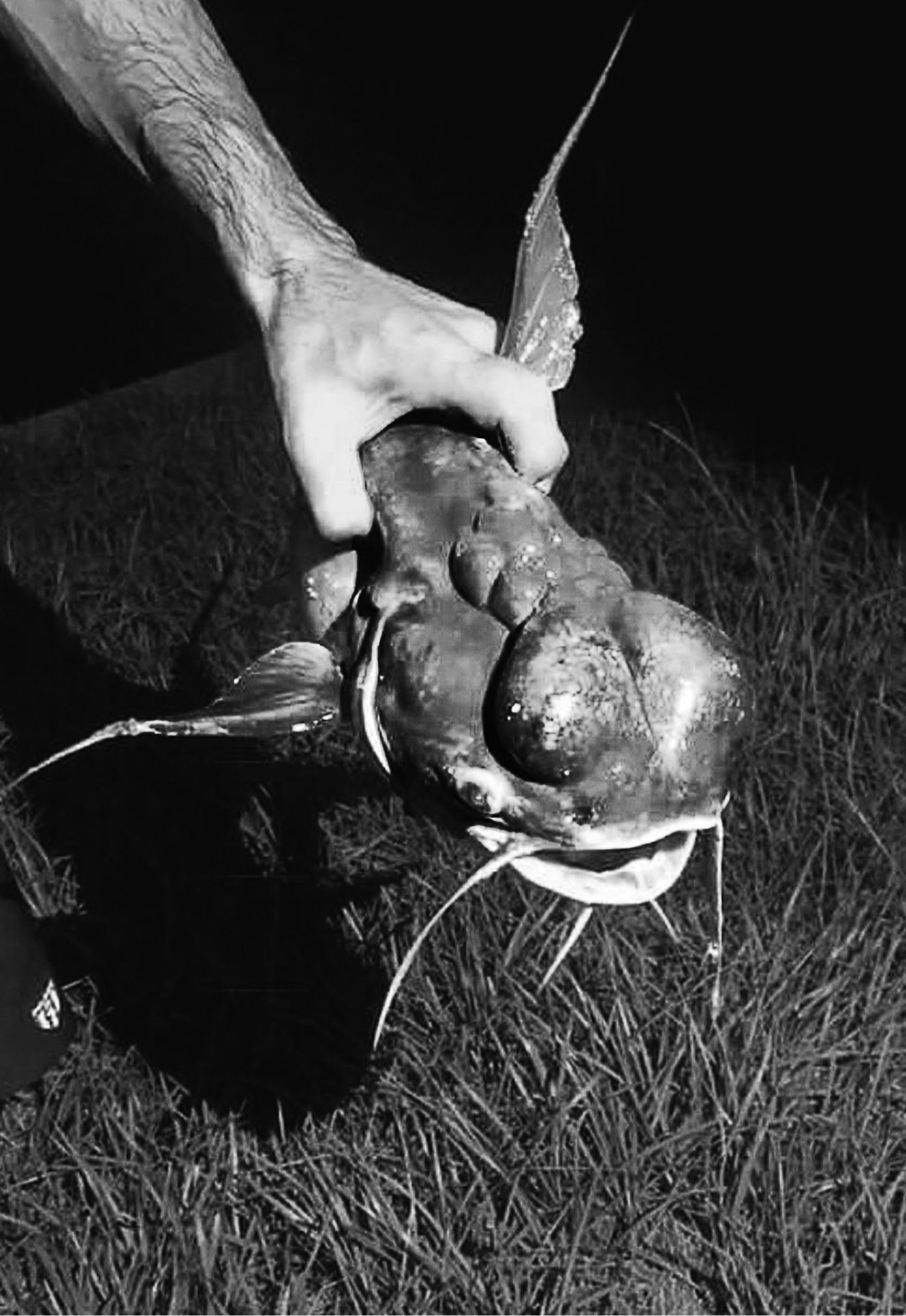
Fish with tumors pulled from the water in southwest Florida in the summer of 2018 during the red tide and blue-green algae crisis, which caused thousands of marine animals to die and hundreds of tons of dead fish to wash ashore
Along with the red tide is cyanobacteria, more commonly known as blue-green algae. The images sent to me of thick bright green goo overtaking canals look toxic and unnatural. When these microscopic bacteria grow out of control, we call it a bloom. These blooms cause a depletion of oxygen in the water and a flood of toxins including hepatotoxins, cytotoxins, and endotoxins, which cause destruction to any life in the water. Blue-green algae thrive in freshwater, inundating lakes, rivers, and streams. The combination of red tide in coastal waters and harmful blue-green algal blooms in freshwater has severe consequences for the local economy, human health, and the environment of Florida. Red tide blooms begin miles offshore, but the situation became severe in 2018 when the blooms came inshore right to the mouth of the Caloosahatchee River and surrounding bays, as these microorganisms use man-made nutrients to grow and spread.
Toxic algae blooms have increased thirtyfold since the 1960s with more than three hundred coastal systems impacted and nearly every state in the U.S. experiencing HABs, according to the National Centers for Coastal Ocean Science (NCCOS). The EPA says that nutrient pollution (too much nitrogen and phosphorus) makes the problem worse, leading to more severe and frequent blooms. Other contributors are warm water, water stagnation, and storm water runoff that contains pesticide residue from lawns and commercial farms.
“When nutrients from agricultural and urban areas are transported downstream, they can cause cyanoHABs in reservoirs, which can impair drinking water quality and result in closures of recreational areas,” according to the U.S. Geological Survey.
How the HABs took over Florida’s waterways is a more complicated tale. A water crisis doesn’t develop overnight, and the state has been mismanaging its water for more than a hundred years. The heart of the issue comes down to draining a swamp. In this case, it’s the Everglades, a large, interconnected marshland ecosystem in South Florida that once spanned some four thousand square miles, and now is less than half that area.
The region was one of the most biodiverse areas in our country, rich with exceptional flora and fauna, but the “swampland” was considered a nuisance to development. Michael Grunwald writes in The Swamp: “Americans believed it was their destiny to drain this ‘God-forsaken’ swamp, to ‘reclaim’ it from mosquitoes and rattlesnakes, to ‘improve’ it into a subtropical paradise of bountiful crops and blooming communities. Wetlands were considered wastelands and ‘draining the swamp’ was a metaphor for festering problems.”
Starting in the nineteenth century, both politicians and business leaders schemed how to turn the wetlands into something productive. They discovered that if they drained the water, they could transform the land into the perfect spot for sugarcane fields. In fact, the region became one of the largest areas of rich, fertile soil in the country; it is now home to hundreds of thousands of acres of sugarcane crops. Other developments followed and population boomed. Today, we are dealing with the effects of rerouting nature’s waterways and losing an ecosystem that acted as a natural water treatment system that helped to filter waste and purify the water.
The Everglades begin far north of Lake Okeechobee, one of the largest natural freshwater lakes in the country, in the Kissimmee River Basin. Water from this great watershed once traveled the Kissimmee River through creeks and tributaries to the lake, from which it then passed into the Florida Bay. Underlying the river of complex grasses is porous limestone that captures massive amounts of freshwater that supply scores of lakes, springs, and marsh systems. The Kissimmee River was an important component of the Florida Everglades until it was cut off by the Army Corps of Engineers in an attempt to manage Florida’s freshwater for agricultural, industrial, and residential development. More than a hundred miles of winding river and tributaries that flowed gradually down the spine of the state to Lake Okeechobee got converted into a massive manually controlled canal, a fifty-six-mile channel direct to Lake Okeechobee, a massive sewer of wastewater discharge that would have otherwise been cleaned of most nutrients in the natural grasses of the meandering river.
Through the late 1920s, a series of hurricanes and resulting floods shifted the focus from draining agricultural fields to flood control, two vastly divergent tactics. In the 1930s, the Army Corps of Engineers was brought in to construct a continuous ridge of levees around Lake Okeechobee, together with four massive canals connecting Lake Okeechobee to the Atlantic Ocean. This is when agriculture took off, and with the ability to rebuild, agribusiness gained permanent control of the region and has refused to let go. Sugar was and still is the predominant crop in the Everglades, and production more than doubled within the first decade after the Army Corps demonstrated they could maintain control of the floodwaters, much to the pleasure of federal representatives who were obliged to their financial benefactors.
In the late 1940s, there were a series of hurricanes and record rainfall where hundreds of thousands of acres in both agricultural and urban areas were drenched in 108 inches of rainfall in just six months. Post–World War II construction began on a series of dikes, dams, and canals with the ability to control the flow of 1 billion gallons of water a day. South Florida experienced a postwar population explosion, which continues to this day. The impacts: the Kissimmee River and its important nutrient-cleaning grasses were devasted by drought, and the Florida Bay is no longer brackish, as was intended by nature with the intrusion of saltwater, which has forever changed its unique biodiversity. Most of South Florida was never meant to be farmed or inhabited; man has irrevocably destroyed this unique tropical wetland and its ecosystem.
Today, the managed runoff from industrial and residential developments and dairy farms north of Lake Okeechobee void the natural wetlands that filter nutrients and other pollutants. The reversal of flows from nutrient-rich farmland in the Everglades to the south have turned Lake Okeechobee into a virtual cesspool of pollution. Nutrients and minerals have accumulated in Lake Okeechobee, causing seasonal toxic blue-green algae blooms, beginning in the 1960s, monitored and managed throughout the 1970s and exploding in 1983, when the toxic algae covered its entire surface.
The situation in Florida has persisted for too long with little action on the part of state or federal agencies. Discharges from Lake Okeechobee have presented serious ecological and environmental problems for decades. This disaster has significant environmental consequences for the Gulf of Mexico, the Atlantic Ocean, hundreds of miles of coastline, the Florida Everglades, and scores of intercoastal waterways and marshlands.
In July 2018, fourteen Florida Waterkeeper groups, a network of clean water advocates, came together in Tallahassee to meet with the Florida Department of Environmental Protection (FDEP) to discuss the HABs and express their concerns. They submitted a joint request to their local and state leaders asking them to follow these action steps: (1) create a comprehensive audit of infrastructure vulnerability and storm risk to accurately price the cost of inaction; (2) prioritize green infrastructure, and (3) enhance protection of wetlands and mangroves.
The Waterkeepers also submitted a statement about the ongoing impacts of hurricanes and storms on the state’s waterways, and specifically that of Hurricane Irma in 2017.
“Hurricanes and major storm events can deteriorate water quality threatening human health and the environment, particularly in Florida. Such storms generate large volumes of flood water, causing sewer and septic systems to fail, and flush large quantities of sewage and pollutants into our oceans, bays, rivers, and lakes. Nutrients, pesticides, fecal bacteria, heavy metals, petroleum products, industrial chemicals, and many other contaminants enter our waterways and make them unsafe for swimming or fishing. Major storm events and the associated pollution can significantly impact local fisheries and tourism-based economies, and the people and livelihoods that depend on them, often taking months or years to recover,” the statement said.
The groups also discussed ongoing threats to Florida’s water, including excess nutrient pollution from a variety of factors including sewage sludge, failing septic tanks, aging infrastructure, storm water runoff, and agricultural runoff, all of which feed the toxic blue-green algae and red tide. They called on the state to start addressing root causes, stopping pollution at its source.
In addition, they submitted research samples taken in July 2018 of cyanobacteria in the Cape Coral tide canals located on the Caloosahatchee River, which revealed levels of the toxin microcystin (a potent liver toxin) to be nearly 40,000 ppb. The EPA has set safe levels at 4 ppb. The Waterkeeper groups requested the reactivation of the Harmful Algal Bloom Task Force, more testing of the actual bloom to understand its health implications, and better communication from state authorities to residents about toxic outbreaks.
Another group working to raise awareness and push state legislators to take action is Captains for Clean Water, a nonprofit group that started as a group of fishing guides who were fed up with Florida’s water mismanagement.
“Given the destruction seen firsthand, we were convinced that if everyone knew what we knew, the problem would have been already fixed,” reads a statement on their website. “We discovered, the solution has been delayed for decades because of a lack of political will and public awareness.”
Tourism makes up about $67 billion of the state’s economy. If visitors are afraid of the water, it has huge consequences for fishing, boating, and other water-related businesses including beachside hotels and restaurants. This group of activists knows firsthand how many Floridians depend on tourism and fishing to make their livings.
Chris Wittman, a co-founder of Captains for Clean Water, who lives and works on the water near Cape Coral, told CNN that he sees the current situation as a breaking point both ecologically and economically.
“This is not the Florida that people move here for. There are people that save all their lives to move to Florida, retire…enjoy our natural resources and this is what they’re served,” he said.
The Captains believe a first step to helping restore the Everglades and Florida’s waterways already exists. Congress passed the Comprehensive Everglades Restoration Plan (CERP) in 2000, as a way to “restore, preserve, and protect the south Florida ecosystem while providing for other water-related needs of the region, including water supply and flood protection.” It’s the largest hydrologic restoration project ever attempted in our country, but the project has wobbled from lack of both funding and political backing.
“As planned, CERP alone will not save the estuaries,” according to the Captains’ site. “Increased storage, treatment, and conveyance of water south of Lake Okeechobee is essential to stop the damaging discharges and to restore the flow of clean freshwater to Everglades National Park and Florida Bay.”
Both Republicans and Democrats running for reelection in Florida have promised to fix the state’s water problems and reallocate more resources to projects like CERP, which has not had any projects completed since it was enacted.
“Their constituents are not happy with the current state of their waters, with the current state of their water management system, and they’re more engaged than they’ve ever been,” Chris said. “They realize that they aren’t going to be able to get around this topic and the citizens are going to hold them accountable.”
A similar devastating blue-green algal bloom occurred in the state in 2016. Mike Conner, from the environmental advocacy group Bullsugar.org, told NPR at the time, “This is a man-made—this is a government-sponsored disaster.”
That year, Florida governor Rick Scott declared a federal emergency and asked for federal funds, but the White House rejected the request, saying Florida had the resources to handle the problem itself. Mark Perry, executive director of the Florida Oceanographic Society, an environmental education and research center in Stuart, Florida, said at the time that he thought federal agencies should help manage the algae crisis, but the long-term solution was to restore the natural flow of water and to send the Lake Okeechobee water south through the sugar farmlands.
The root cause for this mess (and so many others like it) is a politically driven process. Months, years, or decades of oversight, mismanagement, or corruption drive these tragedies. We must work to overcome the disconnect between decision makers in government and residents living with these water woes.
More than 1,000 miles of rivers and streams, almost 350,000 acres of lakes, and 900 square miles of estuaries were not meeting the state’s water quality standards due to excess nutrients, according to a 2008 FDEP report. Environmental groups in Florida sprang into action, filing a consent decree with the U.S. EPA saying the agency had “failed to perform a non-discretionary duty to set numeric nutrient criteria for the State of Florida,” as required by the Clean Water Act. The EPA responded and Florida was on track to become the first state in the nation to set limits for sewage, manure, and fertilizer runoff. But in 2010 three state leaders fought to delay those federal standards for nutrient pollution in state waters, specifically for nitrogen and phosphorus. Once Governor Scott, Agriculture Commissioner Adam Putnam, and Attorney General Pam Bondi were elected, they sent a letter to then EPA administrator Lisa Jackson just ten days into their terms complaining that the pollution limits were an “onerous regulation” by an “overbearing federal government.”
The letter continued, “We each ran on the platform of fiscal responsibility and heard from numerous constituents about concerns of an overbearing federal government that’s placing burdensome regulations on Florida’s families and employers.”
The limits meant runoff would have to be cleaned up at the source, and polluters (including Big Ag) did not want to take on those costs. Instead, they hired a high-powered PR firm to help spread the story that these regulations would cost too much and even created a fake “clean water” coalition chock-full of industry leaders.
“According to the Florida Department of Environmental Protection, the EPA mandates set to be finalized this November 14 will impose capital costs of over $4 billion on municipal wastewater treatment utilities and over $17 billion on municipal storm water utilities,” state leaders wrote in the letter.
Those figures were based on reverse osmosis, one of the most expensive forms of wastewater treatment, rather than on more affordable systems. The FDEP soon weighed in, asking the EPA for permission to set its own rules. In 2013, the EPA agreed, letting the state manage its own pollution limits for nutrients.
That’s not all. Rick Scott also worked to dismantle state programs and reduced budgets intended to help monitor and improve water quality. In 2011, Scott slashed more than $500 million from the budget of the South Florida Water Management District, which was responsible for Everglades cleanup and water quality projects in Lake Okeechobee and the St. Lucie and Caloosahatchee watersheds. That same year, he also fired 270 employees and cut benefits to gouge another $100 million from regional water district budgets. I find it hard to believe these districts could maintain their workload with fewer people and resources.
“Since 2011, when Scott got into office, the critical measures of phosphorus load and nitrogen load into Lake O started to increase, and they are all still on upward trends,” wrote Dave Conway in Florida Sportsman.
He also contended that the Scott administration has ignored key scientific studies of the nutrient load in Lake Okeechobee. The FDEP disregarded data produced by the South Florida Water Management District and instead used a computer model to monitor nutrient levels.

Hands Along the Water, a nonprofit volunteer organization representing the citizens of Florida, organized an amazing show of unity at Florida beaches across the state in August 2018 to bring attention to the toxic algae crisis.
Florida has seen the perfect storm of a state, influenced by industry, setting its own water quality standards, taking away valuable resources from those responsible for both protecting the water supply and preventing pollution, and legislators snubbing the science. More lawmakers and environmental advocates need to come together to restore the freshwater flows of the Everglades, set stricter limits on fertilizers and other chemicals from farms and lawns, and work on better plans for flooding and storm water systems.
Regional water issues go beyond one state. The Great Lakes are a mess. The Sacramento Delta is a toilet bowl. The Ohio, Missouri, and Mississippi Rivers are laden with toxins. We need more people and resources focused on solutions for our country’s waterways. Now is not the time to walk away from regulations that could help save our most precious resource.
THE EPA VS. THE ECONOMY
Donald Trump’s presidency has been marked by his unyielding pursuit of his campaign promises and rallying cries, including one of his most famous slogans, “Drain the swamp!” He promised to “make our government honest again” by getting rid of business as usual in Washington and curbing the influence of lobbyists. Unfortunately, Americans were duped. Draining the swamp for him has been about deregulation and putting into office allies who agree with him.
Another of his talking points was putting coal miners back to work. Trump sees the EPA as an obstacle to stimulating the economy for middle-class Americans.
Two months after he was sworn into office, he visited the headquarters of the EPA in Washington, D.C., for a ceremony and said, “I want to acknowledge the truly amazing people behind me on this stage. Our incredible coal miners.”
He then signed an executive order instructing federal regulators to rewrite the Clean Power Plan, rolling back crucial climate and clean air regulations. The Clean Power Plan didn’t look to phase out coal, gas, and oil; it didn’t ban the use of fossil fuels or require any power stations to close. It simply looked to reduce greenhouse gas emissions by about 30 percent and gave power companies decades to comply. The plan was designed to promote the development of renewable energy sources in our country.
“My administration is putting an end to the war on coal,” Trump said at the signing ceremony. “With today’s executive action, I am taking historic steps to lift the restrictions on American energy, to reverse government intrusion, and to cancel job-killing regulations.”
In the audience that day was Barry Russell, the president and CEO of the Independent Petroleum Association of America. He said in a statement that he welcomed President Trump’s “bold decision to tackle the growing regulatory state and identify rules that harm the economy and threaten American jobs.”
People outside of the industry had a different perspective on the day.
“President Trump’s executive order to roll back vital climate and clean air protections is the most brazen and transparent assault on the health of Americans in my lifetime,” Heather Zichal, former deputy assistant to the president for energy and climate change, told The Washington Post.
To be clear, power and water are inextricably linked. Power plants across the country create water stress and are the largest contributors to toxic pollution in U.S. waters. The EPA has studied power plants and in 2013 discovered that they dump more pollutants—mercury, arsenic, and lead—into our drinking water sources than the next nine industries combined.
“Thirsty energy sources like coal can take twenty thousand gallons per megawatt hour to fifty thousand gallons per megawatt hour, while wind power requires almost no water at all,” according to the World Resources Institute.
Why do we have to choose between environmental protections and economic development? If we continue to enact policies that are indifferent toward our water resources and climate change, what will be the real cost to our collective livelihood? We need to stop spreading the lie that deregulating the government allows for a thriving economy.
I see regulations not as federal overreach but as effective means for protecting human health. Research compiled by the Cowles Foundation for Research in Economics at Yale University points to environmental regulations enacted in 1990 that helped reduce toxic emissions for the next twenty years. The study’s authors, professors Joseph Shapiro of Yale University and Reed Walker of the University of California, Berkeley, found that regulation of U.S. manufacturing plants contributed to a 60 percent decline in toxic emissions from 1990 to 2008, a time when manufacturing output increased by 33 percent. The researchers used data from both the U.S. Census Bureau and the EPA to track how manufacturers were complying with new requirements of the Clean Air Act.
Studies have also looked at whether regulations hurt the economy and cause people to lose their jobs. One study conducted by economists Eli Berman and Linda T. M. Bui from Boston University looked at the impact of air quality regulations in Los Angeles. The area enacted some of the strictest standards in the ’80s. The regulations did not create a decline in employment, and the research suggests that labor demand can increase, as companies have to hire more people to help comply with regulations.
“We find no evidence that local air quality regulation substantially reduced employment,” the authors wrote in the study.
Another economist, W. Reed Walker, published research on the impact of workers by the 1990 Clean Air Act amendments that required companies to get operating permits. He found that the average worker from a regulated sector who left their firm (whether they were fired or quit) saw an earnings loss of about 20 percent from their preregulatory earnings. He calculated the total of these workers’ losses at about $5.4 billion. The EPA estimated the health benefit of these same regulations to have a value of up to $1.6 trillion.
“In light of these benefits, the earnings losses borne by workers in newly regulated industries are relatively small,” he wrote in his 2013 paper, which was published in the Quarterly Journal of Economics. “Benefits from environmental policy far exceed the costs.”
While regulations may contribute to cuts in certain sectors, they can also create jobs in new ones. Job gains and losses are all part of a healthy economy. New companies are always emerging to keep up with technology and innovation, while older companies can fall out of favor when they don’t evolve with the times.
We must remember that the environment is the economy. In 2018, our country experienced fourteen weather- and climate-related disasters, each causing more than $1 billion in damages, for a total of $91 billion. These numbers and costs are the fourth highest since record keeping began in 1980. I’ll discuss the impacts of climate change more in depth in the next chapter. In Sarasota County the red tide and blue-green algae drove down hotel occupancy rates by more than 11 percent at the end of 2018. This was one of the steepest declines seen since the September 11 terrorist attack in 2001, during what is usually a busy travel time to the region. It’s a sure sign of how environmental disasters can impact business. About 80 percent of hotel owners in Sarasota County also reported that their business looked down for January, February, and March of 2019.
We have all forgotten that the EPA was created by conservatives and many of the laws on the books today were adopted with bipartisan support from our lawmakers. Abraham Lincoln said, “A house divided against itself cannot stand.” Let’s give the EPA back the tools it needs to do its job and ensure public and environmental health and vitality for years to come. It’s time to come together and depoliticize funding and enforcement. Let’s put bigger consequences in place for those who don’t follow environmental rules. Let’s strengthen our resources by helping more credible scientists who care about our country’s future work at the federal and state level. Things won’t get better if we sideline the science.
ACTION STEPS
Separation of Politics & Water
We need to stop politicizing regulations. Clean water and clean air should not depend on who is sitting in the White House. It’s not a “blue” or “red” issue; it’s an everyone issue. It’s an Earth issue. The best way citizens can impact this process is to stop voting for lawmakers who refuse to talk about water and the environment. It’s time to pay better attention to who is funding your candidate’s campaign. We need to turn connections to big industry into a political liability. We’re already seeing this in Florida. Big Sugar has traditionally funded many campaigns but in 2018 the only person who ran for governor with sugar money was Agriculture Commissioner Adam Putnam. Sugar companies and their cronies gave Putnam’s campaign and his PAC $804,000 in direct contributions. He received another $7.6 million from other political action committees funded in part by the industry. It’s no surprise that he was the only candidate denying the sugar industry had any part in the nutrient-rich algal blooms happening in the state’s waterways. A new crop of candidates running throughout this country are getting their money from crowd-sourced donations. These candidates are truly funded by the people and are the most likely to listen to our environmental concerns. If you want to find out more about who is funding the candidates running in your state, you can use this easy search tool at www.opensecrets.org/states. Open Secrets is run by a nonpartisan, independent, and nonprofit organization, the Center for Responsive Politics, the nation’s top research group tracking money in U.S. politics and its effect on elections and public policy.
WIFIA: Investing in New Infrastructure Projects
In 2018, the EPA announced a new program that could provide as much as $5.5 billion in loans through the Water Infrastructure Finance and Innovation Act (WIFIA) program, which is intended to generate a source of low-interest financing for large-scale drinking water and wastewater infrastructure projects nationwide. Under WIFIA, states and individual communities that are seeking to finance major water infrastructure projects can apply for loans offered at below-market interest rates that require repayment to begin five years after a project is complete.
As of August 2018, the program received a record number of requests with sixty-two letters of interest, requesting more than $9.1 billion in loans, or more than double what the program has allocated. To date, the EPA has issued over $1 billion in WIFIA credit assistance through loans to King County (Washington), the city of Omaha (Nebraska), the San Francisco Public Utilities Commission (California), and the Orange County Water District (California). Let’s continue to flood this office with requests and put on the pressure to increase its lending capabilities so we can improve our water infrastructure. For more information about the WIFIA program, visit their website: www.epa.gov/wifia.
Becoming Better Advocates
The power of the lobbying industry to influence our political system is enormous. Companies, labor unions, and others spend billions each year to lobby Congress and federal agencies. In 1998, lobbying spending totaled $1.45 billion; today, it’s more than $3 billion. Imagine if citizens and groups that represented our public health had those kinds of budgets and sway. Only big industry has the kind of money and power to put a professional in every single meeting and in every congressional office, to weigh in at every comment period, and to be part of every discussion session, so that their voices are heard. It’s hard for any politician to resist that kind of power.
But the times are a-changin’. We can become our own lobbyists. The power of the people lies in coming together so that our voices and concerns are at the table, especially when decisions about our future are being made. In the past, people only became involved in real disasters like in Hinkley or Flint. It was during those times that people would pick up their heads and say, “Maybe we need to stop supporting these guys who were telling me everything is okay.” In communities throughout the country, people are now working for change and they need your support. It can come in the form of writing letters, calling your senators and representatives, showing up to town hall meetings, or donating to environmental protection foundations. You can check out this great tool at www.townhallproject.com, a website that empowers constituents across the country to have face-to-face conversations with their elected representatives. Another tech venture, www.countable.us, is working to make political engagement easier, and, dare I say, fun. This free app posts clear and succinct summaries of laws Congress is considering and with the click of a button you can contact your lawmakers. You can also see how your elected officials voted on bills so you can hold them accountable in the next election cycle. In 2019, we had 126 women working in the House of Representatives, so let’s guide both the freshmen and the more seasoned officials to the issues we care about.
We need more voices chiming in during public comment periods. Part of getting involved is having a better understanding of how the process works. Twice a year, federal agencies like the EPA publish their regulatory agenda, which offers information on the regulations that they plan to issue. When congressional bills become laws, federal agencies are tasked with putting those laws into action through regulations. This process looks like this:
- An agency initiates a rule-making activity and adds an entry to its regulatory agenda.
- A proposed rule or other document is published to www.Regulations.gov.
- The public is given the opportunity to comment on this rule for a specified timeframe.
You can use this tool to get your opinion into the public record and help lawmakers get more input from their constituents. You can visit this website anytime and search for specific rules or see what’s trending.
In 2017, the EPA put out a call for public comments about what regulations needed repeal, replacement, or modification. The call came from an executive order issued by President Trump, asking agencies to reevaluate their regulations. More than fifty-five thousand comments came into the EPA full of pleas from Americans to protect our most basic rights to clean water and air and urging the agency to keep enforcing the regulations we have. It was a good start. Now imagine if we had 1 million, 10 million, or 100 million comments. That’s democracy.