
2. It Began in Hinkley…and It’s Everywhere Now - Superman's Not Coming: Our National Water Emergency and What We the People Can Do About It
By Erin Brockovich
2. IT BEGAN IN HINKLEY…AND IT’S EVERYWHERE NOW
Everything for me started in Hinkley, California, a tiny Southern California community located in the Mojave Desert. I was thirty-one years old, a single mom with three little kids. I’m now fifty-eight and have four grandchildren!
In 1991, I was working as a legal clerk and discovered that a carcinogen called hexavalent chromium (also known as chromium-6) had contaminated the water in the town—leading to a years-long environmental investigation and lawsuit. I started my work with the idea that one person can make a difference, and as I went along, I decided that person could be me.
By 2016, a report from the Environmental Working Group (EWG) found that about two-thirds of the American population—218 million people—are drinking water contaminated with potentially unsafe levels of that same chemical, chromium-6. To say that I’m furious is an understatement. Hinkley was one small town with a giant electric company that thought they could pollute the water and get away with it. Today, Hinkley is everywhere, and I’ll tell you exactly how it’s happened.
But first let’s get back to these roots. Hinkley is really a kind of barren town, but there’s a beauty to it and that’s why people live there. Not everyone wants to live in the big city around congested streets and honking horns. People move to places like Hinkley for wide open spaces and to see the stars at night. It had sprawling alfalfa fields and farms filled with dairy cows. It’s the kind of place that’s supposed to be safe to live and raise kids in.
A big part of my fascination with what happened in Hinkley came from my parents and from growing up in Kansas. In the Midwest, we know that the greatest gift we have isn’t how much money we have in the bank—it’s our water, it’s our land, it’s the air we breathe, it’s our health, and it’s our family.
I was doing my best to uncover what the heck was happening out there. Originally, the law firm I worked for had taken on a real estate case from a woman who didn’t want to sell her house to Pacific Gas and Electric (PG&E), the largest public utility company in the world at that time. When I went to visit the town and hear her story, it was obvious something more was brewing.
The first thing I noticed was that the water was lime green. I thought, “Okay, we’re definitely not in Kansas anymore.” I had never seen green water like that. Then I noticed frogs with two heads, and others just lying lifeless at the surface of the water. The trees were dying. Wildlife was missing. People would tell me bizarre stories about their animals too, and how they would run in circles and knock their heads against trees. The cattle had hundreds of visible tumors all over their bodies—something I had certainly never seen before. The stories from people who lived out there centered around sickness. People had everything from constant nosebleeds to multiple miscarriages to cancer. The town was rural. It was supposed to be a serene, peaceful environment, but something was affecting the people, the wildlife, and the plants. It didn’t make sense.
I kept pondering everything I had seen in the town. What’s the one thing that trees, animals, and people all rely on? What’s something that brings them all together? It’s the water. Water is the source of life and it takes life too, and that’s what set me on my journey.
On the three-hour drive from Hinkley back to my home in Los Angeles, I was constantly wondering what the hell I was doing. I made very little money. I never saw my kids, who were all under the age of ten. Everyone thought I was crazy and that I had no business researching a toxic case, or at least that’s what they told me.
Yet this little nagging thought from my dad kept me going. He taught me that deception is the root of all problems. In Hinkley, and everywhere since, the problems I work on start with a lie—something we are all taught about as kids growing up. In high school, I lied to my dad once about being at school when I really had skipped that day to go to my friend’s lake house. The one thing you couldn’t do was lie to my dad. He grounded me for an entire school semester, which meant no phone privileges, no dating, and no social activities after school, and I missed a trip to Chicago I had scheduled with friends. The day after “my sentence,” he flew out of town on a business trip, and before he left, he wrote me a letter that I have kept all these years. I want to share the most important paragraph from it with you.
I know last night tore you up—it did me too! But we are dealing here with a very basic principle and you are old enough to understand it. That is, if you, your brothers and sister, your Mother and I cannot freely and honestly communicate with each other and believe what we are saying and hearing then we have lost everything! To do otherwise tears up the very fabric of our family, which until you start your own, is the finest possession you will have on this Earth.
My dad was right, and in today’s world we have lost the most basic principle of open, honest communication and trust. It doesn’t matter how much money you have in the bank or if you are a liberal or conservative, no one should be poisoned or lied to about it. Ever.
I kept following my instincts in Hinkley. I kept talking to the people who lived there. It seemed obvious to me that when people drink a poison, it’s going to make them sick. But I wasn’t a doctor or a scientist, a lawyer or a government employee. I didn’t study mass torts. What business did I have out there? One time I was talking to a PG&E expert, telling him about some of my findings, and he said, “Oh, we see that out here all the time.”
I don’t think so! Green water and two-headed frogs are not normal.
Lesson: Use your senses. If you’ve noticed something strange in your community, don’t let other people’s opinions get in the way of one of the most basic scientific skills—trusting your observation.
In fact, people ask me all the time how I got started in Hinkley and wonder what tools I used during that case. I tell them about three very simple concepts: logic, leverage, and loyalty. Let me explain.
LEARN THE THREE L’S: LOGIC, LEVERAGE & LOYALTY
Logic. It’s all about common sense. If you see a tornado coming your way, you are not going to take the time to go look at the Weather Channel and find out the category of the storm. Your instinct tells you to run and get to safety as quickly as possible. You can use those same kinds of observation skills when it comes to your water. Something smells funny? That’s a good observation. A lot of common sense came into play in my work in Hinkley, because I didn’t have a precedent for what was happening at the time. You can use this tool in your own community too. Did you get a water violation notice in the mail? Don’t just throw it in the junk pile. That’s a big clue that something is wrong with your water and that more investigation is needed. Use your logic and pay attention to what’s happening around you.
Leverage. That’s all about gathering and building community. It involves talking to your neighbors and friends, which I know sounds like a strange concept in our digital world. Start fact-finding and asking questions together. Use the power of different perspectives to your advantage. Don’t be afraid to speak up and check in with one another. It’s not always easy because people may have different opinions, but this step can be a real game changer. Think about the impact of one person going to a city council meeting versus one hundred people showing up. We have strength in numbers, and if each person commits to talking to a neighbor or posting on their social media page, you can easily grow your impact. In Hinkley, we held community meetings and I personally went door-to-door talking with many people about what was happening. It was the first step in organizing and educating them about the issues at stake.
Loyalty. This step is about not giving up and about staying committed to your cause. When you stick with a cause, you will get somewhere. You may have setbacks, but you keep going. People may try to throw you off your game, and you need to remember that drinking brown water (or whatever it is for you) is not normal. Follow that hunch. Loyalty to my cause is what helped me get through long nights of research, talking to hundreds of experts, and keeping at it for years until the case was settled.
Whatever your cause, you need nothing more than your eyes, ears, nose, and a little common sense to see an environmental catastrophe in the making. You see, officials, government regulators, and corporate minions all have one thing in common: they are just ordinary people doing their jobs, and many of them are out to lunch.
I’m not foolish enough to think that we don’t enjoy a certain standard of life thanks to business and industry. We need jobs and commerce. People need cars to get around town and electricity to read books at night. I’m not suggesting we turn away from modern life. We do need to learn to work together. Business can’t make people sick or destroy the water we all need to live. It’s not sustainable. We need purpose-driven corporations that are willing to clean up their messes and to work with communities to support us all.
We have a real opportunity right now to create change. Think about some of the biggest companies in the world, such as Google or Uber. These companies were created by looking at how to solve problems. Google’s original mission statement was “to organize the world’s information and make it universally accessible and useful.” Uber wanted to solve the question of how to get a ride at the push of a button. We need more people working on solutions to our water issues, and that means both entrepreneurs who want to create companies and employees working inside companies to help solve these big problems.
Hinkley was just a microcosm of what’s happening throughout the world today. I’m here to sound the alarm for you. The EPA isn’t going to save us, and neither are our politicians. We need to rally ourselves.
You might be thinking: I’m not an activist. I don’t understand the science of these chemicals or hold a degree in toxicology. Heck, I’m just trying to keep my family afloat and do the best I can.
I hear you. At the risk of sounding overly confident in your abilities, I don’t think you need to be anything other than a compassionate, caring individual with integrity, respect, and appreciation for this world. It’s really all you need to get involved. It could mean looking around to notice any patterns, or smelling the air, or sometimes it requires getting very quiet. I find many things in the field simply by being silent. If you are quiet enough, you can hear nature speaking to you. Many times, I just listen.
ACTION STEP: Identify the Problem
Science is not just people in white lab coats or Einstein’s equations scribbled in a notebook. It’s an observation leading to a hypothesis—a possible theory. It’s truly a process of discovery that requires asking questions about the natural world and looking for answers.
The first step in the scientific method is simply asking a question based on something you observe. You know the basic questions: Who, What, When, Where, Why, or How? Start with these basic questions and from there you can start researching.
Many times, as I go along in my investigation, I also use the concept of Occam’s razor, which is just a fancy way of saying “keep it simple.” Usually, the simplest solution is also the correct one. If the water looks or smells funny, most likely something in the water is making it look or smell that way. Plain and simple. If someone was dumping a substance into the water, and now you notice changes, then most likely the culprit is that substance.
Here are a few good questions to ask:
- What has changed in the surrounding area?
- Has the source of drinking water changed?
- Are changes happening in the way we treat our water?
- Is it possible someone has been discharging substances into our water?
- Are there any new businesses in town or old ones moving out?
These small changes have a big impact on our water systems.
I’ll never forget the day I was standing in the hot sun collecting samples of water and doing field research when a PG&E lackey came up to me and said, “You’re not a doctor. Do you even have a college degree? You have no right to comment on green water.”
I realized at that moment how much intimidation is used in these kinds of cases. The more I kept pursuing leads and talking to people, the more clues I found. The closer I got to the truth, the more PG&E tried to bully me. Companies may try to bully you too. The “big guys” don’t want you to discover the truth, so they will try to make you feel small, bad, or wrong. I looked right back at him and told him, “I didn’t know I needed all that to be a human.”
For me, dealing with dyslexia throughout my life has made me indignant when people tell me I can’t do something, and I hate when people tell me that what I see isn’t real. Many people in the communities I have worked with experience these same frustrations too. It makes sense to be upset when you are told the water is fine, especially when you know it’s not. No one wants to be labeled as irrational or unwise. It upsets our natural instincts, which is the first way we can begin to help ourselves.
I’m here to tell you nothing is wrong with you. Don’t let anyone convince you that brown water is good to drink. Your most basic right is to protect your health and well-being. In some indigenous languages the word for water means “lifeblood,” because it is literally that essential to all life on earth. Many of the issues we face today have huge implications for both our bodies and our environment. You’re not too small to stand up to these challenges. You are much mightier than you can imagine.
This guy from PG&E was using a kind of argument called an “appeal to authority,” which is a logical fallacy. In plain English, it means if an argument comes from someone who lacks certain credentials, then it can’t be true. Authority figures use this tactic to keep the upper hand all the time. But having a leg up does not mean that you are speaking the truth. In fact, using this kind of argument usually does the exact opposite—it helps hide the truth.
When it comes to my work in Hinkley, the research stands and continues to grow stronger. A Goliath energy company knowingly polluted the town’s water and many, many people became sick and died because of careless actions. At one time, Hinkley was a thriving farm community; today it’s a ghost town. The pollution drove the life right out of there. Even after all these years of legal actions and follow-up, the pollution is still there. If it can happen to Hinkley, it can happen anywhere. I may not have had all the fancy letters after my name, but I sure as heck knew that what was happening was wrong and it needed to be addressed. It’s like the slogan from our own Department of Homeland Security: “If you see something, say something.”
In Hinkley, chromium-6 seeped into the groundwater from a PG&E gas compressor station. It was originally used at the facility to stop rust from forming in cooling towers and pipes, and then later discharged into unlined holding ponds during the 1950s and ’60s, eventually leaching into the soil and contaminating the aquifer that supplied the town’s drinking water. Groundwater in Hinkley tested as high as 580 ppb in the ’90s when, really, almost no level is acceptable. So, you can see why the people there might have been feeling those effects. It’s so sad to think that one chemical, one company, and so much negligence could cause this much damage. It’s estimated that it will take at least 150 years to clean up the mess.
The class-action lawsuit against PG&E was filed in 1993, alleging that the company knew that harmful chemicals—especially hexavalent chromium used in production—were seeping into the groundwater and contaminating the water supply. Ultimately, that case resulted in the largest medical settlement lawsuit in history and put my life on a whole new trajectory. I helped more than 650 plaintiffs. Right after Hinkley, we discovered other towns nearby in California with similar issues related to hexavalent chromium, causing health problems and wreaking havoc on more lives. In 2006, PG&E paid another $335 million to settle a series of lawsuits for chromium-6-contaminated water, affecting about 1,100 people in Kings, Riverside, and San Bernardino Counties.
As I continued my work, I discovered that hexavalent chromium was used everywhere. It was an industry standard, used nationwide by giant corporations such as Lockheed Martin and Boeing and found seeping into water supplies near coal ash dump sites across the country. In fact, chromium-6 was the single most common corrosive inhibitor used in cooling towers in the United States until the 1990s. Millions of gallons of this toxic chemical were used everywhere from schools to hospitals to courthouses to food-processing plants to refrigerated warehouses. The cooling towers became filled with massive doses of chromium-6 and then as the water in the towers began to cloud up with minerals, the water would get discharged into the wastewater system, which was little more than unlined lagoons. The lagoons were designed to percolate the wastewater into the earth for “treatment,” but sadly that contaminant went right into our drinking water. I can always tell when a community is dealing with this chemical because the water turns yellow-green.
For years, I couldn’t understand why PG&E was so ruffled by one woman and one community bringing this issue to light. But when you know the dangers of this chemical and you know it’s everywhere, at some point you will have more serious repercussions to deal with. At stake in Hinkley, and in many similar cases, was whether the science could prove that a chemical caused cancer and/or other health problems. Industry officials want us all to believe that these concerns are inflated and that no regulations are needed, because otherwise they must pay. They put profits above public health. The irony is that companies like PG&E have the resources, the technology, and the manpower to clean up their own mess, and yet they choose to lie, cheat, sue, intimidate, falsify documents, and outright bully anyone trying to protect the rights of drinking-water consumers.
FAKING THE SCIENCE
PG&E went to great lengths to cover up their misdeeds and influence the regulatory process. The company was not pleased when the Erin Brockovich movie came out exposing the dangers of chromium-6. A spokesperson from the company tried to downplay the movie’s implications, saying, “Our general response with respect to the movie is just that we recognize it’s a dramatization. It’s an entertainment vehicle.” PG&E also sent an internal memo to its employees that said, “ ‘based on a true story’ doesn’t mean that everything in the story is true.” PG&E also wanted to make sure that all the media attention was not going to influence chromium regulations. In fact, the company created its own action plan stating they did not want the public swayed by a popular yet fictionalized movie.
Sound science is the basis for all legislation and policy decisions to protect public health, but large companies can influence the scientific process and conceal their own studies to avoid or postpone regulations. We’ve seen this dynamic play out with both the tobacco and the pharmaceutical industries for decades, and it’s happening with chemicals that are polluting our water. For years, the Chrome Coalition, an industry group made up of both chrome producers and consumers, has worked quietly to minimize the health effects of exposure to chromium-6 by infiltrating the scientific literature.
“Between 1996 and 2008, Industrial Health Foundation, the legal arm of the Chrome Coalition…hired third parties to produce at least 18 epidemiological studies or reviews of the safety of chromium, all of which minimized the risk of disease related to chromium exposure,” according to an article from the Union of Concerned Scientists (UCS).
Environmental pollution is not easy to detect or prove. It’s part of why regulating industry can be so difficult. It takes years to build a scientific case to prove the harmful effects certain chemicals have on our health. Asbestos was used to insulate houses for decades before we finally banned it. One of the biggest hurdles in the Hinkley litigation was establishing whether or not ingestion and skin exposure to chromium-6 could cause harm to residents. PG&E hired ChemRisk, a scientific consulting firm used by many companies dealing with regulatory issues. Dennis Paustenbach, a San Francisco scientist with a track record of product defense for companies like ExxonMobil and Dow Chemical, was CEO of the company at that time. Dennis, along with board-certified toxicologists Brent Finley and Brent Kerger, had the task of proving that chromium-6 didn’t harm humans when ingested or from skin exposure. They decided to conduct original research that would add human studies to the record.
The scientists sat in a hot tub filled with chromium-6 contaminated water for hours smoking cigars and then took urine and blood samples for their study. Sounds like hard work, right? They found increases in total chromium concentrations in both their blood and urine samples, indicating that the chemical may have penetrated their skin, but the levels were not sustained for the five-day testing period, so they concluded that the exposure “was not expected to result in systemic uptake of measurable amounts of chromium-6.” They also drank jugs of water contaminated with the chemical and ran more tests, coming to the same conclusion, that oral exposure was not dangerous. These studies were published in the Journal of Toxicology and Environmental Health without disclosing that these scientists were paid by PG&E. This work was not peer-reviewed or independently vetted by other scientists; it slipped through the back door into a major scientific publication. ChemRisk earned $1.5 million for consulting on the Hinkley case. While funding is typically disclosed in scientific journals today, more than 60 percent of research and development in science is still conducted by industry, 20 percent comes from universities and 10 percent from government, according to the Organisation for Economic Co-operation and Development (OECD).
I spoke recently to my friend Gary Praglin, one of the attorneys in the case, and he said all the lawyers at the time were mocking the research, calling it “three men in a tub.” They couldn’t believe these scientists were paid top dollar to sit in a hot tub.
“They put it on with a straight face and they acted like people were crazy to think that chromium-6 was anything other than an inhalation carcinogen because there were no published studies that said that it was—except for one,” Gary said. I’ll get to that study in a moment, because it played a key role in the case.
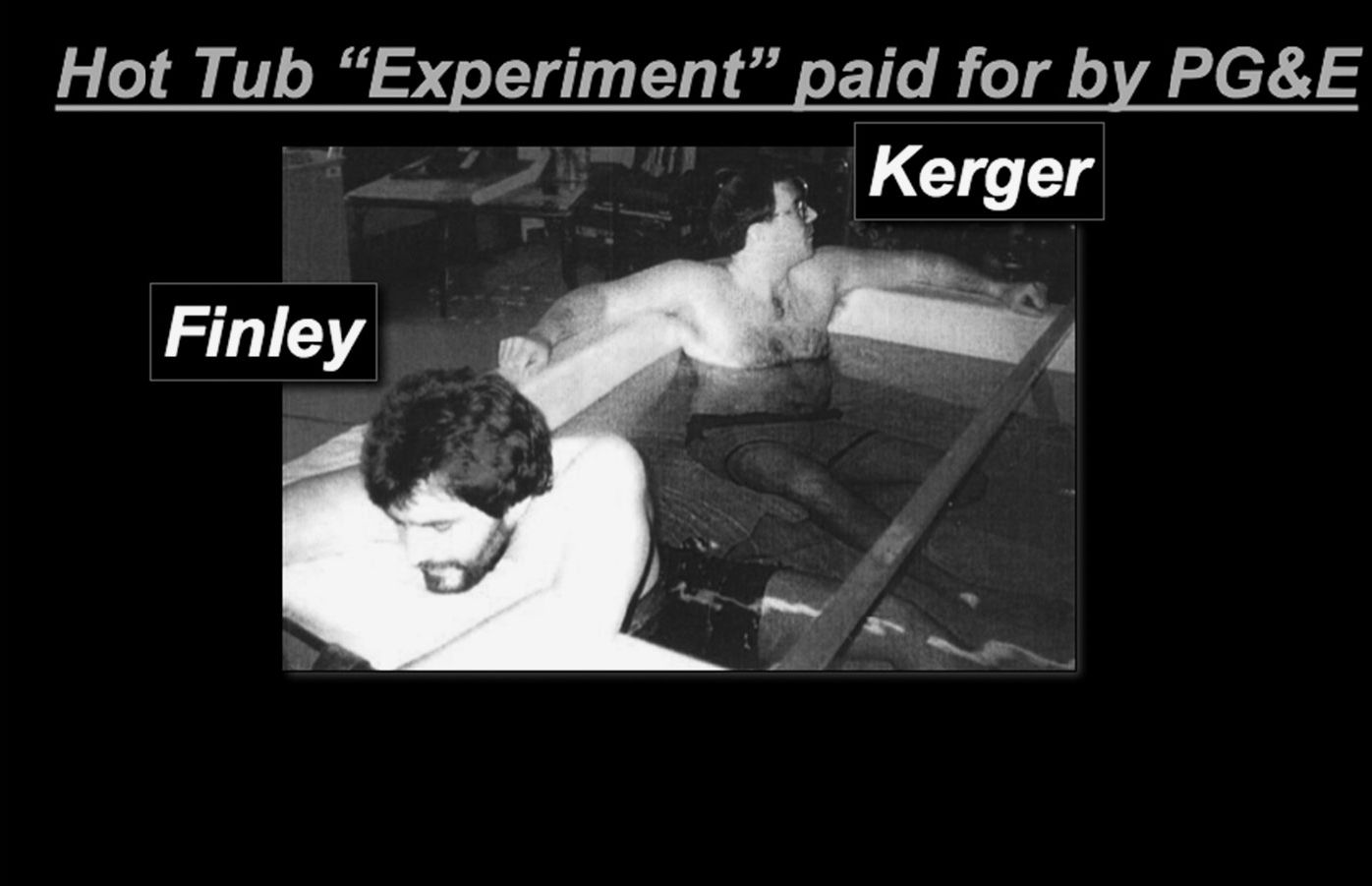
Scientists in a hot tub filled with chromium-6-contaminated water for three hours in an attempt to prove the chemical did not harm humans. The results were published per litigation and were bought and paid for by PG&E.
ChemRisk scientist Brent Finley also appeared on an ABC News segment in 1996 with Cynthia McFadden, drinking the green chromium-tainted water.
She responded by saying, “There are those who would say you drinking a gallon of this chromium-laced water doesn’t prove anything except that you—in some people’s minds—may be foolish.”
How many times will we be duped by an expert on TV who drinks the water as “proof” that it’s safe for consumption? You will see this trick used again when I discuss the Flint, Michigan, water crisis, which is another reason why I tell people to trust their own instincts rather than the opinions of the so-called experts.
Even after PG&E lost the Hinkley case, they did not back off their pursuit to downplay the effects of hexavalent chromium. It’s very difficult to remove this chemical from the water and meet stricter standards, so it was worth both their time and resources to find science to ensure they wouldn’t have to get involved with its cleanup. They took it a step further by trying to reverse the only study that showed just how dangerous chromium-6 could be for humans.
Let’s look at the work of Dr. Zhang JianDong, who published a study in 1987 about people dying of cancer in a rural northeastern Chinese area at rates higher than other nearby villages. He spent twenty years studying this region and treating the residents with health issues. Like Hinkley, the area had massive chromium waste contamination in the groundwater—as much as 300,000 tons of chromium-6. He received a Chinese national award for his research, which U.S. scientists translated into English. We cited the study in court as evidence that chromium-6 might cause cancer when ingested. This study was the one study that showed exactly what PG&E did not want anyone to know.
But in 1997 (while PG&E was dealing with another lawsuit in Kettleman City, California), Dr. Zhang, now retired, appeared to retract his life’s work, when a “clarification and further analysis” got published with his name as the author. The article, which appeared in a reputable U.S. medical journal, essentially claimed the cancer link to chromium in the rural villages did not exist. The article became evidence for U.S. regulatory agencies, including the EPA, to say that ingesting chromium-6 did not pose a cancer risk.
The later study didn’t deny the high cancer rates, but it did say factors like lifestyle and other environmental issues were the likely cause, which Dr. Zhang adamantly disputed. Still, he and a Chinese colleague appeared as the sole authors of the “updated” report, even though it did not have a Chinese translation and the two doctors did not speak English.
Of course, Dr. Zhang did not write that article. Court papers later revealed that the second study was “conceived, drafted, edited, and submitted to medical journals by science consultants working for the lawsuit’s defendant, a utility company being sued for alleged chromium pollution.” The consultants were from ChemRisk, the company founded by Dennis Paustenbach. The Wall Street Journal reported the company “helped save industry hundreds of millions of dollars in cleanup costs for chromium pollution in New Jersey.”
Instead of owning up to their mistakes, PG&E went out and hired scientific consultants to track down some of the only evidence about the dangers of this chemical and essentially muddy the research. They made it look like Zhang had revised his finding after taking a closer look at the original data. The Journal of Occupational and Environmental Medicine retracted the paper in 2006. So for nine years the research delayed regulations, compromised public health, and even influenced media.
John Stossel from Fox Business and 20/20, who has interviewed me several times, wrote in his 2004 book Give Me a Break, “It was never established that the power company made anyone sick. The power company looked guilty because it did what companies usually do—escaped the lawyers by settling, paying some $300 million….Hexavalent chromium is a carcinogen if inhaled at high levels, but the EPA says no data suggests that drinking chromium causes cancer.”
Can you see how important the science becomes in these cases? Corporations have deep pockets and go to great lengths to create scientific doubt or bury information to protect their own financial interests.
A 2012 UCS report outlines the main ways corporations manipulate and control the scientific process and scientists in general:
Terminating and suppressing research. Companies have controlled the dissemination of scientific information by ending or withholding results of research that they sponsor that would threaten their bottom line.
Intimidating or coercing scientists. Corporations bury scientific information by harassing scientists and their institutions into silence. Scientists have been threatened with litigation and the loss of their jobs, have had their research defunded, have been refused promotion or tenure, and have been transferred to non-research positions, all of which leads to self-censorship and changes in research direction.
Manipulating study designs and research protocols. Corporations have employed flawed methodologies in testing and research that are biased toward predetermined results, such as changing the questions scientists are asking.
Ghostwriting scientific articles. Corporations corrupt the integrity of scientific journals by planting ghostwritten articles about their products. Rather than submitting articles directly, companies recruit scientists or contract with research organizations to publish articles that obscure the sponsors’ involvement.
Publication bias. Corporations selectively publish positive results while underreporting negative results. While not directly corrupting science itself, these publishing and reporting biases skew the body of evidence.
But that’s not all. PG&E also infiltrated a blue-ribbon panel. Shortly after the movie came out in 2000, former California governor Gray Davis came to my boss Ed Masry and me and said, “We need a blue-ribbon panel for hexavalent chromium.”
Despite PG&E’s efforts to downplay the movie, it did bring attention to chromium pollution and its effects on human health. The California legislature passed a law requiring levels of chromium-6 to be more closely monitored in drinking water, and the California Environmental Protection Agency’s Office of Environmental Health Hazard Assessment (OEHHA) announced that it wanted to establish an MCL for the contaminant. They needed a panel to review the scientific literature. A blue-ribbon panel brings together a group of experts to investigate and analyze a given question. They must be independent and use their expertise to study the issues and report their findings or recommendations to those with decision-making power.
Academics from the University of California organized the panel, then called the Chromate Toxicity Review Committee. The committee was supposed to provide guidance in identifying the optimum drinking-water level, or public health goal (PHG), for chromium-6 in drinking water. By September 2001, they finished their research and forwarded a report to OEHHA.
They reported, “We found no basis in either the epidemiological or animal data published in the literature for concluding that orally ingested Cr (VI) [chromium-6] is a carcinogen.”
How did they come to this conclusion? PG&E hacked the panel! Paid industry scientists were appointed to the panel to downplay the effects of hexavalent chromium and influence the recommendations in another case of corporate-manipulated science. In addition, they had paid litigation experts presenting evidence to the panel and PG&E covered up facts in relation to the panel and the science that it relied upon.
In response to the panel’s report, OEHHA withdrew its recommendation for a PHG for total chromium of 2.5 parts per billion and 0.2 parts per billion for chromium-6. PG&E, which had had a case pending with the people in Kettleman City for seven years, came to court and told the judge everything had changed.
Gary and I both testified at a hearing of the California Senate Health and Human Services Committee in February 2003, and Gary spoke specifically about how this research influenced the case.
“They were waving the blue-ribbon panel report—like a flag,” he said in his testimony. “They said to the judge, The State of California has spoken. It has said that chromium-6 does not cause cancer by ingestion, and they wanted to amend their paperwork, their motions, their declarations, and move to dismiss our case. And they got that permission to do that. They amended all their paperwork, and we were given permission to take discovery—to take depositions, issue subpoenas—and we have obtained thousands of pages of documents in connection with the blue-ribbon panel process.”
In my testimony at that same meeting, I talked about how the blue-ribbon panel was “created for a noble and lofty purpose, but it became corrupt, skewed, and biased for self-interest.” The process was flawed.
“If we allow this panel—the chromium blue-ribbon panel—to control and manipulate science, they will be endangering tens of thousands of innocent people,” I said. “The general public’s health is now at stake.”
Under state law, the first step to establish a limit for any chemical in the drinking water is to know what level would pose a health risk. If the expert panel can’t find the appropriate data, they can’t know the risk and then the state can’t set a standard. You can see for yourself how good laws can go bad.
The panel cited a 1968 German study where mice were fed large doses of chromium-6-contaminated water and developed stomach tumors. After reviewing the study, the chromate committee concluded that a virus that hit the mice might have caused lesions that German researchers mistook for chromium-induced tumors.
Thankfully, Gary helped to break the story and expose that the panel had two paid PG&E consultants on it. One of those consultants was none other than Dennis Paustenbach and the other was Dr. Marc Schenker. Both were paid to advocate PG&E’s position that chromium-6 does not cause cancer when ingested, during litigation against the company. Not only were these consultants paid millions by PG&E for their work, but they lifted two chapters of the panel report straight from their previous work. Sounds like a conflict of interest to me! Eventually, the panel report was thrown out due to all this controversy.
“The caution I’d give anybody involved in public health is that when you look at science, you have to ask who wrote and funded the studies being used. If it’s all being written by industry hired guns, they are out to save a buck for the companies,” Gary said in a 2004 article. When I spoke with him recently, he said this statement is still true today.
Flash forward almost twenty-five years from when I started my work in Hinkley.
In July 2014, California became the first state in the nation to regulate this substance and establish a maximum contaminant level (MCL) for chromium-6 in drinking water. The MCL was 10 ppb for this industrial byproduct. For reference, the rest of the country uses a federal standard of 100 ppb for total chromium, including other types like chromium-3, which is nontoxic. Those federal standards were created at a time when hexavalent chromium was not linked to cancer, but subsequent studies have shown a direct correlation.
One piece of research that helped set the standards in California was from the National Institutes of Health. The National Toxicology Program essentially re-created the animal studies from Germany.
The National Toxicology Program studies (from 2007) found that:
sodium dichromate dihydrate, a compound containing hexavalent chromium, causes cancer in laboratory animals following oral ingestion. Researchers found significant increases in tumors at sites where tumors are rarely seen in laboratory animals. Male and female rats had malignant tumors in the oral cavity. The studies conducted in mice found increases in the number of benign and malignant tumors in the small intestine, which increased with dose in both males and females.
In September 2017, California dropped its MCL. The Superior Court of Sacramento County invalidated the standard, saying that “the state failed to properly consider the economic feasibility of complying with the MCL.” The Safe Drinking Water Act does require the state to determine that the cost of treatment offsets the public health benefits. In this case, the court did not rule on whether the MCL was economically feasible or that it adequately protected public health, it simply found that the department did not adequately document whether the MCL was cost-effective.
The challenge came from the Solano County Taxpayers Association and the California Manufacturers & Technology Association, a trade group whose mission is to improve and enhance a strong business climate for California’s thirty thousand manufacturing, processing, and technology-based companies. The city of Vacaville, California, estimated that the standard would cost about $7.5 million.
“As if the current challenges we’re facing with the water supply in California aren’t bad enough, along comes this unnecessary regulation, which will place steep cost burdens on taxpayers without a benefit to public health,” Ourania Riddle of the taxpayers’ association said in 2016.
While the MCL is no longer in effect, the state water board is in the process of adopting a new one rather than appealing the court’s decision. I truly hope that the research available today will help determine a new MCL that is in the best interest of public health and safety.
Frankly, no level is safe in my opinion, but if these are the cards we are dealt then we need some measured level of safety. We need a national standard too. If California created one at the state level, then it’s possible for the rest of the country to follow suit.
Incidentally, it’s been common knowledge in the scientific community for years that people who inhale hexavalent chromium can contract lung cancer. Is it really so surprising that swallowing it also leads to cancer?
Ultimately, the Hinkley case taught me that pollution happens, that it affects us all, and that corporations try to cover it up. Little did I know that my work in Hinkley was the tip of the iceberg. As I worked to bring these issues to light, I found a rabbit hole bigger than anyone can imagine. When I began, I thought I had discovered a one-off situation, but I’ve come to realize that such issues are in all our backyards. They may already be happening in yours right now. Systematic failures, corruption, and pollution are not stopping, and we need to be informed.
FIRST STEPS
Notice the water coming out of your tap and ask yourself some questions. Get as specific as you can.
- How does it taste?
- How does it look?
- How does it smell?
- Does the water affect your body? Does it make your skin feel dry, itchy, or “off” in any way?
- Have you noticed any changes in your water quality in the last year?
News You Can Use
It’s time to start fact-finding, observing, and understanding the issues at hand. Stay informed about your local water issues. Look for articles in your local newspaper or on TV about water contamination or problems in your town. Sign up for newsletters of local water or environmental groups. Start paying attention to any stories about your water source and treatment facility, including boil advisories or chemicals that have been detected above legal limits. Pay careful attention to any companies in your area cited for illegal dumping of their waste, especially into waterways. Look for stories about Superfund sites and their cleanup.
Learn how to separate facts from fiction. Always try to find the original source of a story. “Fake news” was the 2017 word of the year, and it means false, often sensational information disseminated under the guise of news reporting. Real news stories will typically have three or more sources to comment on the story; they portray both sides, and they provide the who, what, when, why, and how. Ideally, news stories are objective, present facts, and report information from witnesses or experts. If an expert or scientist is quoted, do your own research and find out what other work they have published. Are they an industry supporter or are they an independent source? A blog post or an opinion piece is usually one person’s view of a topic, which is very different from a news-based article. Watch out for persuasive language or opinions that try to influence your thinking. Get the facts and then make up your mind about how you want to proceed.
Build Your Confidence
No one feels confident in the beginning of a water struggle, but I want to encourage you to push past those initial fears. Don’t believe the thoughts that say “I’m too young,” “I’m too old,” “I don’t have enough experience,” or “I don’t have influence or power.” Now is not the time to let those fears take over. I’ve seen people of all ages and backgrounds fight for what they feel is right and win. Take the attention away from yourself and put it on your message. You deserve access to clean water. Think of each and every person in your community that you can help. Remember you just need enough confidence to take that first step in the right direction.