
Introduction - Superman's Not Coming: Our National Water Emergency and What We the People Can Do About It
By Erin Brockovich
INTRODUCTION
Someone once asked me, what would your epitaph be?
My answer: Someone who gave a damn.
Let me be the first to tell you that life takes an interesting turn when your name becomes a verb. Well, first my name became a movie and then it became a verb. To “Erin Brockovich something” has become synonymous with investigating and then advocating for a cause without giving up.
My name is also used to describe other people. There’s an Erin Brockovich of China. She’s found more than four hundred villages in her home country where the children have been sickened by their water supply. There’s an Erin Brockovich of Kenya, who is fighting lead poisoning, demanding compensation and cleanup from the government and companies whose factories have dumped toxins. There’s an Erin Brockovich of food, whose youngest child had a severe allergic reaction to scrambled eggs and now advocates for reducing chemicals in our food system.
But before the movie and before I became a name people recognize, you should know that I was raised in Kansas—the land of sprawling wheat fields and bright yellow sunflowers. Lawrence, to be exact, which is the sixth largest city in the state, nestled between the banks of the Kansas and Wakarusa Rivers. It’s a vibrant college town today with a population of fewer than 100,000 people. Like many parts of my home state, we had hot, humid summers and cold, dry winters. The American poet Langston Hughes spent his boyhood in Lawrence, and he based his first novel Not Without Laughter, published in 1930, on his experiences growing up in small-town Kansas, tornados and all.
I was born in the summer of 1960 when Chubby Checker’s dance hit “The Twist” was playing on every radio and life in America seemed rosy and bright. Little did anyone suspect that the 1960s would be marked by such upheaval and that by the end of the decade, it would feel more like our great country was falling apart. Rachel Carson’s book Silent Spring was published in August of 1962, calling out the chemical industry and launching an environmental movement. The Cuyahoga River in Cleveland, Ohio, burst into flames in 1969. Images really can tell a thousand words and the dramatic photos made headlines throughout the country. How did a body of water ignite into flames? A Time magazine article described the river as so saturated with industrial waste and sewage that it “oozed rather than flowed.” That sight sparked major reforms and a newfound need for environmental action, which included the passage of the Clean Water Act and the creation of state and federal environmental protection agencies.
When I was a little girl, my father would sing songs to me all the time about water. Sometimes, we would be playing down at the creeks and he would make up little tunes. “See that lovely water, trickling down the stream, don’t take it for granted, someday it might not be seen,” he would sing.
My dad was a star college football player at Kansas University. He served stateside in the U.S. Naval Air Force during World War II. He went on to work for many years as an engineer for Texaco and later for the Department of Transportation. He was a genuine hardworking American who loved his family. He and my mom were married for sixty-five years. If that’s not a testament to love, then I don’t know what is! They both instilled so many of their values about persistence and drive in me. Not to mention that my mom was a journalism and sociology major, which I think helped fuel my snooping instincts.
Before he died, my dad promised that in my lifetime water would become a commodity more valuable than oil or gold, because there would be so little of it. I believe he was right and that time has come.
My dad had good instincts. He was the kind of father who was always there for me, and he shared his wisdom. He once said, “When I’m not here to save you, it’s important for me to know that you can save yourself.”
I was the youngest of four children, but my parents didn’t baby me. They always told me that there’s no single way to do something. If you can’t make it work, you find another way. They taught me to fight for what I wanted in my life, and for that I am forever grateful. Despite my love of learning, I struggled in school and was eventually diagnosed with dyslexia, which meant I had trouble with reading comprehension. I was smart, but my grades didn’t reflect it.
I had a teacher in high school named Kathy Borseff, who recognized that I knew all the answers in class, but I would flunk my written tests. One day she did an experiment and let me stay after class to take the test orally. I got an A+. She changed my life with that experiment. Experts knew so little about dyslexia at that time, and I hated people labeling me inferior and putting me in a box as a slow learner. Dyslexics typically have high IQs, but they are misunderstood. We think and learn differently. Thankfully, my parents protected me from losing my self-esteem too. They were constantly reminding me that I didn’t have to choose to see myself as “slow,” and I was thankful for the reminders.
I would frequently come home from school feeling so frustrated from the hurdles of the day, and one time my mom said, “Erin, you’ve gotta have some stick-to-itiveness.” I rolled my eyes because I didn’t think it was a real word. But not a few minutes later my mom came back with a Webster’s Dictionary in her hand, and I was shocked to see it on the page. The definition: a propensity to follow through in a determined manner; dogged persistence born of obligation and stubbornness.
What a word! I was captivated by this concept and it gave me a lot of hope. Even if I had challenges, I didn’t have to give up on the dreams I had for my life. In fact, I’d argue that these early challenges helped shape me into the woman I am today. Perhaps some of the challenges you are working with right now are shaping you too.
I still use this word as a reminder that I can’t give up, even when the going gets tough. If you know my work, you’ve seen what I’m talking about. I’m not one to give up easily. One of my favorite parts about stick-to-itiveness is that it’s not a skill you are born with. It’s something you cultivate. Anyone out there can develop the ability to follow through, regardless of the stumbling blocks. In fact, dyslexia helped me in my work because I tend to think backward. When I study any water contamination case and see the levels of pollution, I go back in time. If the levels are high today, what did they look like five, ten, or even twenty-five years ago? You would be surprised by the levels of pollution you can find by taking a little trip in time.
All said, my parents offered me this great set of commonsense skills to work with that saved me and continue to influence my work today. Throughout this book, I will share those same tools with you.
Our water has become so toxic that towns are issuing emergency boil notices and shipping in bottled water to their residents. As I started gathering research for this book in 2016, members of our very own U.S. Congress had their water shut down in Washington thanks to unsafe lead levels.

In the restroom at the Cannon House Office Building, the oldest congressional office building, in 2016
In response, Congressman Dan Kildee, who represents Flint, Michigan, a city now famous for its drinking water problems, said in a statement, “Every American deserves to have access to safe drinking water. America is the richest and most prosperous country in the world—we can afford to provide safe drinking water to our citizens.”
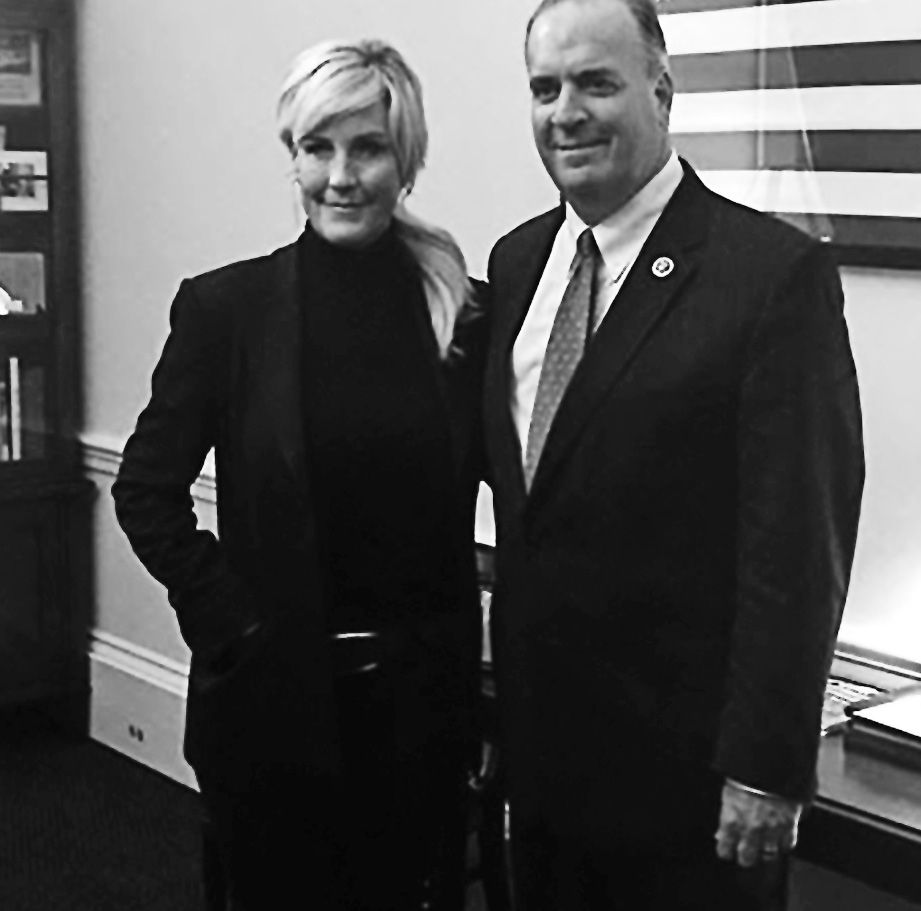
Erin with Dan Kildee, the U.S. representative for Michigan’s 5th Congressional District since 2013. Kildee was born and raised and still resides in Flint, Michigan.
Kamala Harris, U.S. senator from California, has tweeted, “I’ve said this many times & will say it again: everyone has a fundamental right to drink clean water. The Administration should take steps to protect Americans from these chemicals that are already impacting the water supplies of millions of Americans.” This tweet was in regard to news that the Environmental Protection Agency (EPA) is still not setting drinking water limits for two toxic chemicals, PFOA and PFOS, which are contaminating millions of Americans’ tap water at this very moment (and which you will read extensively about in this book). You will also learn a lot about chemicals going unregulated, even when the science shows they are linked to cancer and other major health issues.
As if poisoned water wasn’t a big enough issue, the last six years (2013–2019) have been the hottest years on record. As our climate changes, and we experience more droughts, floods, superstorms, melting glaciers, and rising sea levels, we are seeing greater strains on our water supplies, infrastructure, and economy.
For years, I’ve been teaching one very simple concept: Superman is not coming. If you are waiting for someone to come save you and clean up your water, I’m here to tell you: No one is coming to save you. We can’t survive without access to clean water (or water at all) and yet we are losing access to our most precious resource. Without water, it is literally GAME OVER for all of us. The time has come for us to save ourselves.
We are amid a major water crisis that is beyond anything you can imagine. Pollution problems persist and toxins are everywhere, stemming from the hazardous wastes of industry and agriculture. We’ve got more than forty thousand chemicals on the market today with only a few hundred being regulated. We’ve had industrial byproducts discarded into the ground and into our water supply for years. The companies who dump these toxins know it. They have always known it. The government knows it too. These issues affect everyone—rich or poor, black or white, Republican or Democrat. Large and small communities everywhere think they are safe when they are not.
Each water system is unique, but some of the most toxic offenders that I will talk about in this book include hexavalent chromium (an anticorrosive agent), perfluorinated chemicals (PFCs)—which include perfluorooctanoic acid (PFOA, used to make Teflon pans) and perfluorooctanesulfonic acid (PFOS, a key ingredient in Scotchgard), trichloroethylene (TCE, used in dry cleaning and refrigeration)—lead, fracking chemicals, chloramines (a water disinfectant), and more. Many of these chemicals are undetectable for those drinking the water. Hexavalent chromium is an exception, as it typically turns the water green at high doses and water heavily treated with chloramines usually has an odor. But like a blood test for disease, you can only find what you test for. If you don’t order a specific test for one of these chemicals, you won’t know it’s there. And you can’t treat water, unless you know what’s in it. Many of these substances cause irreversible health problems when ingested and people in communities throughout the country are dealing with these repercussions. This book will highlight just a few of the thousands of stories. Some cases have good outcomes, some are still in process, and many are still struggling.
Now, I know what you might be thinking. What about the EPA, Erin? What about corporate remediation departments? Aren’t the experts handling it?
The short answer is no.
These issues start with tiny little seeds of deception that add up over months and years to become major problems. Our resources are exhausted. Corruption is rampant. Officials are trying to cover their tracks. People are either completely missing the mark or not putting all the pieces together when it comes to the severity of this crisis. I’ve got senators and doctors calling me, asking me what to do.
But before you put this book down in deep despair, I want to urge you to muster up your own stick-to-itiveness and keep reading. I want to remind you that we are in this together. No one person must—or can—fix it alone. Not one senator, one community member, CEO, mom, or dad. It’s up to all of us. We’ve got to work together.
Even in the movie that shares my name, we had a team working around the clock. I went door-to-door to talk with residents who had concerns and were asking good questions. We hosted community meetings. We worked with some of the best legal teams, researchers, and academics in the state of California. It was not a one-woman or one-man job. We fought together.
I’ve noticed over the years that when I visit towns and work with people, the number one thing everyone seems to need is permission. They are looking for someone to tell them that it’s okay to move forward. Empowerment is a process that happens as we give ourselves authority to act on what feels right, what we know is right. But sometimes people get stuck. We are afraid to act out, and believe it or not, I can relate to that. It’s not always easy to speak up or out of turn. Since we were young girls and boys, we learned to ask for permission—whether it was permission to leave the dinner table or to use the bathroom during class. As we get older, we must get permits to build an extra addition onto the house. We sign permission slips for our kids to go on field trips. It becomes a habit to think we need permission to act. We request time off from work—we don’t just take a vacation. We text people instead of calling them. All these little acts add up and then we think: Who am I to stand up at a city council meeting and ask a question? I don’t know all the answers. I’m not a water expert. What does everyone else think about the water? Is it really a problem or am I overreacting? We all have these doubts and questions. In the end, I think that the permission we are seeking is more about support. We want to know if we take action, it will be successful in some way and that our community will not shun us for these actions.
Let this book stand as your personal permission slip. Yes, you have permission to ask questions. Yes, you have permission to scrutinize your water professionals and find out if they have the right credentials. Yes, you have permission to start a Facebook group to make more people aware of your cause. You have permission to stick up for yourself when it comes to your health, your family, your life. The world needs all of us to get involved now more than ever.
The first action that you can take is to become part of what I hope will be the first-ever national self-reporting registry at www.communityhealthbook.com. (We do have state registries but many people aren’t reporting.) This crowd-sourced map is my legacy project and it allows individuals and community groups to report and review health issues (cancer being the most prevalent) and community environmental issues by geographic area and by health topic. This self-reported research provides missing data points coming from the people that local, state, and federal agencies cannot or will not talk to and will not communicate to each other about. The research is intended to connect the dots between clusters of illness and environmental hazards in specific communities and regions of the country. If you or someone you know is sick or suffering, please report it. I will talk more about the map in chapter 3, and throughout this book.
None of us need a Ph.D. or a science degree, or need to be a politician or a lawyer to be aware and to protect our right to clean water. I’ll take you step by step through how to take these actions to save your family and community. We have the power together to fight for better enforcement of the laws on the books, to push for new legislation, and to storm our city halls until our voices are heard and the water is safe for everyone to drink.