
1. Just How Capitalist Is China? - Capitalism with Chinese Characteristics: Entrepreneurship and the State
By Yasheng Huang
Chapter 1: Just How Capitalist Is China?
In 2004, Lenovo, a computer maker based in China, acquired the manufacturing division of IBM. This event, coming off the heels of the news that China had contributed more than the United States to global GDP growth, took the world by storm. Richard McGregor (2004), a reporter for the Financial Times, captured a widespread sentiment when he wrote that the purchase was “a symbol of a new economic era, of how a fast-rising China had suddenly grown powerful enough to subsume an iconic American brand.” Princeton economist and New York Times columnist Paul Krugman (2005) had not been alarmed with Japanese acquisitions in the 1990s but he was about Chinese investments. He believed that the Chinese corporate acquisitions posed a great threat to the United States. There are even those who hailed the Lenovo acquisition as heralding a new world order with China at its center (Shenkar 2006).
Business-school academics are particularly enamored with Lenovo. For them, Lenovo is proof positive of China's fertile entrepreneurial environment and rising competitiveness. In his book, The Chinese Century, Oded Shenkar, a professor at Ohio State University, rejects the notion that China lacks its own homegrown corporate giants. Lenovo, he argues, is just as homegrown as the best of the Indian corporations, such as Wipro or Infosys (Shenkar 2005). Lenovo is also featured prominently in Made in China: What Western Managers Can Learn from Trailblazing Chinese Entrepreneurs, a book by Donald Sull, a business professor at INSEAD (Sull 2005).
There is one problem with these otherwise perceptive books – Lenovo is not a Chinese company. There is no question Lenovo is a huge success story but it succeeded precisely because it was able to operate outside of the Chinese business environment. The Chinese face of the firm is Lenovo China headquartered in Beijing. This is the original firm founded in 1984 under the Chinese Academy of Sciences (CAS). But the real corporate control and equity holdings of the production and technology development of Lenovo actually reside elsewhere – in Hong Kong. Consider Lenovo (Beijing) and Lenovo (Shanghai), the business units of the firm that run manufacturing, R&D, software development, and customer services. Both of these business units are not only foreign-invested enterprises (FIEs); they are, in fact, wholly owned FIEs – that is, they are 100 percent owned by a legal foreign entity, which is Hong Kong Lenovo. They have no direct equity relationship with Lenovo China. As wholly owned FIEs, the Beijing and Shanghai divisions of Lenovo are more foreign than GM's operation in Shanghai, which is a 50–50 equity joint venture. The foreign operations of Lenovo are so substantial that in 2003, seven of Lenovo's Hong Kong subsidiaries were included on a list compiled by the Chinese government as among China's 500 largest FIEs.
This is a book about this and many other phenomena of the Chinese economy. In the first part of this chapter, I provide a detailed account of Lenovo in order to make a larger point – the Chinese economy is so complicated that what appears to be straightforward and obvious on the surface is not at all so once we dig into the details. To get into these details requires going far beyond the normal empirical basis of much of the economic analysis on China (e.g., data on GDP and foreign exchange reserves). In this book, I have examined numerous government documents, including memoranda and instructions issued by officials of the central bank and by senior bank managers and a large quantity of survey data on households and Chinese firms. The conventional economic data, such as GDP, exports, and FDI, serve as motivations for further research rather than as statements about settled conclusions. (I provide more details on the empirical sources of the book later in this chapter.)
The Lenovo example is not just about getting the facts right about the Chinese economy; it is also about drawing the right analytical and policy implications from China's growth experience. This is another theme running throughout the book. Much of the received wisdom in the academic literature states that entrepreneurship, financial liberalization, and private property rights security are not significant components of Chinese economic growth. (Or, at the very least, to the extent that these components are important, they have very different manifestations from those prevailing elsewhere.) The success of the Chinese economy has inspired the idea that economic growth follows from an adept tailoring of economic policies and institutions to their local contexts rather than from an application of universal economic principles. Let me apply this idea to the experience of Lenovo.
A critical detail of the Lenovo story is its foreign registration status. A reader may wonder, “So what?” What is so significant about the fact that Lenovo is registered as a foreign-owned company in China? Furthermore, isn't it the case that Hong Kong is now a part of China so the designation of Hong Kong Lenovo as a foreign firm is a frivolous legal fiction? The answers to these questions show precisely how important it is to get the details of the Lenovo story right.
Understanding the Hong Kong roots of Lenovo entails significant implications about constructing the right causal attributions. Hong Kong is a laissez-faire economy based on a market-oriented financial system, rule of law, and property rights security. Hong Kong, many would argue, is the closest living case to the textbook version of neoclassical economics in the world. This is why it matters so much to accurately attribute the success of Lenovo. If we believe Lenovo to be a product of China's business environment, then many of those who argue that China has created a unique, country-specific formula for cautious deregulation, state ownership, and selective government intervention in the economy have a point. If we believe Lenovo to be a product of Hong Kong and Hong Kong institutions, the success of Lenovo then becomes a story of rule of law and market-based finance. It is thus worth going into some details about this matter.
Apart from the initial financing from CAS in 1984, it is the market-oriented and conventionally Western Hong Kong capital market that supplied Lenovo with almost all of its subsequent capital during the critical growth period of the firm.1 In 1988, Lenovo received HK$900,000 from China Technology, a Hong Kong–based firm, to invest in a joint venture in Hong Kong. This investment thereby established Lenovo's legal domicile in Hong Kong. (Originally, the firm was known as Legend.) Here, luck and fortuity played a role. The father of Liu Chuanzhi, the main founder of Lenovo, ran China Patent Agent based in Hong Kong. China Patent Agent was a major shareholder of China Technology. Computer manufacturing is capital-intensive and requires substantial investments. It was the capital market in Hong Kong that met this high level of capital requirements of Lenovo. In 1993, Hong Kong Lenovo went public on the Hong Kong Stock Exchange. The initial public offering (IPO) raised US$12 million, which the firm plowed back into its investments in China. Lenovo is a success story of the market-based finance of Hong Kong, not of China's state-controlled financial system.
Although it is true that the founders of Lenovo all came from CAS, that the firm became a business subsidiary of CAS is a historical artifact. The founding capital was 200,000 yuan, an enormous sum in China in 1984. The money was actually a loan from CAS, not an equity investment. In fact, the arrangement was exceedingly convoluted. According to one account, the 11 founders of Lenovo had secured the money as a bank loan, which they lent to CAS. CAS then turned around and loaned the money back to Lenovo. Under Western law, Lenovo would have been a straightforward private firm with CAS as its creditor, not the equity holder. But the reason why Lenovo incorporated itself this way has nothing to do with the actual share of capital contributions. The reason is that in 1984, there was really no legal vehicle to register an independent private-sector firm of the size of Lenovo and operating in a modern industry such as computer manufacturing. In the 1980s, although private-sector liberalization in rural China went far and deep (a topic I revisit in the next chapter), the urban economy remained almost completely state-controlled. Many of the large-scale otherwise private businesses were incorporated in this way in the 1980s.
Understanding Lenovo's Hong Kong connections also helps us gain the right perspective on the Chinese business environment. The legal status of Lenovo as foreign-owned mattered to Lenovo in a most fundamental way – this was its entry ticket into computer manufacturing in the first place. After its founding, Lenovo was denied a production license in computer manufacturing in China. Instead, the Ministry of Electronics granted a production license to the Great Wall Group, a traditional SOE. Lenovo only began to produce computers in China not as a Chinese company but as an FIE originating in Hong Kong. Every single manufacturing, service, and R&D operation launched by Lenovo in China has followed exactly the same route. They are either wholly owned by Hong Kong Lenovo or they are foreign joint ventures with other Chinese firms. In 1997, Hong Kong Lenovo absorbed the last remaining Chinese operation, its Beijing operation.2
As an FIE, Lenovo came under the jurisdiction of the Foreign Equity Joint Venture Law or the Wholly Foreign Equity Law. Chinese laws and regulations provide a more liberal operating space for foreign-registered firms than they do for domestic private firms. In the 1990s, China pursued a highly biased liberalization strategy that conferred substantial tax and policy incentives on FDI while restricting the growth potentials of the indigenous private sector.3 Until 2005, many of the high-tech and so-called strategic industries were declared off-limits to domestic private entry. Indigenous private entrepreneurs, many highly capable, could grow their businesses only via foreign registration. This is why Lenovo acquired a foreign legal status. As an FIE, Lenovo was able to operate in greater regulatory space and with more autonomy. As an illustration, the firm that bypassed Lenovo and was given the production license in computer manufacturing – the Great Wall Group – operated completely within China's domestic business environment. The firm floundered badly.
Professor Sull chronicles seven other firms in his book: Sina, UTStarcom, AsiaInfo, Haier, Galanz, Wahaha, and Ting Hsin. Every single case Professor Sull discusses is a Lenovo-like story. The firms are all registered as foreign firms in China, or some of their main operations are so registered. Sina, UTStarcom, Ting Hsin, and AsiaInfo are wholly owned FIEs, 100 percent owned by foreign investors, identical to Lenovo (Beijing) and Lenovo (Shanghai). Galanz and Wahaha are joint ventures. (In 2007, Wahaha's founder was involved in a bitter dispute with its foreign business partner, Danone.) Haier itself is not an FIE but its main business and production units are FIEs, including its core areas in refrigerator and washer and dryer production. All of these firms are legally classified as FIEs and they fall under the relatively more liberal purview of China's foreign investment laws and regulations.
It is quite understandable that Sull assumed that all of these firms are Chinese. They are Chinese to the extent that their managers and owners are ethnically Chinese, but their legal status is foreign. That corporate success in China requires a combination of Chinese management and foreign legal status is probably the cleanest illustration of the massive distortions in China's business environment – that this is a system that has imposed a straitjacket on the domestic private sector. It is thus not a coincidence that corporate success stories in China all share an underlying commonality with Lenovo and Sina. In 2002, Forbes compiled a list of the most dynamic small firms in the world. On that list, four are run by Chinese entrepreneurs and derive most of their revenue from their China operations, but each one of them is actually headquartered in Hong Kong.
The rise of Lenovo has so impressed some foreign analysts that a McKinsey consultant goes so far as to claim that China has the “best of all possible models” (Woetzel 2004). This reasoning holds up the particular policy and institutional path that China has followed as a model for other developing countries. China has inspired Western researchers to argue that microeconomic and macroeconomic successes do not depend on adoption of Western-style financial and legal institutions. This is the argument in an influential finance paper that claims that informal finance is nearly as good as market-based financial institutions in channeling capital to the private sector (Allen, Qian, and Qian 2005).
The story of Lenovo casts doubt on all these postulations. Yes, China lacks efficient legal and financial institutions, but it has access to them – in Hong Kong. Take the view that formal finance does not matter. The management of Lenovo certainly would not agree with this. The firm raised more than US$12 million from its Hong Kong IPO. Formal finance – and the institutions supplying it – is absolutely essential to the success of Lenovo. Informal finance might be sufficient to start small kiosk businesses or simple production, but it is not adequate for firms to acquire modern production facilities and to move up on the technological ladder.
Lenovo is the most prominent product of what is known as “round-trip” FDI – “foreign” capital that is first exported from China and then imported back into China. The key function of Lenovo's Hong Kong operation has nothing to do with technology. In fact, according to one of the best and most-detailed accounts of Lenovo, the managers and scientists at Lenovo had far superior technical expertise than the Hong Kong firm with which it teamed (Lu 2000). The true contribution of China's open-door policy is not just about allowing foreign entry but also about allowing Chinese exit. It enabled some of China's own indigenous entrepreneurs to find an escape valve from a very bad system. To put it another way, China's success has less to do with creating efficient institutions and more to do with permitting access to efficient institutions outside of China.
This – largely unintended and under-appreciated – effect of China's open-door policy should be explicitly recognized, but recognizing this effect is qualitatively different from stating that China does not need efficient market-based institutions. The story of Lenovo is precisely about the importance of efficient market-based institutions. Lenovo was able to tap into these institutions because China is fortunate enough to have the most laissez-faire economic system at its doorstep. Hong Kong is a safe harbor for some of the talented Chinese entrepreneurs and an alternative to China's poorly functioning financial and legal systems. It is only a slight exaggeration to say that Lenovo benefited as much from the British legacy as from the growth opportunities within China itself.
China is unique in that some of its capable entrepreneurs have the option of accessing one of the most efficient financial markets and legal institutions in the world. But here is an important policy implication. It would be futile for other developing countries to emulate China's domestic financial and legal institutions and practices as a way to achieve economic growth. As successful as Lenovo is, the special circumstance of Hong Kong limits the general applicability of this model. In this connection, McKinsey's exhortation that China has “the best possible” business model is equivalent to urging other poor countries to acquire their own Hong Kong, a piece of advice of dubious utility.
Finally, there is the issue of whether or not getting the story right about Lenovo and about China really matters for China. Maybe the lessons of China cannot be readily extended to other countries, but as long as the China model works for China, this is fine. Isn't it the case that many firms like Lenovo are able to tap into Hong Kong's financial market and legal institutions and are able to emerge as competitive giants on the world stage? As long as there are substitute mechanisms, China's growth can continue.
This is a flawed inference from the success of Lenovo and other Chinese companies. Recall the fact that Lenovo was able to tap into the financial market of Hong Kong surreptitiously – Liu Chuanzhi's father was an executive in Hong Kong. Familial connections enabled Lenovo to escape from the clutches of China's poor institutions, but for each Lenova-type success story, there are untold cases of failure of indigenous entrepreneurs for whom access to Hong Kong is not an option. This is true especially of those would-be entrepreneurs located in China's vast rural and interior regions. One can go even a step farther. China's need for an efficient financial system is greater in the interior regions than it is in the coastal provinces precisely because the interior is so short of other conditions for growth.
Bad institutions are especially detrimental to rural entrepreneurship, the type of entrepreneurship that matters far more to the welfare of the vast majority of the Chinese, as compared with urban, high-tech entrepreneurship. Two chapters of this book delve extensively into this issue. Unlike many countries, the most dynamic, risk-taking, and talented entrepreneurs in China reside in the countryside. These rural entrepreneurs created China's true miracle growth in the 1980s, first by dramatically improving agricultural yields and then by starting many small-scale businesses in food processing and construction materials. The open-door policies alone can do very little – and they did very little – to help these entrepreneurs in the interior regions.
To a large extent, the story of Lenovo mirrors the story of China. What appears to be abundantly obvious on the surface is, in fact, not obvious at all. To get the facts right requires a deep digging into many details. A substantial portion of this book illustrates this point. In part, this is a history book – marshaling facts and data about the evolution of the Chinese economic system over the last three decades. But, as my account of Lenovo shows, getting the China story right is also about constructing the correct explanations about China. The explanation I put forward in this book is simple and even bordering on the mundane: China succeeded where and when bottom-up, private entrepreneurship flourished and it stagnated where and when entrepreneurship was suppressed.
In this chapter, I begin with a basic question, “Just how capitalist is the Chinese economy?” This is a legitimate question, considering the following. First, the year 2008 marks the 30th anniversary of China's economic reforms (1978–2008). By 2008, it will have taken China one year longer to reform its socialist economic system than the duration of the pre-reform central planning system itself (1949–1978). (Indeed, by the account of economic historians, a full-fledged central planning system was not established until the mid-1950s.4) The question of the pace at which China is transitioning to capitalism is worth considering. Second, some of the most prominent and authoritative China economists have already declared that China's transition to a market economy is now complete.5 The remaining challenge, they argue, is economic development. It is legitimate to subject this judgment to an empirical test.
One of the most important – if not the most important – hallmarks of a market economy is the role and magnitude of the private sector. However, as in so many other areas of the Chinese economy, there is no straightforward answer to this seemingly direct question about the size of the Chinese private sector. The reason is that the Chinese style of reforms has spawned a large number of firms that have fundamentally confusing and often deliberately vague ownership structures. After sorting through some definitional complications, I show that the size of the Chinese private economy, especially its indigenous component, is quite small. Using fixed-asset investment as a measure of policy, I show that the policy treatment of the indigenous private sector deteriorated substantially in the 1990s as compared with the 1980s. This policy reversal is the most important reason why China's transition to capitalism remains incomplete 30 years after the reforms began.
The second section of this chapter provides a preview of my account of the Chinese reforms during the last 30 years and concludes with a précis of the remaining four chapters of the book. Three issues are highlighted. First, a good account of the Chinese economy should be able to explain both its many well-known weaknesses – the weak financial system, the under-developed private sector, and the deterioration of social performance – as well as many of its considerable achievements, such as its rapid growth and its impressive reduction of poverty. The key factor identified in my account is a reversal of economic policies at the end of the 1980s. In the 1980s, the direction of economic policy was progressively liberal, primarily in the rural areas of the country. Access to finance by the private sector improved rapidly and rural entrepreneurship was vibrant. In the 1990s, the direction of economic policy was reversed, with an increasing emphasis on industrial policy and state-led investment drives. Although GDP growth was rapid during both eras, both the drivers and the effects of the growth differed substantially. In the 1980s, the rapid GDP growth was accompanied by fast personal income growth, an improving income distribution, and a steep decline in poverty. Since the early 1990s, and at an accelerating pace since the late 1990s, the welfare implications of the fast GDP growth turned adverse. In other words, many of the best-known achievements of the Chinese economy owe their origins to the policies of the 1980s and many of the deep-seated problems today are an outgrowth of the policies of the 1990s.
The second part of my account emphasizes the importance of the rural sector. The importance of the rural sector derives not just from its sheer weight in the Chinese economy and society – that China has a large rural population – but also from the institutional perspective. In China, the origins of market-based, entrepreneurial capitalism are heavily rural in character. This observation entails some significant auxiliary implications. One is that the fate of rural entrepreneurship has a disproportionate effect on the character of Chinese capitalism. When small-scale, market-oriented, broad-based, and politically independent rural entrepreneurship is accorded greater operating freedom and supported by policies, entrepreneurial capitalism thrives and produces many of its associated virtuous effects. When rural capitalism is restricted in favor of its urban counterpart, Chinese capitalism is less welfare-improving. In essence, this is the tale of the two decades. In the 1980s, the country was moving directionally toward the virtuous kind of capitalism, or what Baumol, Litan, and Shramm (2007) describe as entrepreneurial capitalism. In the 1990s, the country still moved toward capitalism but of a different and less virtuous kind – the state-led brand of capitalism.
The third part of my account has to do with how to interpret China's growth experience. My purpose here is to present the relevant factual details and to develop the right analytical perspective based on them. I argue that China's growth experience is actually very conventional. Private ownership, financial liberalization, property rights security, and even some degree of constraints on the political rulers are as essential to China's economic success as they are to economic successes elsewhere. The success of Lenovo, which “borrowed” the institutional benefits of Hong Kong, illustrates this point. On the other hand, many of China's failings are a direct result of the country's poor and underdeveloped economic and political institutions and, more important, a consequence of the fact that the country reversed its policies and practices from the directional liberalism of the 1980s to the directional illiberalism of the 1990s.
1 Just How Capitalist Is China?
A hallmark of a market economy is the size and the vitality of its private sector. There are two standard perspectives on this question as related to China. One is the view that growth happened in China despite the absence of sizable private ownership. Advocates of this view point to TVEs – the growth engines in the 1980s and the first half of the 1990s – as an illustration. The other standard perspective is that China's private sector was not substantial ex ante but became substantial ex post. This perspective is rooted in the gradualist framework on the Chinese economy. According to the gradualist perspective, China did not actively privatize its SOEs, but it successfully created a hospitable business environment for the entry and the organic growth of private entrepreneurship. Over time, the private sector grew to overshadow the state sector. Market economy developed by evolution rather than by revolution.
I provide an alternative perspective in this book. Later in this chapter and in Chapter 2, I delve extensively into the TVE phenomenon; the gist of the finding is that TVEs, upon a microscopic examination, were in fact a substantially private phenomenon. In this section, I look into the gradualist perspective on China's private sector. The issue here is not so much whether the gradualist perspective is directionally accurate about the growth of China's private sector. There is little question that the size of China's private sector today is much larger than that in 1978. (In 1978, it was zero.) The issue is just how successful is China's evolution toward a market economy. Scholars schooled in the gradualist perspective declared a huge success. The analysis I present in the following paragraphs reached a far more tempered judgment on this question.
As almost with any other aspects of the Chinese economy, the issue comes down to data as well as perspectives. Let me use the example of Huawei Technology Corporation, one of the largest private-sector firms in China, to illustrate the myriad complexities of the Chinese economy. By most accounts, Huawei, with sales revenue of about US$5.7 billion and operating in more than 90 countries, is China's most successful private-sector firm. But our knowledge of its actual ownership structure is almost non-existent. Huawei is a microcosm of China's private sector – we know that it is there but we do not know its actual size and its boundaries. The convoluted ownership structure of China's private sector – and of Huawei in particular – makes it very difficult to answer the question, “Just how capitalist is China?” Huawei, like Lenovo, is an apt case study of the enormous complexities of the Chinese economy.
We came to know a bit more about Huawei as a result of a lawsuit against the firm in 2002. The lawsuit itself reveals little about the ownership structure of the company, but it reveals some of the reasons why there is so little outside knowledge about it.6 The case was filed by Mr. Liu Ping, one of the earliest employees of the company. Upon leaving the company, Mr. Liu, who had accumulated substantial shares in the company, was told that Huawei would redeem his shares only at the original 1-to-1 ratio. Mr. Liu contended that this was unfair. The assets of Huawei had increased several-fold since he joined the firm in the early 1990s.
The lawsuit reveals some fascinating details about this otherwise very secretive company. For example, Huawei mandated that all of its employees purchase shares, which suggests that its employees own at least a portion of the firm. But the company has never issued any share certificates explicitly recognizing their ownership. The employees were required to sign share certificates upon purchasing the shares, but Huawei kept all the copies. Because there is no information about how many shares were issued, we do not know whether Huawei is an employee-owned company. Even if we assume this to be the case, there is no paperwork actually documenting it as such. For a firm that even Cisco views as its main technological rival in the 21st century, it has some of the world's most medieval recordkeeping practices.
It is not unreasonable to assume that Huawei has gone out of its way to purposely obfuscate its ownership structure. The reason is not hard to understand. The firm was established in 1988 and, until very recently, the telecommunications sector was declared off-limits to private-sector firms in China. In addition, Chinese financial regulations have stringent restrictions about issuing shares to employees. It is all but certain that Huawei, by virtue of the fact that it is a private-sector firm, is in technical violation of many of these regulations. This hypothesis also dovetails with the widely held knowledge that Huawei has backing from the Chinese military. It is inconceivable that a politically naïve private entrepreneur could have gone as far as this firm has.
The lawsuit also shows that a number of state-owned telecommunication firms in Shenzhen were granted shares by Huawei, although, again, there is no information about the amount of the shares. It is possible that Huawei has some state share capital on its balance sheet, but we can safely rule out the possibility that Huawei is a state-owned firm. One telling clue is that its general manager, Ren Zhenfei, has been in his position since the founding of the firm in 1988. The longevity of the general manager is the most reliable way to distinguish a true private-sector firm from an SOE. The government frequently shuffles the management of SOEs and, therefore, SOE managers typically have very short tenures.
Obviously, it is impracticable to determine the size of China's private sector by examining the tenure of general management. The information simply is not available. In this section, I present two measurements, each with its advantages and disadvantages. But the common advantage is that they are relatively systematic and they are derived on the basis of explicit assumptions and judgments about the workings of the Chinese economy. They are thus “falsifiable.”
We distinguish between two types of measurements – output-based and input-based measures of the size of China's private sector. The output-based measure is often used by academics to gauge both the size of China's private sector and the evolving policy environment for the private sector. I show that this is the correct measure to assess the size of the private sector in China, but it is deeply problematic as a measure of the evolving policy environment. The basic problem is that this measure confounds the effects of two factors – the policy changes and the firm-level efficiency differentials between SOEs and private-sector firms. A rising ratio of private-sector output to the output of the state sector can be a result of policy changes toward the private sector or can be a result of the fact that private-sector firms are simply more efficient than SOEs. We do not know which factor is driving the change in this ratio.
Let me illustrate this point with an extreme example. No one would accuse Leonid Brezhnev for being pro-private sector, but actually under his leadership, private plots contributed to roughly one half of agricultural household income in the Soviet Union (Gregory and Stuart 1981, p. 230). This was so because private farming was so much more efficient than the state farming so its contributions to income were disproportionate to the inputs allocated to it. Private plots only accounted for 1.4 percent of cultivable land in the Soviet Union (Hewett 1988, p. 117).
The minuscule share of private plots in the Soviet Union suggests that a better measure of the changes in the policy environment should be based on an input allocated to private sector rather than its share of the output. The most appropriate input-based measure is the fixed-asset investment capital. Fixed-asset investments are equivalent to purchases of plants, property, and equipment in the Western accounting system. There are two reasons why this is a better measure of policy. One is that fixed-asset investments remain substantially controlled by the state; thus, changes in the patterns of fixed-asset investments are a more accurate reflection of the policy preferences of the Chinese state. The second reason is that in a poor country, capital is scarce relative to labor. So capital allocation is more indicative than labor allocations of the fundamental orientation of the economic system.
In the following sections, I assess these two questions. First, how large is China's private sector? Second, has the policy environment improved over time for China's private entrepreneurs? Unfortunately, these weighty questions do not have straightforward answers. I elaborate on various measures and approaches and on the assumptions and definitions behind them. The treatment is quite detailed (and even tedious), but the only way to get at these issues is to sort out many of the complications in the Chinese data.
1.1 How Large Is the Chinese Private Sector?
Defining China's private sector is fiendishly difficult. Some scholars have used the state and non-state categories of firms as a way to assess private-sector development in China (Bai, Li, and Wang 2003). The state-sector firms are traditional SOEs, whereas the non-state-sector firms encompass a huge variety of firms, including collective enterprises, truly private firms, shareholding enterprises, domestic joint-ownership firms, and FIEs. In some studies, SOEs that have issued shares on the stock exchanges are also counted as part of the non-state sector.
Information on state and non-state firms is easily available but it is not very useful. Depending on the definition that is used, there are vastly different estimates of the size of the non-state sector. Based on one definition, the share of the non-state sector in industrial output value was 68.4 percent in 1997 (Wang 2002).7 Based on the definition of the National Bureau of Statistics (NBS), the non-state sector accounted for only 21.2 percent of industrial value-added in the same year (NBS 1999a). Equating the non-state sector with the private sector is problematic.8 Local governments control collective firms to varying degrees.9 The vast majority of the SOEs that have issued shares on China's stock exchanges are technically classified as non-state firms but they are still tightly controlled by the state.
In the following paragraphs, I present estimates based on a superior approach that gets at the core issue about firm ownership. An accurate definition of a private-sector firm should be based on how its control rights are assigned. Control rights mean the rights to appoint management, dispose of assets, and set the strategic direction of the firm. On this count, SOEs that issued shares on the stock exchanges are not private because they are still tightly controlled by the government. The difficulty, however, is that it is not easy to know whether a firm in China has private or governmental control rights. To arrive at an estimate of the size of China's private sector, an analyst would have to make certain assumptions about which types of firms in China have private control rights.
A study by two Organisation for Economic Co-operation and Development (OECD) economists, Sean Dougherty and Richard Herd (2005), represents the most systematic and comprehensive attempt.10 Their paper is based on a very unique dataset compiled by the NBS. The dataset covers more than 160,000 industrial firms in China between 1998 and 2003. (The Appendix to this chapter provides further details on this dataset.) I first summarize their findings and then present my own estimates. My own estimates, which reveal a far smaller indigenous private sector as compared with the OECD study, are based on the same methodology as the OECD study but on different assumptions about what types of firms have private control rights.
The advantage of the NBS dataset is that its data are disaggregated at the firm level and cover a wide range of firm activities. One critical piece of information in the dataset is the shareholding structure of the firms. This is a solution to the uncertainty over the ownership boundaries of Chinese firms. The OECD economists use the shareholding structure as the basis for their definition. One caveat, however, is that the NBS dataset is biased toward large firms – defined as those with at least 5 million yuan in sales. So the estimates here reflect the private share of the industrial value-added produced by the largest firms in China, not the private share of the entire industry. (The 2004 economic census has data on private businesses below the 5-million-yuan threshold. However, NBS does not publish the shareholding information.)
The Appendix to this chapter explains their classification methodology in greater detail. The most critical assumption in their methodology is that a category of firms known as legal-person shareholding firms are privately owned. They conclude that the private economy accounted for 52.3 percent of industrial value-added in 2003, compared with 27.9 percent in 1998.
I examined the dataset used by the OECD economists and checked their findings. I used exactly the same ownership classification methodology they used and was able to reproduce findings broadly similar to theirs.11 I also extended their methodology to the 2005 data. The results are presented in Table 1.1.
Table 1.1. Estimates of private-sector shares of industrial firms above scale in Chinese industrial value-added/profits, 1998, 2001, and 2005 (%)
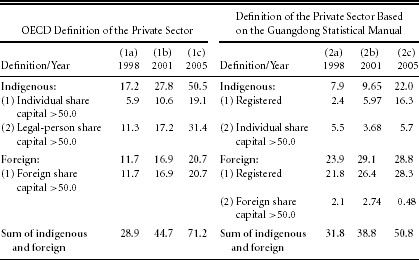
Notes: I follow the classification methodology used by Dougherty and Herd (2005). Their methodology involves two steps. First, they divide the firms into state and non-state firms. State firms, in turn, comprise two types of firms: SOEs and collective firms in which the collective share capital exceeds 50 percent. The second step is to classify all those firms in the non-state category as those with more than 50 percent of share capital held by legal persons, individual investors, and foreign firms. The Guangdong definition includes all the firms explicitly registered as private-sector firms (siyin qiye) and those non-state firms in which private share capital is substantial. I set the “substantial” threshold at 50 percent. The non-state firms in the Guangdong definition refer to shareholding cooperatives, other alliance firms, and other shareholding firms with limited liabilities.
Source: NBS database of industrial firms above 5 million yuan in sales. See the Appendix to this chapter for an explanation.
I separate data on indigenous and foreign private-sector firms rather than reporting them together. In the OECD definition, indigenous private-sector firms are defined as those firms with substantial individual share capital and legal-person share capital (i.e., exceeding 50 percent of the total share capital). The foreign private-sector firms are those with foreign share capital exceeding 50 percent. By the OECD definition, the sum of the indigenous and foreign private-sector firms in China's industrial profits is 28.9 percent in 1998, 44.7 percent in 2001, and 71.2 percent in 2005, respectively.12
The OECD economists assign the entire output by legal-person shareholding firms to the private sector.13 Is this a reasonable approach? Getting this question right is critical. In 1998, legal-person shareholding firms accounted for 40 percent (11.3/28.9) of the purported private sector. Excluding these firms would reduce the share of the private sector in industrial value-added from 28.9 percent in 1998 to only 17.6 percent (i.e., 28.9 percent minus 11.3 percent). For 2005, the private sector exclusive of legal-person shareholding firms would be 39.8 percent rather than 71.2 percent (i.e., 71.2 percent minus 31.4 percent). This is another illustration of a common refrain in this book – getting the details right matters.
Legal-person shareholding refers to cross-shareholding by firms. Probably because of the connotations of this term, the OECD economists might have assumed that legal-person shareholding implies that China has a keiretsu arrangement similar to that in Japan where firms own each others’ stocks. The difference with Japan, however, is that in China much of the legal-person share capital originates in the state sector, via SOEs establishing or holding significant equity stakes in other firms. These firms then become affiliates or subsidiaries of the SOEs. The subsidiaries of the SOEs, on account of their final ownership, are still SOEs.
One way to learn more about these legal-person shareholding firms classified by the OECD study as private is to check their names. Even a casual glance at the data reveals that many of these legal-person shareholding firms are among the best-known and quintessential SOEs in China. They include subsidiaries of Daqing and Dagang oilfields, owned and operated by two of China's largest SOEs. Daqing is owned by PetroChina and Dagang is owned by China National Petroleum Corporation (CNPC). The list also includes subsidiaries of NORINCO, a large defense-product firm. PetroChina, CNPC, and NORINCO are not only SOEs; they also are known as central SOEs directly supervised by the State Council. In fact, some of these firms have the word “state-owned” in their names.
Another well-known SOE on the list classified by the OECD study as private is SAIC Motor Corporation Limited (SAIC Motor). In the NBS dataset, the state share of SAIC Motor's share capital structure is 0 percent; it is 70 percent legal-person shareholding and 30 percent individual shareholding. So this firm qualifies as a private firm in the OECD definition. But SAIC Motor is not even remotely a private firm. SAIC Motor was established in 1997; its predecessor was Shanghai Gear Factory. In 1997, 30 percent of the share capital was issued on the Shanghai Stock Exchange and the rest of the share capital was held by Shanghai Automotive Industry Corporation (SAIC), which is 100 percent owned by the Shanghai government. Because the Shanghai government owns SAIC Motor via SAIC – a legal-person shareholder – the state share capital is reduced to zero; however, from a control perspective, there is little question about who controls this firm.14
The example of SAIC Motor also illustrates the nature of the SOE reforms in the 1990s. Much of the reform effort had nothing to do with actually changing the owners of the firms but rather it was directed at securitizing the full but previously implicit equity holdings of the state in the SOEs. Although these reform measures copy the superficial forms of a capitalistic market economy, none of them has anything to do with its essence – transferring corporate control from government to private investors.
The high concentration of the ownership structure of the legal-person shareholding firms is another sign that these firms are not private at all. In the NBS dataset, SAIC Motor has the most dispersed shareholding structure among the legal-person shareholding firms because 30 percent of its shares are held by individual shareholders. (This is because the firm is listed.) In contrast, of 16,871 legal-person shareholding firms in the NBS dataset for 1998, 75 percent have zero individual share capital. The average individual share capital is only 3.7 percent. This is entirely expected given the heavily accounting nature of the SOE reforms. As evidence, 7,612 of these so-called legal-person shareholding firms are actually factories – they are simply production subsidiaries of other SOEs. This explains the extraordinary concentration of ownership and control of these firms.
Table 1.1 breaks down the private sector into indigenous and foreign components. There is a substantive reason for doing this. It is well documented by now that in the 1990s the Chinese state systematically favored foreign firms at the expense of indigenous private-sector firms.15 Although this policy bias can be evaded in various ways (Lenovo being a successful example), it cannot be evaded completely. The brunt of the policy bias is borne by those indigenous private entrepreneurs who do not have the option to convert their businesses into legal foreign firms. These types of firms show up as indigenous private-sector firms in the NBS dataset.
According to the OECD definition, indigenous private-sector firms are those with individual share capital of more than 50 percent. Another definition is suggested by a statistical manual prepared by the Guangdong Bureau of Statistics.16 The Guangdong definition of indigenous private-sector firms includes registered private-sector firms and non-state firms in which individual share capital is substantial. (The non-state firms in the Guangdong definition refer to shareholding cooperatives, other alliance firms, and other shareholding firms with limited liabilities.) I set that threshold at 50 percent of the private share of the equity. These two definitions lead to similar estimates. Under the OECD definition (excluding the legal-person shareholding firms), indigenous private-sector firms produced 5.9 percent of profits in 1998, 10.6 percent in 2001, and 19.1 percent in 2005. According to the Guangdong definition, these three figures are 7.9, 9.7, and 22 percent.
It is striking how small the indigenous private-sector firms were as recently as 2001. Let me use the average of the OECD and Guangdong estimates, which comes to 6.9 percent for 1998 and 10.2 percent for 2001. To be sure, because the NBS dataset covers only the largest industrial firms, this finding reflects the position of China's indigenous private sector at the top of the corporate chain, rather than at the bottom. But, we still reach the same inescapable sobering conclusion: At the end of the twentieth century, the size of the indigenous private sector in China was minuscule. By 2005, however, the indigenous private sector did become sizable (at 22 percent of the industrial value-added). The flourishing of the indigenous private-sector firms is a very recent development.
Let us also compare indigenous private-sector firms with FIEs. There are two definitions of FIEs. The OECD study adopts a conservative definition, covering only those firms with foreign share capital exceeding 50 percent. This definition is too narrow because under Chinese law, any firm with 25 percent of foreign share capital is classified as an FIE and an FIE is subject to the regulatory regime of the foreign sector. The prevailing Chinese definition classifies FIEs by their registration status because it is the registration status that determines the basis of their legal and regulatory treatments. I adopt this definition here under columns (2a), (2b), and (2c) of Table 1.1. In addition, I include firms not registered as foreign firms but whose foreign share capital exceeded 50 percent.
Based on the OECD definition, the percentage shares of FIEs were about 1.6 to 2 times the percentage shares of indigenous private-sector firms (excluding the legal-person shareholding firms), although the two came much closer by 2005. Based on the Guangdong definition, the differences are larger. In fact, the data on aggregate size obscure the extent to which indigenous private-sector firms are undersized. This is because there are far more indigenous private-sector firms than there are FIEs. Let me illustrate this point using the OECD definition. The 5.9 percent share of indigenous private-sector firms in 1998 was spread among 19,322 firms, whereas the 11.7 percent share of FIEs was produced by 15,934 FIEs. The aggregate size of the indigenous private-sector firms is less than half the size of the foreign private-sector firms, and their individual sizes are even smaller. Even the latest data for 2005 show a larger foreign sector – at 28.8 percent – than the indigenous private sector at 22 percent.
To the extent that the Chinese economy is capitalistic, it is based on foreign capital, not on indigenous private capital. This is prima facie evidence of the severity of the policy biases in China. The system privileges one type of firm – FIEs – at the expense of another type, indigenous private firms. This is not to imply that China has not made progress in its economic transition. It has, but let us keep an appropriate perspective. Between 1978 and 2001, the size of the indigenous and foreign private sector among the largest firms grew from 0 to 38.8 percent. This implies an annual growth rate of the size of the private sector of about 1.7 percent a year. It is commonly alleged that China adopted a gradualist pace of reforms, and here is a concrete illustration of this gradualism. Economist Jagdish Bhagwati once described India's embrace of Fabian socialism under Nehru as a “measured and slowly paced ascent up the Marxist mountain.”17 What happened in China since 1978 can be described as a very measured and slowly paced descent from the same mountain.
1.2 Has the Policy Environment Improved for China's Private Sector?
The industrial value-added is the right measure of the size of the private sector in China today (provided that the assumptions of what constitutes the private sector are correct). However, many economists have used the output-based measure for a different purpose – to show the evolution of China's policy environment over time. This is problematic.
Recall the example of the Soviet agriculture in which private farming contributed substantially to agricultural income despite the massive restrictions placed on the private sector. An output-based measure incorporates two very different effects. One is the “policy effect”: the increase in the private-sector share that results from a more favorable policy environment. But this measure also incorporates what might be called an “efficiency effect.” The private firms are more efficient than the SOEs and, therefore, even given a very narrow business space, they can out-compete the SOEs. This suggests, at least theoretically, that the ratio of the private to the state sector can rise without any improvement in the policy environment for private-sector firms and with rising inefficiencies of SOEs. Indeed, one can think of a situation in which the private output share rises because of policy constraints on the private sector. Credit-constrained private-sector firms have few options to grow other than to increase their efficiency. SOEs, lavished with resources, have no such incentives. Thus, the efficiency differential can be very large precisely because of the policy discrimination.
There is an easy way to expose the flaw with the output-based policy measure. Let us choose a period we know for sure to be adverse for private-sector firms. That way, we cannot attribute any increase in private-sector output during that period to policy improvements. This is the 1989–1990 period when the post-Tiananmen leadership launched a systematic crackdown on the private sector. Private-sector employment fell during this period and many private firms were closed down. Credit was tightened. Yet, despite the adversity in the policy environment, the gross output value of the industrial private sector, as a ratio to the SOEs, increased from 7.6 percent in 1988 to 8.6 percent in 1989 and to 9.9 percent in 1990.18
Apart from the empirical inaccuracy of using the output of the private sector as a policy measure, there is also the issue of correctly attributing credit for the growth of the private sector. Treating output increases as a measure of policy implicitly assigns credit to the government. On the other hand, if we view the output increase as an efficiency measure, credit would then go to the Chinese entrepreneurs. The fact that the private sector was still able to grow in an enormously difficult environment after the Tiananmen crackdown is a tribute to the agility and acumen of Chinese entrepreneurs, not to the wisdom of the policy of the Chinese government.
I advocate using a different indicator to measure the policy evolution. This is an input-based measure of policy evolution. The input we focus on is capital allocated for fixed-asset investments (FAIs). There are several advantages to using fixed-asset investment data as a measure of China's evolving policy environment. First, by Chinese standards of statistical reporting, the data are remarkably consistent across different reporting sources. The standard source of data used by scholars is the annual China Statistical Yearbook (CSY) published by the NBS. I have cross-checked the CSY with a number of publications specializing in reporting fixed-asset investment data and found few variances among the sources.
Another advantage is that the coverage of the private sector in the area of investment activities goes back to the earliest years of the reforms. This may be because fixed-asset investment activities went through a government scrutiny process that required a bureaucratic paper trail. The third reason we focus on fixed-asset investments is that they are heavily controlled by the government, as compared to other activities in the Chinese economy. (The Appendix to this chapter provides more details related to fixed-asset investment data.) Because this measure directly tracks government policy preferences and practices, it is superior to the output measure. It does not involve the kind of confounding problems of distinguishing between the effect of policy and the effect of firm-level efficiency differentials that cloud the output measures of private-sector development.
Table 1.2 presents a number of private-sector development indicators based on fixed-asset investments. The reform era is broken down into four periods in the table: (1) 1981–1989, (2) 1990–1992, (3) 1993–2001, and (4) 2002–2005. This represents a political periodization of the reform era. The 1981–1989 period was the era of Hu Yaobang and Zhao Ziyang. The 1990–1992 period is often described as the “Tiananmen interlude,” when central planners exerted control over economic policy after the Tiananmen crackdown. The 1993–2001 period carries the unmistakable policy stamp of Jiang Zemin and Zhu Rongji. During the 2002–2005 period, a new leadership, headed by Hu Jintao and Wen Jiabao, established its rule. It is only natural to ask what the private-sector policies were under these four distinct leadership periods.
Table 1.2. Fixed-asset investment measures of private-sector development: Period averages (%)

a The Guangdong definition includes registered private-sector firms as well.
b Unclassified refers to units outside the state, collective, and private sectors, as well as FIEs and various mixed-ownership firms.
c 2002–2003 only.
d 2002–2004 only.
Note: FAI stands for fixed-asset investment. In 1996, the government raised the reporting threshold from 50,000 to 500,000 yuan for the state and collective sectors.
Sources: Based on various sources on fixed-asset investments compiled by the NBS. See the Appendix to this chapter for a detailed explanation.
Panel (A) of the table presents statistics on fixed-asset investments in the registered private sector. The registered private sector includes two types of entities – self-employed household businesses (getihu) and what are known as privately run enterprises (siying qiye). For both types of entities, the control and revenue rights are unquestionably private. The difference between the two stems from a historical policy of registering small household businesses and large private enterprises separately. The regulatory definition of the former is an entity with seven or fewer employees and the definition of the latter is an entity with more than seven employees. (Throughout this book, unless otherwise noted, “private sector” refers to the indigenous private sector and excludes the FIEs.)
This is admittedly a narrow definition of the private sector. In the Appendix to this chapter, I address various definitional and measurement complications that may surround the indicators presented in the table. (These dynamics include the declining importance of agriculture, the existence of hybrid ownership firms, and the effect of including housing investments in the data.) None of these issues detracts from the following central point – the most liberal policy toward the private sector was in the 1980s under the leadership of Hu Yaobang and Zhao Ziyang, not in the 1990s. The primary difference between the two decades is the private-sector policies in rural China: In the 1980s, the policies were liberal, but in the 1990s, they became restrictive. In Chapters 2 and 3, I examine numerous government documents and household survey data to illustrate the specific policy developments that explain this pattern of fixed-asset investments.
Table 1.2 presents two types of indicators – indicators based on percentage shares and indicators based on annual growth statistics. Row (1) presents percentage shares of the registered private sector in China's fixed-asset investments. The private sector claimed the highest share of China's fixed-asset investments at the very start of the reform period; its share then lost to other firms throughout the 1990s and began to recover somewhat only during the 2002–2005 period. During the 1981–1989 period, the share of the private sector was 21.4 percent; during the Tiananmen interlude, the share declined modestly, to 19.8 percent, and then sharply to 13.3 percent during the 1993–2001 period. During the 2002–2005 period, the share rose slightly to 14.7 percent.
The most important development in the 1990s is that the contraction of the rural private investments. What China economists understatedly call a “Tiananmen interlude,” in fact, was both severe in its effect and long-lasting in its duration. The growth rates of private investments slowed down dramatically during the 1990–1992 period. The rural private investment rate after the Tiananmen interlude never recovered to the levels prevailing before.
The most revealing effect of the 1989 Tiananmen crackdown is the contrast between the growth rates of the private sector and the growth rates of the state and rural collective sectors. This is shown in Panel (D) of Table 1.2. The growth of the private sector virtually collapsed during the Tiananmen interlude and recovered only during the 2002–2005 period. Row (7a) shows that the annual growth rate was 19.9 percent in the 1980s, 2.6 percent during the 1990–1992 period, 12.4 percent during the 1993–2001 period, and 26 percent during the 2002–2005 period. Rural private sector investments, however, never regained their momentum of the 1980s. The growth rate in this critical sector of the economy in the 1990s and 2000s was a fraction of the growth rate during the 1980s (Row [7b]).
By contrast, the investment growth of the state and collective sectors accelerated sharply in the aftermath of Tiananmen. The growth rate of SOEs during the 1990–1992 period tripled over that in the 1980s. Contrary to the view that the state was divesting from the SOEs in the 1990s, the investment growth rate of the state sector in the 1990s and 2000s accelerated over the growth rate in the 1980s. Row (7c) shows that the growth rate of the state sector averaged 8.1 percent in the 1980s. But, during the 1990–1992 period, growth accelerated to 23.8 percent and then 9.1 percent during the 1993–2001 period and 13.4 percent during the 2002–2005 period. Data on equipment purchases and nonresidential installations in the rural collective sector exhibit exactly the same trends (Rows [8b] and [9b]).
The Appendix illustrates that broadening the definition of the private sector does not change qualitatively the point that the private-sector policy environment became illiberal in the 1990s. (The only revision is that the broadest definition of the private sector does show the policy environment during the 2002–2005 period to be more liberal than that in the 1980s.) We also have some independent verifications that our measure accurately tracks private-sector policies. It is not in dispute that the Chinese government implemented a crackdown against the private sector after the 1989 Tiananmen crackdown. This shows up in our fixed-asset investment measure. All indicators in the table during this period contracted. (It should be noted that a measure based on output would show an improvement in the policy environment immediately following Tiananmen.) We also know that since 2002 there have been a number of liberalization measures aimed at the indigenous private sector. There was a more explicit political affirmation of the private sector at the Sixteenth Party Congress in 2002, a constitutional amendment in 2004 aimed at enhancing property rights, and a fairly sweeping sectoral liberalization measure in 2005 (the so-called 22 articles). Our fixed-asset investment measure tracks very well these policy developments during this period.
2 Getting the China Story Right The previous portrayal of the state of the private sector and the uneven pace of policy evolution is not as positive as much of the received wisdom on the Chinese economy. But, let me state the following point explicitly and strongly: China's economic achievements have been both substantial and real. A good, parsimonious account has to be minimally consistent with and hopefully explanatory of both the real successes of the country as well as its many obvious failings. The key component in the explanation is suggested by the fixed-asset investment data presented previously: Private-sector development in the rural areas was rigorous and broad-based in the 1980s but it languished in the 1990s. In the remainder of this chapter, I provide an outline of my account. As the Lenovo story shows, getting the details right matters both for analysis and for drawing the right policy implications. But here is the difficulty about researching the Chinese economy: We have abundant data on macroeconomic outcomes, such as statistics on GDP, exports, FDI, and so forth, but there is an acute shortage of data on what I call microeconomic processes – referring to policies, institutions, and the nature, behavior, and conditions of the economic agents. All things considered, it is relatively easy to get the facts right about Lenovo. After all, it is a Hong Kong–incorporated and listed firm and, as such, it is required to disclose a lot of information about its operations. Yet, some still get it wrong. Now try to arrive at an accurate estimate of the size of China's private sector when we do not even have available the basic information that one takes for granted in a market economy – such as who owns what – about the most prominent private-sector firms such as Huawei. In this section, I first present a number of perspectives on Chinese economic policies and institutions in Western academic literature. In the formulation of their views on the Chinese economy, many of these academics were heavily influenced by observations of the easily available outcome data. They then proceeded to make inferences about Chinese policies and institutions. I call this approach an inference-based approach. Although this approach has some merits, its accuracy critically depends on the accuracy and comprehensiveness of the outcome data. Often, Western academics work with and accept at face value a narrow set of data, such as GDP per capita. In this book, I show that in certain circumstances, there is no guarantee that GDP per capita truthfully reflects the welfare of the average Chinese person. My own approach is primarily based on making direct observations of Chinese policies and institutions. This approach first formulates a view of these policies and institutions and then renders a judgment on their economic outcomes. A view produced by this approach would argue that the most important factors in China's growth experience are private ownership, security of property rights, financial liberalization, and deregulation. The welfare of the Chinese population improves along with the growth of its GDP when and where these institutional conditions are becoming stronger. The welfare of the Chinese population improves less or even declines when and where these institutional conditions are being attenuated. But, this perspective requires a massive amount of empirical documentation about China's microeconomic processes and practices on the one hand and policy developments on the other. Much of this book focuses on this empirical task. 2.1 Making Inferences vis-à-vis Making Direct Observations about Policies and Institutions
In 2004, the Wall Street Journal published an article based on a survey on and subsequent interviews with a number of Nobel laureates in economics (Wessel and Walker 2004). China featured prominently in the Nobelists’ views of the world and of the future. Most of the Nobel winners in the survey believed that China will overtake the United States or the European Union in 75 years. When asked which country in the world has the best economic policies, the answers were “a tie between Norway and the United States – with China the runner-up.” Professor Harry Markowitz of the University of California in San Diego picked the United States as his top choice because it has the most free market. But, in his estimation, China was a close second to the United States. Professor Robert Mundell of Columbia University argued that Deng Xiaoping did more than anyone in the 20th century to improve the living standards of hundreds of millions of people because he “opened the country to foreign investment.” Professor Joseph Stiglitz, also of Columbia University, ranked China very highly in terms of its economic management. The Wall Street Journal article describes Professor Kenneth Arrow of Stanford University as having “grudging respect” for China's performance.
By the OECD's methodology, the private sector produced 71.2 percent of China's industrial output as of 2005, the most recent data available. This figure can be considered as the upper-bound estimate of the size of China's private sector. Irrespective of its many problems, let me take this claim at its face value and compare China with a number of other countries. It turns out that the private sector's share of industrial output in China in 2005 was broadly similar to that of the India of Indira Gandhi, not that of Manmohan Singh – India during the early 1980s. (Chapter 5 presents more details of the China/India comparison.) It is extremely difficult to reconcile this microeconomic observation with the view that China is a close second to the United States in terms of market freedoms. Although Deng Xiaoping probably did contribute more than anyone else in the 20th century to poverty reduction, as Professor Mundell points out, it is questionable to assign the full credit to his FDI policies. The most impressive poverty reduction in China occurred at a time when China had no FDI – in the early 1980s – and, in fact, after China became a member of the World Trade Organization (WTO) in 2001, the emerging evidence is that China's poverty level increased. (I return to this issue in Chapter 5.)
The most likely reason for the highly laudatory views held by these eminent economists is that their judgment calls were heavily influenced by the easily available and highly visible achievements in terms of GDP growth. Because its GDP performance has been so phenomenal, it must be the case that the country has rational economic policies and institutions. This is one example of the inference-based approach in the study of the Chinese economy. For these eminent economists, the Chinese economy presents no analytical challenges: Excellent economic performance must be the result of excellent economic policies.
In Chapter 5, I show that this single fixation on GDP data is a mistake. My view here is not rooted in the common criticisms of GDP statistics – that GDP data may not sufficiently reflect resource costs, the extent of environmental degradation, or the subjective sense of well-being. I leave aside all these universal complications of GDP data. The argument is that China had rapid GDP growth during both the 1980s and the 1990s but the welfare implications for the Chinese people during these two periods have been very different. During the entrepreneurial decade of the 1980s, fast GDP growth was accompanied by equally fast household income growth. During the state-led 1990s, fast GDP growth diverged from household income growth. In particular, rural income – the best measure of the welfare of the majority of the Chinese population – sharply declined in terms of its growth rates compared with the 1980s. Other indicators such as education and health in the rural areas also showed some significant problems in the 1990s.
A second variant of the inference-based approach reasons that China's economic policies and institutions provide rational and efficient functions even though those policies and institutions may appear, at first glance, to be lacking in conventional economic efficiencies. This is a more sophisticated and nuanced approach, and it is more fact-based than the simple declaration that China has good policies. It recognizes a seeming incompatibility – that China has many economic policies and institutions that are overtly inefficient and yet the country has performed well (again in GDP terms). Scholars then propose analytical devices to solve this incompatibility. Although there are different versions of this approach, their commonality is to reason that these manifestly inefficient policies actually have strong underlying efficiency attributes given the specific context of China. This is the approach that has traveled very far in mainstream economics, and several papers anchored in this approach have won coveted spots in some of the most prestigious social science journals.
Let me illustrate by a few examples. One of the most profound puzzles in the study of the Chinese economy is the so-called township and village enterprise (TVE) phenomenon. The best articulation of this puzzle – and the broader puzzle about why China grew at all – is by another Nobel laureate, Professor Douglass North. He states (2005):
This system in turn led to the TVEs and sequential development built on their cultural background. But China still does not have well-specified property rights, town-village enterprises hardly resembled the standard firm of economics, and it remains to this day a communist dictatorship.
A huge amount of analytical energy has been invested in trying to explain the TVEs, a corporate form that seems so different from “the standard firm of economics.” The view that has gained the most traction is the one that models the normally inefficient public ownership – associated with TVEs by many analysts – as a transitional institution to overcome governance problems.19 According to this view, local government ownership of firms is a solution to the problem of a lack of rule of law, in several ways. One is that the absence of rule of law makes it possible for private stealing of assets. Public ownership mitigates against information problems and other problems in a transitional context. Second, the absence of rule of law creates a commitment problem for the public sector as well. The Chinese state, unconstrained by any institutional checks and balances, may expropriate private assets at will. TVEs thus command a substantial advantage in such a hostile political environment. They are owned by the local governments and, because of the incentive alignment between the central government and local governments, they are not subject to the expropriation risks that afflict private entrepreneurs.20
Some scholars have inferred efficient functions from even the most manifestly inefficient policies and institutions. For example, the widely acknowledged fact that the private sector in China is credit-constrained is reasoned to be not so inefficient in its effects. The financing repression of the private sector has an underlying stronger economic rationale – financing government deficits in a system that has poorly developed public-finance tools. And, the financing repression in the formal sector does not matter anyway because of the availability of informal finance (Allen, Qian, and Qian 2005). Whereas elsewhere in the world the concern is that an unconstrained government is a grabbing hand undermining economic growth (Frye and Shleifer 1997), local governments in China are viewed as helping hands because they are subject to effective constraints in the form of “federalism, Chinese style” (Montinola, Qian, and Weingast 1995).
The analytical attraction of this approach is easy to see. Take, as an example, the missing-institutions explanation of TVEs. The model has the feature of “killing two birds with one stone.” It identifies two attributes of the Chinese economic system otherwise viewed as inefficient when each is analyzed separately – lack of political self-constraints and public ownership. Combining the two, an efficiency function emerges. This approach seems to be well suited to China, a country associated with good growth but also with many manifestations of microeconomic inefficiencies.
This functional-efficiency perspective on China – often formalized with mathematical models and proofs – is extremely influential in economics. Papers advocating this perspective were published in top journals and are widely cited by general economists who otherwise may not have detailed country expertise on China. In this book, I adopt a different approach and it is one based on direct observations of institutions and policies. This approach will lead to a depiction of Chinese reforms considerably at odds with the stylizations summarized previously. Instead of devising elaborate analytical tools to solve the supposed incompatibilities, I ask whether these incompatibilities actually exist in the first place. These are the types of questions this book explores:
- “China has experienced rapid GDP growth since the late 1970s, but has that growth always promoted welfare to the same degree?”
- “Are TVEs really publicly owned?”
- “Did China undertake financial reforms in the 1980s?”
- “Did these reforms continue in the 1990s?”
- “Did the Chinese political system always lack self-constraint?”
The devil is in the empirical details. Constructing direct observations, as opposed to making inferences, about the Chinese economy requires a massive amount of information and data. To that end, I have conducted detailed and wide-ranging archival research on government and bank documents, edicts, and directives. The details and the sources of these documents/data and the citation information are presented in the relevant parts of the book, but let me highlight one source of documentary data to illustrate the depth of this research. To ascertain China's financial policies toward the private sector, I have examined thousands of pages in a 22-volume compilation of internal documents of the central bank, all major state-owned commercial banks, and the rural credit cooperatives (RCCs). These bank documents, issued between 1982 and 2004, range from speeches given by bank presidents to their employees, operating instructions issued from headquarters to regional bank branches, internal regulations governing human resource screening and evaluations, lending criteria and rules, and so forth. Although this compilation of bank documents is accessible at libraries at Harvard University and the Chinese University of Hong Kong, as far as I know they have never been examined by a Western academic.
To ascertain the ownership meaning of TVEs, I have tracked down the original government document that provides a detailed definition of TVEs, as well as many other government documents and regulations bearing on the ownership status of TVEs. I have also resorted to different data series from the familiar GDP and output data. As I have already shown, using fixed-asset investment data series suggests a different dynamic regarding private-sector policy evolution as compared with a dynamic based on output data. Instead of simply relying on the Chinese Statistical Yearbook, a standard source of economic data, I have looked at the database on TVEs compiled by the Ministry of Agriculture. The Ministry of Agriculture was in charge of collecting data on TVEs and its database provides a far more detailed breakdown of the ownership categories of TVEs than the Chinese Statistical Yearbook.
For this book, China's GDP and output performance are the beginning of the analysis, not its end. I have used extensively the household income surveys conducted by the NBS on urban and rural areas to examine the growth of personal income – a closer measure of economic well-being of the average Chinese person than the crude measure of per capita GDP. In addition, I have looked into several waves of surveys on Chinese private-sector businesses. The totality of this qualitative and quantitative evidence, as I show throughout this book, conveys an alternative picture of the Chinese reforms compared with the familiar stylizations in Western economics research on China.
2.2 Getting the China Story Right
As far as the leadership and cadre systems of our Party and state are concerned, the major problems are bureaucracy, over-concentration of power, patriarchal methods, life tenure in leading posts and privileges of various kinds.
– Deng Xiaoping, August 18, 1980
In this section, I develop and elaborate on the main argument that I put forward in the book. Let me state the central idea of this argument as explicitly and as directly as possible: The successes of the Chinese economy are a function of conventional sources – private-sector development, financial liberalization, and property rights security. In regions and periods when Chinese economic growth has faltered and/or Chinese economic growth has failed to improve the welfare of the average Chinese, it has been the result of governmental interventions, illiberal financial policies and practices, and property rights insecurity. A second and related idea in this argument is that Chinese economic success is a result of a movement toward manifestly and explicitly efficient policies and institutions, not just a result of functionally efficient policies and institutions. This is probably the stronger of the two ideas that run through this book and it is the one I concentrate on developing empirically.
The social science literature against which I benchmark China is that on the connections between institutions and economic development. This book focuses on the institutional sources of economic growth. I mention but do not go into details about the role of education and human capital in the concluding chapter (mainly as a way to differentiate between China and India). I take for granted the assumption that education, especially basic education, contributes substantially to economic growth.
This book is concerned with three economic institutions and their effects in China – the organization of firms (e.g., TVEs), the orientation of providers of finance, and property rights security. By necessity, we cannot study these three institutions in isolation from politics and from China's political system. Political institutions structure, organize, and order economic institutions and, in this respect, China is no exception. The bulk of the empirical coverage in this book concerns the three economic institutions mentioned previously. However, I offer conjectures – plausible postulations – about the workings of Chinese politics to contextualize the economics and policy discussions.
Ownership, Finance, and Property Rights Security in China. It is no exaggeration to say that the importance of private ownership is a fundamental, core principle of neoclassical economics. Private actors, consumers, or firms, acting in their self-interests and maximizing their own payoffs in the ways they understand them, promote both private and social welfare. This is a central tenet of economics, going back to Adam Smith. Although there are circumstances in which private and public welfare may diverge in a privately owned economy, it is safe to say that the majority of economists accept the general claim that private ownership is more efficient on average as compared with state ownership.
It is in this sense that the TVE phenomenon is viewed as a puzzle. TVEs are believed to be owned publicly, although at lower levels of the government, such as townships and villages. Yet, they have performed superbly. I resolve this puzzle in Chapter 2 where I present detailed documentary evidence that shows a huge gap between the Chinese definition of TVEs and the Western understanding of TVEs. The Chinese define TVEs as a geographic phenomenon – that TVEs are businesses located in rural areas. The Western academic literature has an ownership understanding of TVEs – that TVEs are owned by townships and villages. How substantial is this gap in these two understandings of TVEs? Data from the Ministry of Agriculture show that as early as 1985, out of 12 million businesses classified as TVEs, more than 10 million were purely private. If we get the facts right, TVEs, as it turns out, are a huge private-sector success story.
In recent years, social scientists, especially economists, have substantially advanced our understanding of the effects of financial and legal institutions on economic growth as well as the specific channels whereby these institutions exert such effects. Much of the work in this area is not only theoretical but also deeply empirical, showing strong empirical correlations between good institutions and economic growth. Another characteristic of this body of work is that it identifies fairly specific mechanisms linking institutional quality with growth. It is not an exaggeration to say that the idea that good institutions – understood in a conventional and straightforward sense – are important for growth is based on a solid empirical foundation.21
Against this large and cumulative backdrop of the solid empirical demonstration of the virtuous effects of efficient financial and legal institutions, China appears to be a staggering anomaly, as the previous quote from Douglass North suggests. This book argues that once we look a bit closer, China is not an anomaly. I have already shown that in the case of Lenovo, the microeconomic development of the firm was critically contingent on the presence and operations of conventionally efficient financial and legal institutions – in Hong Kong. Is there any reason to think that the general economic success of China has been a result of institutional forces dramatically different from those that have favored growth elsewhere?
I take on this issue in Chapters 2 and 3. Going through thousands of pages of bank documents, I have uncovered evidence that China implemented financial reforms very early in the reform era – beginning in the early 1980s. These financial reforms encompassed two areas – improving access to finance for the private sector and allowing or even encouraging some private entry into the financial services sector. The documentary evidence also shows, directly and explicitly, that these reforms were initiated at the very top of the Chinese financial system. There were directives and instructions supportive of private-sector lending issued by the governor of the People's Bank of China (PBoC), China's central bank, and presidents of the Bank of China and the Agricultural Bank of China. In the 1980s, China's financial system was moving directionally toward liberalism at a time and at a speed that previous scholarship on China may have under-estimated.
There is an important caveat to this interpretation of China's financial development. Almost all financial liberalization took place in the rural part of the country. In the 1980s, urban China was virtually unaffected by the financial reforms. This raises the issue of the relative economic and institutional importance of rural China vis-à-vis that of urban China. This issue, presented in great detail in Chapters 2 and 3, is at the heart of understanding China. The essence of the argument I put forward in these chapters is that rural China matters for the country not just economically but also institutionally. The economic importance of rural China derives from the fact that China – even today – is deeply rural. The institutional importance of rural China is that rural China was always more predisposed toward capitalism and entrepreneurship.22
Recognizing the extant rural disposition toward capitalism entails important analytical implications. One is that it partially resolves a puzzle why seemingly modest policy changes nevertheless enlisted huge entrepreneurial responses. Economists characterize a critical piece of rural reforms – the dual-track system at which farmers sold their crop at the market prices after they fulfilled their obligations to the state at price points set by the state – as a modest policy departure from the status quo ante (Lau, Qian, and Roland 2000; Rodrik 2007). I come back to this issue later and discuss whether this characterization of the dual-track system is accurate, but for now let me take the claim at its face value. The dual-track system was operationally simple and straightforward, but it required economic agents to have a basic concept of residual claims. As of the late 1970s, rural China still retained some rudimentary capitalistic practices that operated on the principle of residual claims.
Even at the height of the commune system, Chinese peasants still possessed what is known as “private plots” – the land that was owned by the collectives but worked by the peasants themselves.23 The land was not tradable but the revenue rights were private. The production on private plots was not taxed and the returns accrued to the peasants with the assignment rights to the land. Of course, the degree of private appropriability varied substantially in the 1960s and 1970s and depended heavily on the twists and turns of the Chinese politics, which had swung in unpredictable fashions during the Cultural Revolution.
Sachs and Woo (1994) also emphasized the “ruralness” as a determinant in economic transition, similar to the view laid out here. A rural economy, being poorer and simpler, could grow even with partial reforms, they argued. My reasoning, although reaching the same conclusion, postulates an entirely different causal mechanism. It was the pre-existence of entrepreneurship that mattered. “Ruralness” can be thought of as a proxy of entrepreneurship. To illustrate this point, consider a situation in which any residues of entrepreneurship were completely absent. This was in the industrialized Soviet Union. Gorbachev copied the Chinese dual-track system but the experiment failed completely. By contrast, the same reforms produced stunning results in a country similarly rural as China – Vietnam.
The second analytical implication has to do with the effects of ex ante rural entrepreneurship. Financial reforms, even though limited to the rural areas, had a disproportionately contributory effect on the overall entrepreneurial and market development because rural China was already predisposed toward capitalism in the first place. This is why the supply response – surging private-sector investments and rural entrepreneurship – was so elastic with respect to seemingly modest policy changes. By the same token, financial under-development and urban biases in economic policies also had a disproportionate effect on the overall entrepreneurial and market development in the opposite direction. As I show later in this section and in Chapter 3, in the 1990s China moved away from the policy direction of the 1980s. Many of the productive financial experiments in rural China were reversed and the government favored the cities in its investment allocations. This reversal greatly stunted the development of broad-based, entrepreneurial capitalism in China.
Did China grow without a conventional version of property rights security? This is the subject of Chapter 2. Documentary research uncovers internal as well as public policy deliberations in the early 1980s that explicitly sought to enhance policy and political commitments to reforms and liberalization. In the early 1980s, Chinese leaders chose to word their policy announcements very carefully, with the objective of conveying the stability and predictability of their policy actions. They also took proactive and highly symbolic acts, such as returning assets to former capitalists, direct and public meetings between some of the top leaders of the country and private entrepreneurs, and, in some of the local cases, publicly apologizing to those private entrepreneurs who had been wrongly treated by the government in the past.
Directional Liberalism. But, surely this is not the final story. A deeper question is why these policy promises made by the Chinese leaders, however well intentioned and explicitly worded, should have been viewed as at all credible. The political system, then as now, imposes no institutional constraints on the rulers to renege on their promises. The commitment problem, as political economists know very well, is massive in an unconstrained political system. The fundamental dilemma, as stated by Weingast (1995, p. 1), is as follows: “A government strong enough to protect property rights and enforce contracts is also strong enough to confiscate the wealth of its citizens.” This commitment problem, on top of a holdup problem whereby the political elites confiscate wealth ex post, normally would have deterred investments of energy, effort, and capital by would-be entrepreneurs.24
One of the deepest puzzles in the history of Chinese economic reforms is why the supply response of rural entrepreneurship was so massive in the early 1980s. The economic policy change is believed to be “modest,” for one thing. For the other, millions of rural entrepreneurs took upon themselves considerable risks. They put up a significant amount of capital, as we saw in Table 1.2. They needed to feel reasonably confident about the security and the predictability of the investment and political environments. They needed to trust the Chinese state not to renege on reforms. Keep in mind that China was just four years away from the Cultural Revolution. Up to that point, the record of the Chinese state in keeping its promises and delivering on its commitments was not outstanding, to put it mildly.
The political economy question – how China managed to create a prima facie sense of policy credibility and political predictability so soon after the Cultural Revolution – is the crux of the matter. But, arguably, it is the least understood aspect of Chinese economic success. Consider the view that dual-track reforms were a “modest” change. The mechanics of the reforms were simple and straightforward. This is true, but for the system to work as designed, it was critical for the Chinese peasants – numbering in the hundreds of millions – to trust that the grain quotas would not be instantaneously ratcheted up each time they were exceeded. The economics of the dual-track system might be modest; the political economy of it was not.
I offer a conjecture here. It is a conjecture, not a settled claim, because there are simply no data to directly demonstrate my hypothesis. Yet, the question is so monumentally important that any account of the Chinese reforms is incomplete without at least an attempt to explain this question. This conjecture rests on two exercises. The first is trying to come up with a reasonable approximation of the perspective with which a potential Chinese entrepreneur viewed his political milieu. The second exercise is to postulate that a potential Chinese entrepreneur had the ease of knowledge that Chinese politics of the 1980 vintage was objectively different from the Cultural Revolution.
The key to an understanding of the explosive entrepreneurship in the early 1980s is to specify the right baseline benchmark with which the would-be Chinese entrepreneurs viewed their political world of the 1980s. That baseline is not a Westministerian system of checks and balances, which would have shown the Chinese system in a poor light indeed. That baseline is China of the Cultural Revolution from 1966 to 1976, a period during which Chinese politics can be safely described as “nasty, brutish and short” in the Hobbesian sense. The Chinese political system circa 1980, as arbitrary and as absent of self-constraints as it was, marked a substantial marginal change from the status quo ante of the Cultural Revolution. The incentive effects – that the would-be private entrepreneurs felt increasingly assured of the safety of their assets – came from this dynamic development. This is what I call “directional liberalism.”
The next question to consider is whether this marginal change from the status quo ante was substantial. There are two ways to think about this question. First, it is important to highlight the extreme ideological antagonism toward capitalism during the Cultural Revolution era. Private businesses were strictly forbidden and in urban China, all vestiges of capitalism were completely eliminated. (There was more leeway in rural China.) Anyone who went into private business faced instantaneous risks of being arrested and of being severely persecuted.
Entrepreneurs in China of the early 1980s no longer faced this imprisonment risk. Imagine the incentive effect changing from an equilibrium in which a would-be entrepreneur faced instantaneous arrest to one in which this was no longer an automatic risk. This gets to the distinction between the security of the proprietor – the person holding the property – and the security of the property itself. The security of the proprietor is the necessary condition for the security of his or her property. China then and now does not have well-specified property rights security. But, China in the early 1980s moved very far and fast toward establishing security of the proprietor. One should never underestimate the incentive effect of not getting arrested.
A second way we consider this issue is that there were objective – and objectively large – differences between China of the 1970s and China of the 1980s. This gets to the question of whether the potential entrepreneurs in the early 1980s viewed the political and policy signals that they would not be imprisoned as credible. This is not an idle question because the standard political indicators do not show any difference between Chinese politics in the 1970s and Chinese politics in the 1980s. The issue is whether the would-be entrepreneurs themselves had a prima facie reason to believe that there was a great difference. The surging entrepreneurship in the early 1980s was a function of the incentives and the mindset of those going into entrepreneurship. It was not a function of an exact match or lack thereof between the Chinese political system circa 1980 and the textbook version of good political governance.
Quantitative indicators used by social scientists are unable to show any meaningful differences between China under Mao and China under Deng. One widely used political database is the Polity IV database developed by political scientists at the University of Maryland and other universities. The polity score for China in both 1976 and 1980 was −7, with −10 referring to the most autocratic and 0 most democratic. (In fact, China had a score of −7 throughout the reform era.)25 This political ranking implies that the nature of Chinese politics under Deng Xiaoping was identical to that during the waning years of Mao Zedong as well as that in the Soviet Union in 1953, the year Stalin died.
If the Chinese peasants had relied on the Polity IV to judge their property rights security, none of them would have gone into entrepreneurship. The political risks would have been prohibitively high. But, equating Deng's China with the Soviet Union under Nikita Khrushchev and with the last year of Mao Zedong would strike anyone with even rudimentary knowledge of China as incredulous. The political science work on China demonstrates clear and sharp differences between China under Mao and China under Deng in terms of the predictability of the political rules of the game and the degree of institutionalization. Mao, as Shirk (1993) notes, launched mass campaigns such as the Great Leap Forward and the Cultural Revolution to stem the trend of institutionalization. From the very beginning of his rule, Deng Xiaoping “proposed a system governed by rules, clear lines of authority, and collective decision-making institutions to replace the over-concentration of power and patriarchal rule that had characterized China under Mao” (Shirk 1993, p. 9).
The quote printed at the beginning of this section from Deng Xiaoping is the single most incisive analysis of the problems of the Chinese political system. Notice the date of the speech: It was given in 1980, at the very beginning of rural reforms. Every single important political reform, as noted by Pei (2006, p. 11), such as the mandatory retirement of government officials, the strengthening of the National People's Congress, legal reforms, experiments in rural self-government, and loosening control of civil society groups, was instituted in the 1980s. The timing here is critical. The institutional literature stresses the institutional conditions as preconditions for and as antecedents of growth. China met this test. China began to implement these political reforms either prior to or concurrently with its economic takeoff. Although these efforts to institutionalize Chinese politics and to implement incremental reforms may not show up in the Polity IV rankings, they might have contributed to the rising and cumulative sense that the reforms were irreversible and that proprietors and property grew more secure. This dynamic story seems to be able to account for the substantial supply of entrepreneurship at a time when a political commitment problem was theoretically present and realistically massive.
However, the relevant question is not whether China specialists know that there is a difference in Chinese politics between the 1970s and the 1980s. The relevant question is whether the would-be rural entrepreneurs in China noticed the directional liberalism being postulated here. In Chapter 2, I speculate that it is not implausible that the Chinese peasants sensed a change in the political climate in the late 1970s. Admittedly, the evidence I can provide is casual and scant. A stronger statement, however, is that the Chinese rural entrepreneurs had reasons to know that the Chinese politics had changed. This is the Deng Xiaoping effect.
The almost instantaneous credibility of the Chinese reforms owes in no small measure to the fact that Deng Xiaoping, not somebody else, presided at the helm of the Chinese politics. It is the conventional wisdom – both among academics and practitioners – that Deng was the architect of Chinese reforms.26 My account stresses not his reformist inclinations or his political power but rather his credibility vis-à-vis the would-be entrepreneurs. He might have prevailed over his conservative opponents to push forward his reforms, but none of this would have mattered from the point of view of peasants’ incentives and their sense of property rights security if he was not viewed credible. The importance of Deng is that he was observably different from Mao. (And I am not just talking about their difference in physique.) The key word here is “observable” – Deng had a set of credentials that were not obtuse but commonly known. The ease of knowledge is important. The entrepreneurial response originated not from a select group of urban elites but from hundreds of millions of Chinese peasants scattered in far-flung places. They had to believe that the policy change under Deng was permanent rather than cyclical and that Deng's China was objectively different from Mao's China. Here is why Deng mattered: He was purged three times by Mao and one of his sons was crippled by Mao's red guards during the Cultural Revolution. No other Chinese leaders commanded the kind of automatic credibility that he did.27
This book ends with a view that many current problems in China are due to the lack of genuine institutional reforms – reforms of the political system itself rather than a simple shift within the system. Is there a contradiction with the notion of directional liberalism proposed here? Not at all. I go into this issue in more detail herein but suffice it to say here that in the 1990s, China reversed much of the directional liberalism of the 1980s. The policy and political reversals weakened the virtuous incentive effects associated with the directional liberalism and may have irrevocably undermined the hard-won credibility that the Communist Party had acquired in the 1980s. Another factor is that directional liberalism works in a time-varying way – the strength of its effect is a diminishing function of time. The reason for this is straightforward: In 2008, the Cultural Revolution does not loom as large as a baseline benchmark as it did in 1978. Marginal changes, however substantial, may no longer be sufficient to establish confidence in and a sense of property rights security. Institutional convergence with democracy, clean government, and quality governance may now be necessary to move the Chinese economy to the next stage because both the private-asset stakes and the value of political predation have increased substantially.
Reversal of Fortunes. The conjectures and some of the factual details presented in the previous sections are descriptively consistent with the story of surging and vibrant entrepreneurial development and the general economic success of the country in the 1980s. However, the empirical account of the Chinese economy as of the first decade of the 21st century has another side – a relatively small indigenous private sector, severe financing constraints, increasingly investment-driven growth, and massive governance problems. A reasonable reader may ask, “How does one account for all these problems as well as China's well-known successes?”
The fixed-asset investment data presented earlier illustrate a phenomenon few China economists seem to have noticed: Private-sector policies, especially in the rural areas most predisposed to capitalism, became illiberal in the 1990s. Chapters 3 and 4 offer empirical support for this view of the Chinese economy on the basis of documentary and survey evidence. The most substantial reversal occurred in the area of rural finance. Private-sector access to capital to engage in nonfarm activities became very difficult in the 1990s. The embryonic rural financial liberalization – decentralization of management of local savings and loans organizations and a permissive stance toward private entry into the financial services sector – was completely stopped. Rural political and fiscal management was centralized. In more recent years, lease holdings of land have become increasingly insecure as local officials have grabbed land on a massive scale. Directional liberalism turned into directional illiberalism. Not a single new political reform initiative was proposed in the 1990s and many of the political reform initiatives of the 1980s were discontinued (Pei 2006, p. 11).
This portrayal of China in the 1990s is at sharp variance with the received wisdom in the economic research on China, much of which argues that China in the 1990s not only continued but also deepened the reform program of the 1980s. Let us put to a plausibility test the idea that the three generations of Chinese leaders since 1978 have continued with and have deepened the same policy programs. The leadership of the 1990s put Zhao Ziyang – premier and Party general secretary in the 1980s – under what amounted to house arrest from 1989 to 2005. (He died in 2005.) The relationship between the current generation of leaders – Hu Jintao and Wen Jiabao – and their predecessors from the 1990s is no more congenial. An article in the Singapore press summarizes the situation in the five years since Hu Jintao succeeded Jiang Zemin as follows: “[Hu] wrested control of the military from Mr Jiang, co-opted rivals who could be persuaded to switch sides, and ruthlessly sacked those who failed to toe the line, such as former Shanghai party boss Chen Liangyu.”28 The starting presumption – until proven otherwise – ought to be that there were significant policy differences among leaders so at political odds with one another.
The three generations of Chinese leaders do share one thing in common: They do not want to return to central planning. At this level of aggregation, the received wisdom is correct, but this is surely too sweeping a statement to be analytically useful. (It amounts to saying that both Bill Clinton and George W. Bush want to preserve capitalism and, therefore, their economic policies are identical.) We have enough information and data to probe into the specifics of the policies and the policy orientations of the three generations of Chinese leaders. Their rural policies are at the front and center of their policy differences.
Just as rural China illustrates the extent of the directional liberalism in the 1980s, rural China in the 1990s is a case study of policy and political developments in the opposite direction. This is the subject of Chapter 3. (The book focuses on the 1980s and 1990s. In Chapter 5, I take a look at the leadership of Hu Jintao and Wen Jiabao. All indications show that the current leadership is returning to a version of the policy model of the 1980s.) In the 1990s, China did move forward in FDI liberalization and in the area of restructuring urban SOEs. In this book, I assign a greater weight to rural developments than to these other developments in my explanation of the pace and the character of China's transition toward capitalism. The argument is that FDI and SOE reforms are fundamentally urban and, to the extent that entrepreneurial capitalism is rural in origin, rural policies matter more for China's economic transition. One may wish to disagree with how I weight different components of reforms, but it is not the case that I “ignored” FDI liberalization and the SOE restructuring in the 1990s.
What triggered these policy reversals? I leave this issue to future historians, who may have better access to government archives to resolve the issue more definitively. Let me propose a conjecture based on both the timing of the turning points detected in the economic data and the observable characteristics of Chinese leaders in the 1980s and the 1990s.
We have already seen in the data on the fixed-asset investments that the turning point occurred during the 1989–1990 period. Chapter 3 presents data on the growth of rural income and on the changing composition of the sources of rural income. Those data also show that there was a turning point during this period. Documentary research on bank documents shows that the policy reversals became apparent a few years later, during 1993 or 1994.
A reasonable conjecture is that the political and policy turning point was the 1989 Tiananmen turmoil. It is well known that the post-Tiananmen leadership sought to crack down on the private sector, mainly on ideological grounds. The ideological assault was quickly halted, as is well known by China scholars, but a longer-lasting effect of Tiananmen was a substantial change in the composition of the Chinese leadership. Suffice it to mention that the pre-Tiananmen and the post-Tiananmen leaderships differed in one critical aspect – their rural vis-à-vis urban credentials. Before Tiananmen, many of the top Chinese leaders charged with day-to-day economic management – Zhao Ziyang, Wan Li, and Tian Jiyun – hailed from rural provinces that had pioneered in agricultural reforms. They built their economic credentials by having succeeded in the management of agriculture. After Tiananmen, the top Chinese leaders in charge of the economy – Jiang Zemin and Zhu Rongji – came from the most urban and the least reformed region of China – Shanghai. We cannot know for sure whether these observable characteristics of the Chinese leaders explain their policy orientations, but they are not inconsistent with the view that there was a rural policy bias in the 1980s and that there was an urban policy bias in the 1990s.
3 The Outline of the Book
The key to getting the China story right is to understand its rural entrepreneurship. This is why the decade of the 1980s is so important in our efforts to explain China. I devote all of Chapter 2 and a portion of Chapter 3 to this topic. I show that rural entrepreneurship was not only vibrant but also virtuous. Rural entrepreneurs built businesses of a substantial scale in some of China's poorest provinces and, after only a few years into the first decade of the reforms, the private portions of the TVEs were extraordinarily high.
An important theme of this book is that capitalism in rural China is broad-based and vigorously entrepreneurial. Chapter 3 documents the policy reversals that led to financing repression and other restrictions on this virtuous form of capitalism. In the 1990s, China did not revert back to central planning. Far from it. But China began to adopt policies and practices that favored the more state-controlled urban areas. During this period, China made notable progress in reducing the ideological stigma associated with the private sector (much of which was actually revived during the Tiananmen period). But, financial policies became adverse in the rural areas and fiscal and economic affairs in the rural areas were centralized. The power and the reach of the state expanded even when the ownership role of the state declined in the 1990s.
Chapter 4 focuses on a pivotal region of the country – Shanghai. Shanghai is a large economy in its own right but the main reason I focus on Shanghai is political. Shanghai dominated Chinese politics and policy making in the 1990s. In many ways, the Shanghai model is the apex of the development model of the 1990s: The Shanghai leaders designed and presided over this policy model in the late 1980s and in the 1990s expanded this model to the rest of the country in their capacity as national leaders. The Shanghai model possesses the following central elements: an urban bias, heavy-handed interventionism by the state, an investment-intensive growth strategy, and a biased liberalization that privileges FDI over indigenous – especially small-scale – private entrepreneurship.
Chapter 5 takes stock of all these findings and asks the question of whether the policy developments documented in Chapters 2 through 4 really mattered. This is a legitimate question. From the GDP data, one cannot identify a meaningful difference between the 1980s and 1990s. This is why this book treats GDP data as the beginning of the analysis rather than the end. Surveys on household incomes show a dramatic difference between the 1980s and the 1990s. Rural income slowed down considerably in the 1990s. Also, in the 1990s, national income accounting data – that is, GDP data – began to diverge from household income survey data. To put it briefly, household income as a ratio to GDP (all on a per capita basis) declined substantially in the 1990s compared with the 1980s.
In fact, national income accounting data show a substantial difference between the 1980s and the 1990s if one is willing to go one level down in the data disaggregation. In the 1980s, the labor share of GDP was rising and in the 1990s it was declining. In the 1990s, China was producing output at an impressive rate but this output production began to benefit its citizens less and less. This is a cautionary note that we should rely on empirical details other than GDP growth, exports, and FDI to formulate a view of the Chinese economy. Other indicators such as acute income inequalities, social tensions, rising illiteracy, and so forth all show adverse developments in the 1990s. In other words, although GDP growth was fast in the 1980s and the 1990s, the welfare implications were quite different.
A central mechanism of the growth model of the 1990s was to finance state-led, urban China by heavily taxing entrepreneurial rural China. The result was the urban boom – the skyscrapers and urban amenities in Beijing and Shanghai – that many take as a sign of China's economic success. Very few observers have asked the obvious question, “What financed these expensive projects in a poor country like China?” The second obvious question is, “If China spent precious resources on such projects, what other projects had to be given up to finance these projects?” The first question gets to the actual costs of these projects; the second question gets to the opportunity costs. These are especially pertinent questions because such urban projects are nonproductive and state-led urban China is less efficient.
The answer is that entrepreneurial rural China paid the price. Chapter 5 provides some details. In the 1990s, rural tax burdens were high and increased substantially. In addition, the state increased charges for providing basic services, such as education and health. In some parts of the country, local governments began to charge for administering immunization shots. The number of primary schools, as well as the number of medical facilities, fell in the rural areas.
The magnitude of these costly resource-allocation decisions is only beginning to show up now. A little-known fact is that China experienced a sharp rise in adult illiteracy between 2000 and 2005, all of which took place in the rural areas. According to the official data, there was an increase of 30 million illiterates. In Chapter 5, I look into this development in some detail. The way adult illiteracy is measured in China implies that all the new illiteracy was a product of the basic education in the 1990s. Under some highly realistic assumptions, we can show that an increase of illiteracy by 30 million people suggests that China's basic education failed about 30 percent of the rural school-age children in the second half of the 1990s. This estimate is within a close range of the dropout ratios reported by Chinese analysts based on their field research. The rising illiteracy is probably the most long-lasting and the most damaging legacy of the 1990s. The simple GDP data, upon which Western economists have been fixated, do not capture this development at all.
Chapter 5 also places the state of the private sector in China against a broader perspective. It shows that even as China is about to enter the fourth decade of reforms, the size of its indigenous private sector is conspicuously small. The best way to characterize the Chinese economy today is that it is broadly similar to many of the commanding-heights economies of the 1970s. It is capitalistic to be sure, but it is a version of the state-led capitalism that, as Baumol, Litan, and Shramm (2007) argue, characterized Latin America. Today China has other attributes that also put the country closer to the Latin American end of capitalism rather than to the East Asian end – the rising income disparities and the contraction in social opportunities available to the population to attain education and health.
A country that was habitually written off in comparison with China is showing increasing economic vitality and strength – India. Chapter 5 presents a stylized comparison of the two countries. Understanding the emerging Indian miracle is both analytically meaningful and relevant to policies. As China begins to ponder the question of political reforms, it is worth revisiting the supposed tradeoff between growth and political freedom. Many held the view that such a tradeoff existed when India was growing at 2 to 3 percent a year, but this belief was increasingly untenable when India began to grow at an East Asian level. The rise of India, when explicitly benchmarked against China, also raises questions about the importance of “soft infrastructures” – financial and legal institutions – vis-à-vis the importance of “hard infrastructures,” such as bridges and buildings. I delve into some of these issues in Chapter 5.
I conclude the book with some speculative comments about China's prospects in the short to medium run. To get at this issue, one has to start with an assessment of the current leadership of Hu Jintao and Wen Jiabao. At the time of this writing, it is clear that the current leadership is rethinking the policy model of the 1990s and has signaled, if obliquely, an intention to return to the directional liberalism of the 1980s. In the past five years, despite significant political baggage from the 1990s, Chinese leaders have revived the policy emphasis on the rural areas, begun to address the massive problems in the social sector, introduced some financial reforms, and revived at least discussions of political reforms. The policy platform unveiled at the Seventeenth Party Congress in October 2007 is probably the most liberal and progressive one since the Thirteenth Party Congress exactly 20 years earlier. These events bode well for China.
There are, however, monumental odds. The political system today is manifestly and substantially more self-serving than the system in the 1980s. The size of the Chinese bureaucracy has roughly doubled in the last two decades and there are powerful vested interests in the status quo. Corruption has intensified greatly in scope and scale. It is a legitimate question to ask whether the top-down policy adjustments, although raising expectations, can actually deliver the desired results on the ground. There are also significant economic risk factors such as the enormous challenge of managing asset bubbles, rising cost pressures, and stagnant microeconomic performances (e.g., the sharp reduction in productivity growth since the late 1990s).
Although there are no easy choices and there are substantial transitional or transitory risks associated with this strategy, this book ends with a prescriptive note that political reforms – reforms of political governance – will help China return to a sustained and welfare-improving growth trajectory. Directional liberalism worked well in the 1980s because of the special historical and political configurations at the time. This time around, however, a fundamental reorientation toward institutional liberalism is needed.
APPENDIX
A.1 NBS Datasets on Industrial Enterprises
Dougherty and Herd (2005) provide detailed information on the NBS datasets. In the NBS industrial dataset, the shareholders are classified in the following categories: (1) state (direct or indirect), (2) collective (i.e., local governments), (3) individuals, (4) domestic legal persons, and (5) foreign companies. The definition of private sector used by the OECD economists includes firms owned by individuals, domestic legal persons, and foreign companies. The NBS datasets cover all industrial enterprises above 5 million yuan in sales. The number of firms range from 160,000 to 180,000 per year. I thank Professor Yifan Zhang at Hong Kong Polytechnic Institute for making the 1998 to 2001 datasets available to me for analysis and Professors Tao Zhigang and Yang Zhi at Hong Kong University for providing the 2005 data.
A.2 China's Fixed-Asset Investments
The Chinese government has published a series of specialized publications on fixed-asset investments. These are NBS (1987), NBS (1991), NBS (1992), NBS (1993a), NBS (1997a), NBS (1998), NBS (1999b), NBS (2002), NBS (2003a), NBS (2004b), and NBS (2005c). The data in the text and in Table 1.2 come from these sources. In addition, the CSY has a section on fixed-asset investments and our data are complemented by these sources. See, for example, NBS (2005b). Data on rural collective installation investments are partially available. For 1981–1983, 1986, 1988, 1989, 1991–1995, and 1999–2001, there are data on the entire collective sector but not on the rural component. For these years, I have estimated the rural installation investments by using the rural shares of collective investments.
Fixed-asset investments are subject to heavy government controls. A telling piece of evidence, as marshaled by Rawski (2001a), is that China's seasonal investment cycles, as recently as during the 1999–2001 period, matched almost perfectly those prevailing during the centrally planned era. Because fixed-asset investment is a large component of China's GDP, fluctuations in investment levels have a substantial impact on GDP. Here, Rawski shows that China's quarterly GDP growth patterns differed substantially from those in South Korea, Taiwan, and Hong Kong, an indication that factors such as weather or traditional Chinese holidays are not the principal determinants of the seasonal rhythm of China's GDP. Rawski quotes a Chinese economist's overall assessment of the Chinese investment process as follows:
Many basic components of a pure market economy are still in their incipient stage in China, although market-oriented reform started two decades ago. Government-guided investment mechanisms, a state-controlled banking system and dominant state-owned enterprises…still run in a framework molded primarily on the previous planned economy.
A.3 Ownership Classifications
In the 1990s, according to Chinese statistics, a new category of firms, the “other” ownership, increased from zero in the second half of the 1980s to 11 percent during the 1991–1995 period and then to 18.7 percent during the 1996–2000 period. To what extent are these “other” ownership forms effectively capturing domestic private investment?
The “other” ownership category consists of four types of firms: (1) joint-ownership firms, (2) shareholding firms, (3) FIEs, and (4) unclassified firms. Shareholding firms and FIEs dominate this category. During the 1996–2000 period, shareholding firms accounted for 42 percent of the fixed-asset investments of firms in the “other” ownership category and FIEs accounted for 53.2 percent. Since then, shareholding firms have become dominant, accounting for 70.1 percent in 2003, whereas FIEs have accounted for about 27 percent.29
Some of these shareholding firms are private-sector firms. For example, a category of firms known as “shareholding cooperatives” can be viewed as private-sector firms. Many of them are majority-owned by their employees; however, shareholding cooperatives represent only a small portion of the shareholding firms. As of 2002, shareholding cooperatives accounted for only 2.89 percent of China's industrial output by value, as compared with 11.7 percent for privately run enterprises (siying qiye).30 The majority of the shareholding firms, especially the large ones, are still state-controlled. (I revisit this issue in Chapter 4.) So, excluding the “other” ownership category of firms in our definition is empirically defensible.
A.4 Complications and Definitional Issues in the Fixed-Asset Investment Data
Let me address a number of complications involved in the definitions and measurements used in Table 1.2. One potential concern is that the dynamics of the Chinese economy may have affected our findings. For example, the decline of rural private investments may result from the declining importance of agriculture in the Chinese economy, not the decline of the private sector. Agriculture did decline, from around 30 percent of GDP in the early 1980s to about 12 percent in 2005. (It should be noted that rural employment is still very large even today.) Also in the 1990s, the ownership structure of the Chinese economy proliferated with the entry of foreign firms and the rise of firms with mixed ownership. The private share could be pushed down – mathematically – by the entry of new firms. Let me address these concerns here and show that these complications do not fundamentally alter the qualitative nature of our assessment.
The urbanization hypothesis predicts a decline of the rural private sector, not an across-the-board decline of the private sector in the fixed-asset investment share. It is noteworthy that the rural private share declined in the 1990s in conjunction with an overall decline of the private share of fixed-asset investments. If urbanization converted rural capitalists into urban capitalists, then the logical consequence should be a substitution of rural private-sector investments with urban private-sector investments, rather than an across-the-board decrease in the overall private share. This is not what happened. As shown in Table 1.2, the overall private share in the 1990s and 2000s was nowhere near the level prevailing in the 1980s and the rural private share was a fraction of its level in the 1980s. There is no evidence of a rural-to-urban switch.
A more straightforward way to dispel the urbanization hypothesis is to focus only on rural China. In this way, we avoid bundling the two developments together in the data – urbanization and changes in the composition of investment ownership. Row (3) of Table 1.2 presents the percentage ratios of the rural private sector to the rural collective sector. The private sector declined sharply relative to the collective sector in the 1990s. In the 1980s, the rural private sector invested twice as much as the rural collective sector; in the 1990s and 2000s, the rural private sector invested between 50 and 80 percent of what the collective sector invested.
A second potential concern with our findings is our definition of the private sector. Our definition in Panel (A) of Table 1.2 includes only the registered private-sector businesses. This may introduce a downward bias because the decade of the 1990s experienced a proliferation of mixed-ownership firms, such as shareholding firms and FIEs. These new ownership firms are included in the denominator of the ratio calculations but not in the numerator. Is it then possible that the private share was diluted over time by the entry of new types of firms? Let us consider this possibility in a number of ways.31 There is no evidence that FDI diluted the share of the registered private sector. Panel (C) removes the fixed-asset investments by FIEs from the denominator and presents the private investment shares of only indigenous firms. The private investment share in the 1990s and 2000s is still smaller than that in the 1980s when the FIEs were minuscule (under Rows [1] and [6]).
The rise of mixed-ownership firms also does not affect the substance of our findings, but it is more complicated to explain why. First, it is important to stress that the share of the registered private sector declined rather than remaining constant since the early 1990s. Thus, even if it is true that mixed-ownership firms became more important in the 1990s, their rising importance was achieved at the expense of the registered private sector, not at the expense of the state sector. This is a finding worth emphasizing. Many of the reforms touted by economists as ownership reforms have nothing to do with privatization. They are designed as alternative funding devices to supplement a massive investment program organized by the state.
Even if we use a more encompassing definition of the private sector incorporating the mixed-ownership firms, our measure still shows a declining share of the private sector in fixed-asset investments in the 1990s. However, our measure does show some improvement in the 2000s. To illustrate this point, I applied the Guangdong definition to my calculation and included other shareholding firms, domestic joint ventures with non-state firms, and shareholding cooperatives, in addition to the registered private sector. The results are shown in Row (5b). As recently as 1998, based on this broad definition of the private sector, the investment share of the private sector was only 17.2 percent, smaller than that in the 1980s (21.4 percent). Since then, the share went up to 27.6 percent in 2002 and 33.5 percent in 2005. Thus, based on this broad definition of the private sector, all we can claim is that the ownership policies since the late 1990s seem to have become more liberal than those in the 1980s. By the same token, the policy environment during much of the 1990s was more restrictive toward the private sector.
Another way to address the concern of this definitional under-counting of the private sector is to benchmark firms that have clear, straightforward ownership rights at the two extreme ends of the ownership spectrum. This exercise helps us assess two common views in economics research on China. One is that private-sector policies became more liberal over time; the other is that the Chinese state embarked on an increasingly aggressive privatization program vis-à-vis SOEs. The combination of these two alleged developments would have led to rising private-to-state sector ratios of their respective investment shares. Row (2) presents the private-to-state ratios.
In Row (2a), which includes both urban and rural data, the private-to-state ratio declined sharply during the Tiananmen interlude (28.8 percent) and during the 1993–2001 period (25.9 percent). During the 1980s, the ratio was as high as 34.6 percent. The ratio rose above the level of the 1980s to 39.9 percent only during the most recent period (2002–2005). If we confine ourselves only to the rural private sector, the ratio declined continuously since 1990, including during the most recent period, as shown in Row (2b). This is prima facie evidence that the policy treatment of the explicit private sector did not improve relative to the policy treatment of the explicit state sector. In fact, our evidence points to a substantial deterioration of the relative policy treatment of these two types of firms in the 1990s.
Another definitional concern has to do with the inclusion of households in the definition of the private sector. As mentioned earlier, the concept of the individual economy includes household businesses. Households may invest in machines or equipment to run businesses, but they may also invest in housing. The fixed-asset investments recorded under the private sector in Table 1.2 incorporate both types of investments. The issue here is whether if we strip the data of their housing component, we still will see the same declining share of the private sector over the course of the 1990s.
The answer is an unambiguous yes. Rows (8) and (9) of Table 1.2 include only the nonhousing components of the fixed-asset investments. One component is equipment purchases; the other is expenses for nonresidential installations (e.g., factory buildings). The figures in these two rows show the real annual growth rates (deflated to 1978 prices) averaged over the years during the different periods. In both categories of nonhousing fixed-asset investments, the growth rates of the rural private sector are the fastest during the 1981–1989 period, with the growth rates moderating substantially in the later periods. Interestingly, the rural collective sector exhibits the opposite pattern: Its growth rates accelerated by a huge margin in the 1990s. These trends are entirely consistent with the other indicators on fixed-asset investments.