
1. How Did We Get Here? - Superman's Not Coming: Our National Water Emergency and What We the People Can Do About It
By Erin Brockovich
1. HOW DID WE GET HERE?
Let’s get one thing straight. I’m not a troublemaker; I’m an advocate. I’ve shown up to community after community across the country for more than twenty years because the people who live in these towns invite me. I get hundreds of emails every single day, and what they say boils down to two little words: HELP ME.
People across this country (and the world) are scared. They have concerns about what’s happening with their water. The color has changed. It smells awful. Their animals are acting weird. Their kids are dealing with strange health symptoms. I get a lot of emails about cancer—fourteen children on one street with cancer or multiple adults in one neighborhood dealing with the same kind of rare tumor. People who have reconnected through Facebook and discovered that tens upon tens of classmates from the same high school all have cancer. They don’t know who to turn to for help. And thanks to a movie that bears my name, starring an Oscar-winning actress, people write to me. They trust me. Imagine that! A foul-mouthed, short-skirted blonde woman from Kansas.
Many of these people have tried other channels. They’ve tried contacting their local representatives, the EPA, the Department of Natural Resources, the Centers for Disease Control (CDC), or their local water authority, but most of the time their letters and inquiries get lost in the bureaucracy of these agencies. In many cases their concerns are intentionally not addressed. And so people ask me for help.
Thankfully, I have Bob Bowcock, my go-to partner in water investigations. Bob is a water treatment professional, and he’s been a licensed California Grade V water treatment operator since 1985, which is a big deal since we have fewer than two hundred of them in the state. He started his career reading meters and worked his way up as a water treatment operator. Bob managed several Southern California utility districts and worked as a U.S. Army civil affairs leader, designing and constructing water treatment and distribution systems for federal governments in Southeast Asia and South America. He now runs his own consulting firm that provides practical, problem-solving techniques to water-related issues. He’s an expert in emerging technologies related to water and wastewater conveyance, treatment, and disposal, and environmental compliance and remediation.
Bob and I met in court shortly after the movie came out, and I wasn’t sure if he was an attorney, a whistleblower, or just a weirdo stalking me, but once I got to know him and his credentials, we started working together. These days, he’s a good friend and the first person I’ll send out to a community that has written to me. Once he gets to town, he will tour the treatment facility, write a report outlining exactly what is needed to fix the problem, and work with local officials, water treatment operators, and community members on solutions.
In March 2017, Bob and I were coaching Julie and Marie, two women from Columbia, Missouri, who have created a coalition in their town to fight for cleaner water. Since 1995, Columbia has been dumping its sewage right next to where the water wells pump into the drinking water system. These two women have dealt with health issues for both themselves and their kids.
They were telling us about a small setback. The local radio station dedicated a full hour to talk about the town’s water issues and didn’t give them any air time. Not only were they not invited to be on the show, but they weren’t even allowed to speak when they called in. They were frustrated, and I understood their frustration all too well. It’s what I’ve been up against throughout my career.
For years, people have told me I have no right to comment on water. I’m not a scientist or a doctor or a lawyer, and I don’t have the research to back up my claims. How can I comment on the water in the absence of a peer-reviewed study? Here’s what I told these women to say to those who dismiss them, and what I say all the time: I may not have the science, but neither do you.
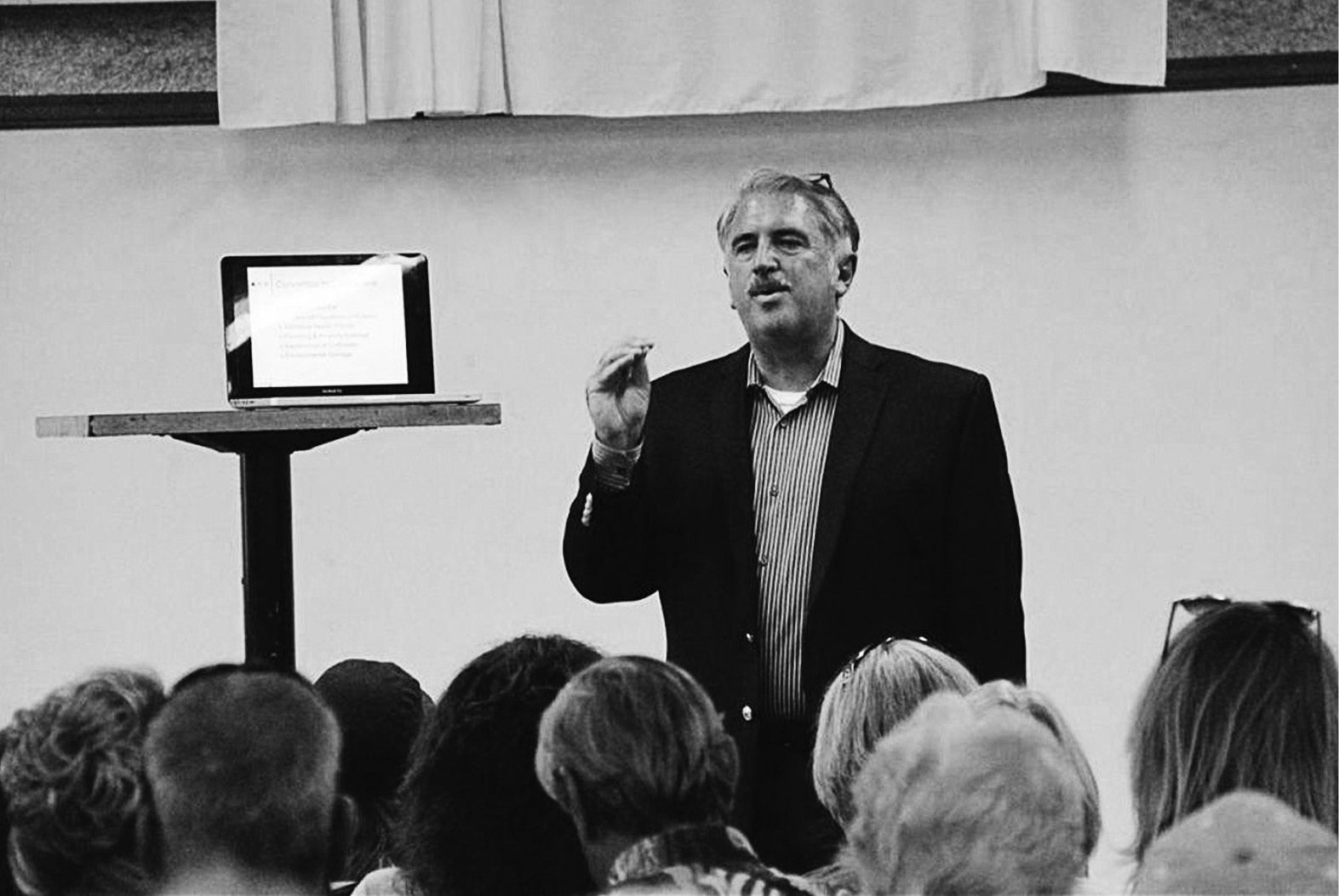
Bob Bowcock, Erin’s water advisor, whose more than thirty-six years of experience have helped communities achieve top water quality, speaking at a community meeting
In the absence of a peer-reviewed study, how can you say that the water is safe?
And that’s a BIG problem in America today.
It’s amazing to me how little most people really know about what’s going on. We’ve got failing laws and polluters still dumping with little reprimand. It’s time to understand how we got here so we can get clearer about what we want our future to look like.
BIRTHING OUR WATER LAWS & THE EPA
The Federal Water Pollution Control Act of 1948 was the first law created to address water pollution in this country, but it was virtually rewritten in 1972 and is now commonly referred to as the Clean Water Act (CWA). President Gerald Ford signed the act (which was proposed by Richard Nixon) into law on December 16, 1974, amid media reports and television documentaries warning that the quality of U.S. drinking water was declining.
Here’s some of what was written in a 1975 EPA press release:
Potential cancer-causing chemicals have been found in trace quantities in New Orleans’ and Pittsburgh’s drinking water. In Boston, lead from water supply pipes has been found in water drawn from the tap. Viral or bacteriological contamination of drinking water has resulted in communication of disease, often in smaller, more rural communities where treatment works are outdated or modern techniques are not available.
In other cities and towns, foul odors and tastes make the water unpalatable. While the overall quality of this nation’s drinking water is well above that supplied in any other country, professional waterworks operators, government, and citizens all agree that a much better job must be done in guarding our supplies.
That was in 1975! It was during the Republican administration of former president Richard Nixon that we officially created the Environmental Protection Agency (EPA), a fact that conservatives today may have forgotten. In fact, in Nixon’s 1970 State of the Union address he made remarks that today might characterize someone as a liberal environmentalist:
We can no longer afford to consider air and water common property, free to be abused by anyone without regard to the consequences. Instead, we should begin now to treat them as scarce resources, which we are no more free to contaminate than we are free to throw garbage into our neighbor’s yard.
This requires comprehensive new regulations. It also requires that, to the extent possible, the price of goods should be made to include the costs of producing and disposing of them without damage to the environment.
We have been too tolerant of our surroundings and too willing to leave it to others to clean up our environment. It is time for those who make massive demands on society to make some minimal demands on themselves. Each of us must resolve that each day he will leave his home, his property, the public places of the city or town a little cleaner, a little better, a little more pleasant for himself and those around him….
With the help of people we can do anything, and without their help, we can do nothing. In this spirit, together, we can reclaim our land for ours and generations to come.
Nixon made these remarks in response to years of widespread and visible pollution. He had bipartisan support for increasing measures to protect the environment, which is hard to imagine in today’s political climate. He set up an Environmental Quality Council along with a Citizens’ Advisory Committee on Environmental Quality. At the same time, Congress sent a bill to his desk called the National Environmental Policy Act (NEPA). The purpose of the act was
- to set a national policy to encourage “productive and enjoyable harmony between man and his environment.”
- to promote efforts to prevent or eliminate damage to the environment and biosphere and stimulate the health and welfare of man.
- to enrich our understanding of the ecological systems and natural resources.
The act called for the formation of a Council on Environmental Quality (CEQ) to offer expert advice on environmental matters to Nixon and to review newly enacted Environmental Impact Statements, a requirement for all federal agencies planning projects with major environmental effects. This led to the creation of the Environmental Protection Agency, a new federal regulatory agency whose purpose was to protect human health and the environment. The agency brought together tens of thousands of well-meaning, intelligent scientists, engineers, lawyers, and administrators.
Since its inception, the agency has worked with the best available science in its efforts to reduce environmental risks to public health and help enforce federal laws aimed to protect human health and the environment. When Congress writes environmental laws, the EPA implements them by working to ensure that all U.S. companies understand how to comply with national regulations and by following up on any violations.
The Clean Water Act was created to protect large bodies of water such as streams, rivers, and bays from being destroyed by things like sewage, biological and radioactive waste, and industrial and agricultural waste. We needed it then and we need it now.
Originally, it was a strong law that helped establish structure for regulating water pollution. It gave the EPA authority to set water quality standards and implement pollution control programs, funded the construction of more sewage treatment plants, and even recognized the need to address nonpoint source pollution from agricultural sources like fertilizers and pesticides along with urban runoff. The law called for polluters to disclose the toxins they dumped into waterways and gave regulators the power to go after offenders with fines or jail time.
Good laws can be written, but they can be hard to follow. If we are not setting standards for what’s safe, then anything goes. Since the 1970s, pollution has only increased, and violations of the law have continued to rise. Between 2004 and 2009, the Clean Water Act was violated more than half a million times, and most of the big polluters evaded any kind of punishment. As you can imagine, without much recourse the violations keep piling up.
But isn’t the law meant to protect us? How can these violations continue?
Sadly, the courts left us hanging for many years. Specifically, a Supreme Court ruling from 2006 was just confusing. In Rapanos v. United States, the Court failed to clearly define which waterways qualify for federal oversight. The ambiguity has played out for years and ultimately left too much legal room for disputes, allowing polluters to dump carcinogenic chemicals and more without much worry about federal enforcement.
In 2015, President Barack Obama (with help from the EPA and the U.S. Army Corps of Engineers) finalized the Clean Water Rule to help clear up the confusion about which bodies of water the federal government could regulate. It clarified that smaller and more isolated waters like streams and lands could fall under federal authority. However, the rule never really went into effect because of a lawsuit still in progress. The current Trump administration has vowed to promote clean water, while at the same time expressing a desire to roll back regulations and restrictions by narrowing the scope of the Clean Water Rule. In February 2017, the president signed an executive order instructing the EPA and the Army Corps of Engineers to review and rewrite the Clean Water Rule and reassess whether the rule is consistent with promoting economic growth and minimizing regulations. The order wasn’t enough to reverse the law. However, on October 22, 2019, the EPA and the Department of the Army published a final rule repealing the 2015 Clean Water Rule and restoring the prior regulatory text. As of this writing, the final rule is set to go into effect on December 23, 2019, but not without a fight from environmentalists. Jon Devine, director of federal water policy at the Natural Resources Defense Council said, “This unsubstantiated action is illegal and will certainly be challenged in court.”
The CWA does not directly address groundwater contamination, so the government also created the Safe Drinking Water Act (SDWA) in 1974 to look specifically at waters designed for drinking use, including aboveground and underground sources. This law governs our tap water and makes the EPA responsible for setting safety standards for what we drink. It also requires all owners or operators of public water systems to comply with these standards. A 1996 amendment introduced the idea of the EPA creating detailed risk and cost assessments and peer-reviewed science to help develop those standards. Again, this sounds like a great way to protect us, but it has some downfalls that have recently come to light.
First, you need to know that the SDWA gives the EPA authority to identify contaminants and regulate their levels in drinking water to protect public health. The agency sets regulatory limits for more than ninety contaminants.
The EPA has three criteria, according to the law, when determining what to regulate:
- a contaminant may have an adverse health effect on people
- a contaminant is known to occur or there is a high chance that the contaminant will occur in public water systems often enough and at levels of public health concern
- regulation of the contaminant will result in a meaningful opportunity for health risk reductions for people served by public water systems
If the EPA establishes a regulation for a contaminant, then public water systems need to comply with it. But if the EPA decides not to regulate a contaminant, then it may issue a health advisory, which is a non-enforceable federal limit that serves as technical guidance for federal, state, and local officials.
Let’s take a moment to get clear: we have enforceable and non-enforceable regulations.
Of the enforceable regulations, we have what are called maximum contaminant levels (MCLs). An MCL is the legal threshold limit on the amount of a substance allowed in public water systems according to the SDWA. The limit is usually expressed in a concentration of milligrams or micrograms per liter of water. These standards are set by the EPA for our drinking water quality. In order to set an MCL, the EPA first looks at what levels of a contaminant can be present with no adverse health issues. That level is called the maximum contaminant level goal, which is a non-enforceable goal. The MCL is set as close as possible to the goal, but this system is not perfect. Sometimes, the EPA will establish a treatment technique (TT) instead of an MCL, which is a procedure that must be followed to treat water for a contaminant. It’s enforceable and it’s not a perfect regulation either for reasons I’ll point out soon. Both MCLs and TTs are known as primary standards in EPA-speak.
Science takes time. The EPA sets standards based on the science available. Maybe they know studies are coming out soon saying that a contaminant could cause cancer, so they set a goal or a health advisory, not an MCL. In other cases, they may have animal studies but not human ones. They can’t set standards when they don’t know the full impact for us. They can’t create regulations without enough data. It’s a slow dance of completing the studies we need to create the right rules and regulations.
Both perfluorooctanoic acid (PFOA) and perfluorooctanesulfonic acid (PFOS) are byproducts of industry—chemicals used to make carpets, clothing, fabric protectors, paper packaging, and nonstick cookware. In 2009, the EPA published provisional health advisories for PFOA and PFOS based on the scientific evidence available at that time, which was considered “inconclusive.” In those days, the MCL was 400 parts per trillion (ppt) for PFOA and 200 ppt for PFOS.
By May 2016, the EPA had significantly lowered the “safe levels” for these pollutants in our water supply, based on standards that assume lifetime exposure rather than drinking these chemicals for only a few weeks or months. The new health advisory for PFOA and PFOS is 70 ppt. These new standards created instant water contamination crises for many cities and towns—fourteen systems exceeded the federal threshold for PFOA and forty systems were above the limit for PFOS.
This advisory came years and years after the agency was first alerted to PFOA contamination in the drinking water near DuPont’s Teflon plant in West Virginia, and more communities continue to come forward. People were exposed for years at this higher level before a new advisory was issued and it’s still not an enforceable one.
Information continues to surface that the companies that made these substances knew about their health impacts decades ago. In 2010, the Minnesota attorney general and the Minnesota Department of Natural Resources filed a $5 billion lawsuit against 3M, headquartered in Maplewood, for damages to the environment. The lawsuit claimed that 3M released its perfluorochemicals (PFOS and PFOA) into the nearby groundwater and in 2004 the chemicals were detected in the drinking water of sixty-seven thousand people in Lake Elmo, Oakdale, Woodbury, and Cottage Grove. While the company tried to argue that no health effect to humans had ever been proven, documents released in the case showed that 3M researchers knew these chemicals could bioaccumulate in fish and that the compounds were toxic. 3M settled the suit for $850 million in 2018, and afterward the Minnesota attorney general’s office released many internal documents including studies, memos, emails, and research reports, showing how much 3M really knew about these chemicals and their harm to both people and the environment.
The Agency for Toxic Substances and Disease Registry released a draft report in June 2018 discussing how people are exposed to these chemicals and the health risks they pose. The agency found that these chemicals are particularly damaging to vulnerable populations, such as infants and breastfeeding mothers, at levels lower than what the EPA deemed safe in the 2016 health advisory.
PFOA alone pollutes the blood of almost all Americans and can even pass from mother to unborn child in the womb. It builds up in our bodies, and studies have linked even tiny exposure to PFOA to kidney and testicular cancers, birth defects, damage to the immune system, heart and thyroid disease, complications during pregnancy, and other serious conditions.
That’s one example. These laws and regulatory agencies are meant to protect us, but the rules get muddy. Is it really too much to ask for clean, safe drinking water? We’ve got to find a way to get the laws and the science to sync up. I imagine it starts with more funding and more resources, and potentially taking a more cautious approach with so many of these chemicals. But it’s important to remember that we wouldn’t need so much regulation if polluters were cleaning up their own messes or not creating them in the first place.
Here’s another question for you: Do you know what the MCL for lead is in this country?
You know lead—a nervous-system toxin that according to our own regulatory agency (the EPA) has no safe level of exposure. Lead in drinking water can cause everything from stomach pains to permanent brain damage.
It’s a trick question. We don’t have an MCL, and that’s another big problem. We have a TT—a “treatment technique” regulation better known as the Lead and Copper Rule.
In Flint, Michigan, lead was leaching into the water supply for almost two years and public officials said everything was fine. Former Flint mayor Dayne Walling went as far as to drink the contaminated water on local TV to assure residents it was safe to drink. Since early 2019, thirteen state and local officials have been criminally charged in connection to the water disaster in Flint, some facing forty or more years in prison with more charges possible.
While school safety continues to be a huge issue in the aftermath of many mass shootings, school after school is finding toxic levels of lead in their water. More than 80 percent of New York City schools tested positive for elevated lead levels in April 2017, and the testing protocol came under fire after experts revealed that the city had been running water pipes the night before testing in 2016, a process called flushing that can make the water appear cleaner when tested. The problem has gotten so bad that states like California are starting to introduce legislation that would make it mandatory to test the drinking water for lead contamination in all school districts and colleges, which is a step in the right direction. I’m still wondering how that TT is going….
The bill’s author, assemblywoman Lorena Gonzalez Fletcher (D-San Diego), told a local radio station, “The lead crisis in Flint, Michigan, was a wake-up call. We’ve had this mentality of putting our heads in the sand and not really asking the questions we need to ask.”
That’s right, Lorena! It’s time to get our heads out of the sand and start holding our officials accountable.
The bill would require schools to shut off any source of drinking water if lead contamination is discovered, and to inform staff and parents about the potential exposure. Do you realize that we weren’t testing all these years or that government and industry employees were messing with the standards set for testing? Even low levels of lead in children’s blood can create permanent damage, including decreased IQ and hyperactivity.
Here’s another example of a law that protects industry, not people. The Energy Policy Act of 2005, which includes the infamous “Halliburton loophole,” has helped create the mess that we all know as fracking. Hydraulic fracturing, an advanced extraction method used by oil and gas companies, requires millions of gallons of water, sand, and chemicals to break apart rock and release gas. The law allows fracking companies to hide the contents of the toxic chemical solutions that they pump into the ground. Thanks to the Halliburton loophole, these fracking fluids are protected under law, and so doctors responding to health complaints can’t access the data showing what chemicals their patients have been exposed to.
How could such a law have been passed? Do you think money might have played a part? A big part. Corporations look at their bottom line first and foremost, hiring lobbyists and, as we’ll see, contriving science to get what they want done.
Millions of Americans live within one mile of a fracking well and studies have found that the toxic chemicals from fracking, natural gas processing sites, and storage facilities are present in high concentrations in the bodies of people living or working near these sites. Now tell me how those who wrote this law can sleep at night.
THE GROWING HEALTH CRISIS
It is devastating that in our quest to become a supergiant, industrialized country, everyday people have been secretly robbed of our most basic human right—our health. Huge corporations and government agencies have been missing the mark, making grievous mistakes, or in many cases intentionally polluting our water for their own profit. And, not surprisingly, it’s making millions of people sick.
Every community meeting that I attend about water turns into a meeting about the health crisis in a community, and that’s not okay.
The reason that I get invited to these meetings is because my name has become synonymous with hope. It’s become synonymous with fighting. And what many of you may not realize is that I never stopped. I became known for my work fighting for people in one town, but the fight is still going strong. The problems portrayed in that film have only gotten worse.
This isn’t my story; it’s everyone’s story.
Once you know the truth and can see it, the question becomes what are you going to do about it?
This is a book dedicated to telling the truth. And sadly, it’s a dirty truth. We can no longer take for granted the simple act of filling up a glass of clean water from our kitchen sink.
I want to help expose what’s going on in this country; help make you aware of these problems, which are not going to fix themselves; and show you how to take actions that can reverse water toxicity in your town, city, and region.
It is hard to believe, but the average American uses nearly a hundred gallons of water each day for everything from drinking to cooking to bathing. We all need access to clean water.
Yet for years, reports and testing across the country show that the drinking water is not as safe or sound as we would like. Our water treatment systems are antiquated and regularly in violation of the laws we’ve established, containing highly concentrated levels of arsenic, lead, bacteria, and more. Unsupervised industry pollution combined with failing infrastructure is a recipe for disaster. To add insult to injury, the more polluted the water becomes, the more chemicals we need to treat it.
Water treatment facilities throughout the country are changing the way they handle our drinking water at alarming rates. Many are switching from chlorine, the primary disinfectant used in drinking water systems for more than a hundred years, to an alternative disinfectant chloramine, which is a mixture of chlorine and ammonia. Some estimates show that about one in five Americans drink water disinfected with chloramine.
One of the main reasons for this switch is to provide increased protection from bacterial contamination and more. But using chloramines is literally one of the cheapest options available and it’s not as effective at controlling taste and odors in the water. Chlorine evaporates into the air relatively quickly, while chloramine is more stable and will last longer in the water system. Research has shown that chloramine causes deterioration of the municipal infrastructure thanks to changes in the water chemistry. In water systems that still use lead pipes or lead components, this reaction causes the lead and other heavy metals to leach into drinking water and out of faucets and showerheads. Instead of spending the money to fix old pipes and update our systems, money-crunched municipalities are adding chemicals like ammonia to drinking water as a quick fix, which only causes more issues.
We know contaminants are in the water, and we know these contaminants are linked to illnesses and health issues, especially cancer.
Here are some numbers for you to consider:
- 1,735,350. That’s the estimated number of new cases of cancer diagnosed in the United States in 2018.
- 15 million U.S. households (or 45 million people) obtain their drinking water from private wells, which are not covered by the EPA regulations that protect public drinking water systems. The presence of contaminants in this water can lead to health issues like gastrointestinal illness, reproductive issues, and neurological disorders.
- Half of all children in the U.S. are dealing with chronic health conditions. HALF. I can’t say all those health conditions are coming from the water, but it certainly is contributing.
- Legionella outbreaks have quadrupled in the last fifteen years. Legionella is a type of bacteria found naturally in freshwater like lakes and streams, but it has become more widespread in man-made water systems like showers, faucets, and plumbing systems. In 2016, about five thousand Americans were diagnosed with this severe (and sometimes fatal) form of pneumonia, called Legionnaire’s disease, which people contract from breathing small droplets of water contaminated with the bacteria. How do they contract it? When they are in the shower.
I’m working with hundreds of communities now (and thousands more are reporting in), and these numbers represent just a small sample of what we are dealing with.
If you think getting involved isn’t for you or that you’re not a leader, I’ve got some news for you. We’re all leaders. We can’t afford to sit on the sidelines anymore—none of us can. You, your kids, your grandkids, and your neighbors need a better world now and a legacy to leave for future generations.
If you can answer yes to any of the following questions, then you have what it takes to effectively lead yourself and others. It’s that simple.
- Did you get out of bed this morning and make breakfast?
- Did you drive your kids to school?
- Did you show up to a work meeting or organize a friend’s birthday party?
The problems we face today are too big for any one person, even me. I need your help. I want to leave a legacy for my grandchildren and yours. We can either use our power to turn the state of our water around or leave our grandchildren with polluted water everywhere and not a drop to drink.
This is your wake-up call, America. Are you ready to act?
PASSING THE TORCH
When I had the honor of carrying the Olympic flame through Pasadena, California, during the 2002 Salt Lake City torch relay, I was scared. No one had given me instructions and I wondered, what am I doing here? But when the person before me handed me that flame, I took off confidently. I suddenly knew exactly what to do. Every time I meet with community members who are organizing for cleaner water in their town, I see the same thing happen. I ask a few questions and offer a few suggestions, and then they take off running with their ideas for change. They know what works best in their community.
I’m counting on you now to do the same. Consider this book your invitation to get involved. I’m here to show you how, and once you’ve got the basics, you’ll have everything you need to save yourselves. It’s time to wake up the hero within you, and now is the time to start. Ultimately, it’s we, the people, who will save the day.

The 2002 Winter Olympics torch relay was a sixty-five-day run throughout the United States that led to the opening ceremony of the games in Salt Lake City, Utah. Erin carried the flame in Pasadena, California, on January 16.
UNDERSTANDING MEASUREMENTS
You will see me using different measurements throughout the book, such as parts per million (ppm), parts per billion (ppb), or parts per trillion (ppt), as they are the most common terms used to describe small amounts of substances found in water. They represent a measure of concentration. For example, a ppm means that in a million units of water exists one unit of that chemical. Scientists uses these measurements to show the amount of a toxic chemical found in a drinking water supply or body of water. It’s wild when you think about how a small dose of a chemical can inflict so much damage.
You can easily convert these numbers too, if needed.
1 ppm = 1,000 ppb = 1,000,000 ppt
DEFINING TOXIC SUBSTANCES & THEIR IMPACT
You will also see me use the terms toxic substance, toxic chemical, or poison throughout this book. Let’s define it as any substance that on ingestion, inhalation, absorption, or exposure within the body, even in relatively small amounts, can cause disorder or harm. Any chemical can be toxic or harmful under the right conditions. Many factors will impact how harmful a substance can be, including how much and by what means a person is exposed and how sensitive that person may be to a substance. Each person is different in terms of constitution, immunity, and more, which is why people display different health problems and issues from the same substance. Some people may not show any signs for years, or ever, after exposure to a toxin, while others may become sick more quickly.