
3. Connecting the Dots & Building a Map - Superman's Not Coming: Our National Water Emergency and What We the People Can Do About It
By Erin Brockovich
3. CONNECTING THE DOTS & BUILDING A MAP
Hinkley resident Roberta Walker is the original water warrior of her town and the first in a long line of women that I have come to know and admire in my work. She is the person responsible for putting her town on the map, but the people of Hinkley were not seeking fame. She and her husband, Greg, had bought their home on ten acres of land for $25,000 in 1976. Greg was raised in the 3,500-person town of Hinkley, and his parents lived across the street. They were raising their two daughters, kept horses, and had a swimming pool—a great relief during those dry, hot summers in Hinkley. Roberta could see Pacific Gas and Electric’s pumping station from her yard. PG&E was the largest employer in town, and she considered them a good neighbor.
In December 1987 during a routine environmental assessment, the company found that chromium had leaked into the town’s groundwater supply and reported the issue to the regional water board, which promptly ordered the utility company to clean it up. In the meantime, they offered Roberta and her family, along with many others who lived near the facility, bottled water. Most of the homes in Hinkley had private wells, which were drawing directly from the contaminated water supply. But Roberta and others in town didn’t question the company. She said officials from PG&E assured her on many occasions that there was nothing wrong with the water, telling her it was still safe to drink, cook, and bathe in it. She assumed that they were the experts and handling any problems with the water, and she was happy to receive the free bottled water.
But Roberta got more suspicious as the years went on. She started to play a game, asking for more and more water. Originally, the company delivered five gallons of bottled water to her home each week. She gradually asked them to increase the water to ten gallons a week to twenty gallons to thirty gallons. She eventually was receiving 150 bottles of water each week. At one point, she even asked the company if she could drain her fifteen-thousand-gallon pool and refill it with bottled water. The response? Sure, no problem.
The company started buying people’s homes in town in the early 1990s. When PG&E officials made an offer on Roberta’s home, she told them she was not interested and that she and her family didn’t want to leave their home. She says the company gave her different reasons for the buyout, at one point suggesting that they wanted to build a freeway through the property. They initially offered her $50,000—double what her house was worth. She said no and a week later they came back with an offer of $60,000. The bids kept coming and kept going up and up, but she and her husband repeatedly said no. Other neighbors started to take the offers and sell their homes. Roberta noticed that after PG&E bought a house, they would demolish the property and burn any trace of what was left there. It looked like the company was essentially evacuating the area. She and her husband just wanted to be left alone so she finally gave them an outrageous offer—a quarter of a million dollars—or ten times the property value of her home. She thought she would never hear from them again, but two weeks later they were ready to accept her offer.
Roberta told me she originally thought it was too much of a good thing—that the chromium-3 levels were too high, which was what PG&E had told the locals. You see, there are two types of chromium—3 and 6. Chromium-3 is a trace mineral that the body can use to regulate insulin activity; it can be found in multivitamins. Chromium-6 is toxic. Roberta discovered the difference when she checked out a book on chromium from the local library. She called PG&E to confirm what type of chromium was in her water. The man on the phone pulled up her record and said, “Chromium-6.” Roberta just about passed out when he told her this news. But she decided to do a little more research at the Lahontan Water Board. She said a little old lady worked at the front desk and allowed her to go to the back to search all the records. She couldn’t believe what she found—an entire file on her family with photos of her house. She saw files on her neighbors too. She said it was surreal and she couldn’t understand why she was being “spied on.” She started making copies of all the files and contacting lawyers. She had approached about 150 attorneys across the state who were too afraid to take on PG&E before she found Ed Masry and me. She’s even more fiery than me, which makes me smile, because in each town I visit I always find another woman who is willing to roll out her fieriness.
ACTION STEP
Get Curious: What’s Really Happening? What Can You Do?
Science is not just for experts. It’s a process anyone can engage in. You start by asking questions and then looking for the answers. An important part of science is making observations, and I think we all need to bring that kind of science back into our lives. Get curious! Notice what’s happening around you and don’t assume someone is taking care of it. If your water smells funny, that’s a valid observation. If it looks dirty, that’s another good observation. Roberta Walker noticed many issues in her community, as do many other people who write to me. They observe changes in their water or in their own health or that of their families, and those observations add up.
Every case I’ve seen starts with someone just like Roberta. It only takes one person who is willing to speak up and stand up. The Hinkley case began with Roberta and her family. Eight plaintiffs eventually grew to 650 people in Hinkley. Almost every community with a water problem has a community leader, and nine times out of ten, it’s a mom at the forefront of the fight. Mothers have the passion, the gumption, and the fortitude. They are the keepers of their backyards and their neighborhoods. Moms notice when their kids are acting strange or have weird health issues. They keep tabs on their kids, their friends, and their pets. I’ve seen so many of these women start with the title of mom, one of the hardest jobs on the planet, but come out of these cases with new titles like scientist, politician, and/or activist.
Environmental pollution exists all over the world. I’ve seen communities that have been exposed to varying levels of chemicals for prolonged periods of time. It takes time to see the effects of toxins on people. Many of these chemicals have latency periods of ten, twenty, or thirty-plus years. In some cases, like Flint, Michigan, it’s only a few months before the symptoms show up. But we can learn from each person who reports their story and start making changes so that others don’t have to suffer the same fate. We have enough evidence and information from the cases already out there to prevent more harm. The solution isn’t to leave more people exposed and we can’t wait for someone to come save us. We, the people, need to save ourselves.
We’ve got to look at the big picture. It’s not just one small community here or there with water problems. The problems are everywhere, and I know this because I am the one receiving the calls and emails from the people who feel the most hopeless and helpless. I respond to requests for help in contamination complaints in all fifty states and in other countries. These people make up whole communities that are witnessing firsthand the harmful health effects that exposure to toxic chemicals has on them and their families.
Part of the missing puzzle has been that there’s no agency on the ground going door-to-door talking to and identifying residents who may be affected by contamination in their area. As a result, many people have lost faith in the federal government to investigate what’s making people sick in their communities, and that’s why they turn to me. No one has access to the kind of general census information that I do, not the EPA, the FDA, or the CDC. They aren’t collecting it! Agencies don’t report to each other either. We have some state registries that track cancer, but even those numbers don’t do much. I have become a kind of reporting agency for suspected disease clusters and environmental issues around the country. Thousands of Americans contact me every month asking for help and telling me about unexplained diseases in their neighborhood or on their streets. So, I started to put together a map of people reaching out to me for help. This map demonstrates that we need to do a better job of listening and responding to these communities, including the ones I haven’t heard from. Without anyone to see the big picture, people are being left in the dark.
I often feel like Bill Paxton from that dramatic scene in Twister when they say the tornado is coming and he says, “It’s already here.” When you see issues in one community here or there, it looks bad. But when you line these communities up side by side and see the devastation, it’s a storm the likes of which we’ve never seen before. The catalyst for former marine biologist turned author Rachel Carson to write her groundbreaking book, Silent Spring, was a letter she received from a concerned citizen about the mass death of birds from DDT spraying. Let’s just say I’m getting that times ten thousand and then some. And just to quash any naysayers, I don’t think thousands upon thousands of people email me because they have nothing better to do with their time than send me fan mail or write me outlandish stories. People write to me when they have serious issues. They are frustrated and need help.
Let’s travel back to 2000 so you can see how the map developed. The movie was an instant hit with audiences and Julia Roberts won the Oscar, bringing even more attention to the film. I started getting stopped in bathrooms by people telling me that I looked like “Erin Brockovich.” I was not prepared for the landslide of communications that came my way. I was getting 100,000 emails a month from people telling me their health and environmental woes. Emails were coming in from 126 countries and territories, and they are still coming today. Water problems exist all over—in Australia, Canada, France, Ireland, Italy, Greece, South Africa, along with every state in our country. I eventually set up Brockovich.com, which is the hub of my work today. I don’t go out looking for problems to solve: communities come to me.
The first step in fixing any problem is realizing you have one, and these emails served as the first sign of trouble. One thing I learned from my friend Trevor Schaefer, who survived a brain cancer diagnosis at the age of thirteen, is that so many of us are walking around with blinders on. I’m not blaming anyone, because I know we all lead busy lives. As a single mom for years, I know how hectic life can get. But until a health tragedy happens to you or your family, you don’t see what’s going on. The emails were a big wake-up call, even for me.
At first, I would get emails and respond to them as best I could. But dealing with dyslexia makes me more of visual person, and in 2008 I decided to start mapping out these emails. For example, if I got an email from Duncan, Oklahoma, I would put a dot on a map. Paw Paw, Michigan: add a dot. Tyler, Texas: add a dot. Kingston, Tennessee: add a dot. Charleston, West Virginia: add a dot. Wedron, Illinois: add a dot. You get my point. Guess what happened after a while to my “arts and crafts” project? That map got covered in ink.
The map is more than just a visual tool; it also helps me to recognize patterns and search my inbox. I would get an email from someone in Indiana—a single mom whose child was dealing with glioblastoma, a very aggressive form of brain cancer. I would think, “That’s awful, but I’m not sure what to do with that.” Then I’d get another email from the same town a week later, and I’d think, “That’s odd. Didn’t I see someone last week reporting about that? And I’d go back and check and realize, Okay, now I have two.” A month could pass and then I’d get another email. And I’d have six people from the same town unbeknownst to each other. I started to plot each person’s story on the map. And a few months later I would look at that map and see I had three hundred dots. And that’s when I thought “Holy Toledo, WTF is going on?”
People wouldn’t just send me their stories, but they would send me pictures of their drinking water too. The colors coming out of those faucets ranged from yellow to green to black. Now, that’s when I would think, “Houston, we have a problem.” A big problem. It seriously frightened me, and I realized I needed to make this project accessible to more people, because 99 percent of Americans have no idea what’s really happening, including our elected officials. Most lawyers won’t touch these cases, and senators and representatives don’t generally respond either. People turn to me when they have no one else to turn to.
I thought, what could I do with this information? It’s a huge obligation to have so many people writing to me. I wanted to be responsible and do my best to help as many people as possible. So, I started plotting all the information on a map with the hope that as more people reported their stories, I could help shed light on these issues. I’ve worked to digitize the process so it’s not just me and a bunch of dots. We now have the technology to report these issues and get to the bottom of what’s really happening in real time with tons of data.
Today, the map runs on sophisticated software that anyone can access online at www.communityhealthbook.com. The software is called MIP (Mobile Investigation Platform) and it combines mobile data collection and geographic information system (GIS) capabilities for a much more user-friendly and efficient system. It’s great for a one-woman operation like me. Now, anyone who wants to report to me can join the Community Healthbook and log their environmental concerns. The software administrators review each report that comes in to keep it organized and on topic. I can use that data to help people in the community whether it’s by raising more awareness, starting litigation, or taking data to Congress. The map also enables people to find others reporting about the same issue—so communities can share resources and help one another too.
Community Healthbook launched in March 2017 and already has more than tens of thousands of people reporting. As more people add their information, we can start to see patterns. People can report information about what they think the source of contamination is—whether they’ve learned this from articles in their local paper or if they know about a chemical that got dumped from an old industrial site nearby. On the back end, the software is loaded with public data, containing relevant information such as EPA violations, water quality reports, and locations of toxic spills and fracking areas. Each person who reports helps to share a larger story of what’s happening in our country and how these pollutants are affecting all of us.
The concept of the map is similar to America’s Most Wanted. Remember that show? Instead of local law enforcement trying to find the location of a criminal, they could leverage the power of communities to help solve the crime, and I’d like to see a lot more of that happening when it comes to contamination. The map is built on a system that allows public health and federal officials to access the data in a protected way so that they can expeditiously investigate root causes and determine any further action. My hope is that this information can help us get new laws passed or get stricter enforcement of the laws already in place to protect those who are most vulnerable and in need of help.
Part of the problem with tracking diseases and clusters of disease is the law. For those who aren’t familiar with it, former president Bill Clinton signed H.R. 3013 in 1996, the Health Insurance Portability and Accountability Act (HIPAA), which was intended to protect patient privacy guidelines. But a sad side effect of HIPAA is that it may have prevented a national reporting database. We simply don’t know what we don’t know, and that’s one way we see water problems and pollution issues as isolated incidents rather than systemic failures. When people report to my map, the system is HIPAA-compliant. If someone reports their health issues on their own, we can track that data and then go back to them later and ask permission to use it, if for example an agency wanted to do a case study. Creating a big picture that helps connect the dots is a huge step forward in solving these issues on a larger scale.
I believe we are in an age of self-reporting. Right now, if people report to their state, it goes into an abyss. We’re not doing anything with the information, and I want to change that. We can use the self-reported data in Community Healthbook as general information to see the larger picture, or if we want to take an issue to Capitol Hill, I can email everyone in a community and ask permission to share their data, and let the experts take it from there.
I’ve learned the value and impact of the power of numbers firsthand by going out in communities and knocking on doors for many years, and more recently by posting on Facebook to connect with even more people. Numbers are important when it comes to these cases. In math, 1 + 1 = 2. But when it comes to principle and leverage, 1 + 1 = 1,000. Let me tell you what I mean by that. One or two people coming down with cancer is sad, but not necessarily cause for concern. But when it becomes hundreds or more people in a small town who are all dealing with a similar kind of cancer, it raises a big red flag. Every community that I’ve worked with that has been exposed to chromium-6, for example, exhibits similar health problems. The people experience chronic nosebleeds, headaches, colon, kidney, and heart issues, bone deterioration, cancers, infertility, and more.
I can almost spot the chemical by the symptoms people describe to me or by the color of the water. Bright green is always chromium-6, which is now found at unsafe levels in the drinking water of more than two-thirds of Americans. The dirty yellow and brown water images from Flint were from corroded pipes. When water stinks of bleach, it means that chemical compounds have built up in the water. These kinds of changes in your water are cause for concern. It’s time to take notice and speak up. Be aware, be informed, be vigilant, be proactive: that’s the best way to protect your health and welfare if you are uncertain about your water condition.
Ultimately, I keep doing this work because I am looking to find the truth. Plain and simple. Seeing is believing and that’s why my map is so important.
CANCER CLUSTERS & TREVOR’S LAW
Let’s look more closely at the issue of cancer clusters. In general, we see about 1,685,210 new cases of cancer each year in the U.S. alone, and each year almost 600,000 people will die from the disease. Communities throughout the country are experiencing unexpected increases in cancer. Here’s a small sample of emails about cancer and disease straight from my inbox that show the stories beyond the statistics:
From Tremont, Mississippi:
Everyone has cancer in our little town. I lost a brother and sister in their 40s and my husband lost two sisters in their 50s. My dad also died of pancreatic cancer. We live in an area where Weyerhaeuser Timber Company sprayed all the hardwood to kill it (for years) and planted pine trees. I would like to find out if all this spraying has caused the high cancer rates in our area.
From Melbourne, Florida:
I grew up in Sayreville, New Jersey. For unknown reasons, many people in my town have died from different forms of cancer ranging in all ages. Dupont Factory and Hercules were located in the town. It is a large cluster of cancer in Sayreville.
From Grand Junction, Colorado:
I am 4 years out from breast cancer treatment. I had stage 2 invasive ductal carcinoma. While lying awake at night thinking about the high number of cancer patients in Grand Junction, I realized that the lady I bought my house from in 1997 died from breast cancer in 2000. The lady that bought my house from me in 2003 is going through breast cancer now. There were old mill tailings that subdivisions, city structures, etc., are built on. I am concerned for the residents in this valley. We have the highest rate of cancer in the state of Colorado.
From Gilbert, Arizona:
My good friend has a rare, aggressive form of sarcoma. His condition was diagnosed a little over two years ago when he was turning 31. He endured 6 tours of Iraq and Afghanistan only to come home to be diagnosed with this disease. I asked his wife permission to contact you as there must be something linked to his childhood that may have contributed to this. He grew up in Bolingbrook, Illinois. Interestingly, 5 other people that he grew up with had aggressive forms of cancer in the same age group and he is the only one still alive. I know you have a lot more resources and may be able to shed some light on what may be causing it. There could be a larger number of people affected that may be unknown. I can help get you in touch with people to provide more details.
From Waycross, Georgia:
This isn’t my story, but a story about our community. We live in Southeast Georgia, where cancer rates are high. It’s gotten so bad that my family and those around us are afraid to drink the water because we don’t know what is causing the cancer. It’s finally making local news, but as you probably know, the government is slow to react. From what I understand, the CDC actually used a local group’s research as their own, suggesting that individuals stop smoking. My husband suggested I write to you. He has been more affected by cancer than I have. His nephew (age 15) and grandmother both died of cancer. His sister and sister-in-law have both survived cancer. Just use Google and search “Waycross Cancer” to read about our community issues. Thanks for your time and your contribution to helping those who don’t know how.
From Clinton, Maryland:
I had a son who died at the age of 21 of colorectal cancer. I live in a cul-de-sac where there are 6 houses. Four of the 6 houses have a member of the family that got cancer and 3 of them including my son has died. The other two were older gentlemen and the other survivor is a man in his 50s. I think there has to be a connection. I just don’t know where to start looking. My son was a healthy active athlete that played basketball in high school and college, watched what he ate, and exercised constantly. For him to die from cancer is just inconceivable. Several others on a cross street to mine have also died of cancer that I know about, but there could be more that I am not aware of.
From Newburgh, Indiana:
I am a 63-year-old female. I was diagnosed with the Sarcoidosis Disease in 1998. I lived in a rural area named Lyles Station Indiana for many years. This area is very close to the power plant located in Mt. Carmel, Illinois. What concerns me is that the population is very small and there are at least 4 other people that I personally know who have the same diagnosis. One passed away a few years ago due to complications. Since this is such a rare disease it concerns me that something may be causing this condition. I contacted the CDC and got no response. I also know you have some concerns about the quality of drinking water in the Evansville, Indiana area. This is the area I have lived and worked in for the past 15-plus years. Again, I am close to the Alcoa Plant in Newburgh, Indiana. I have followed your story, so I know if there is a reason for me to be concerned, you will know how to assist me.
These are real people asking good questions and making good observations. It’s time for someone to provide them with answers.
When it comes to a cancer, it’s easy to say that genetics or lifestyle play a part, but then we have the issue of children. Cancer is the second leading cause of death among children, exceeded only by accidents. They don’t smoke, drink alcohol, or work stressful jobs. Yet, forty-six American children are diagnosed daily with cancers unrelated to genetics or family history. We know that children can be more vulnerable to chemical toxins than adults because they have both faster metabolisms and less mature immune systems. These numbers say to me that we need more research to understand what’s really going on.
One person who cares very deeply about this issue is my friend Trevor from Boise, Idaho. In 2002, at the age of thirteen, he was diagnosed with medulloblastoma, a highly malignant form of brain cancer. And Trevor was not the only one. Despite living in a small, idyllic mountain town, four other kids were diagnosed with the same disease the same year as Trevor, and the town had an abnormally high number of cancer cases both prior to and after these diagnoses. His mom, Charlie Smith, was concerned and took this information to the Cancer Data Registry, but officials told her that even if her data proved to be true the town was too small to warrant a cancer cluster study. They were not statistically significant.
Trevor did not let that stop him. Not only did he endure invasive tests, an eight-hour surgery to remove a golf-ball-sized tumor from his brain, and fourteen months of radiation and chemotherapy, but he made a promise that if he survived, he would dedicate his time to helping other children with cancer. He turned to politics and took his promise to Washington, D.C. In 2011, the Strengthening Protections for Children and Communities from Disease Clusters Act, also known as Trevor’s Law, was introduced by Senator Barbara Boxer (D-CA) and co-sponsored by Senator Mike Crapo (R-ID). This bipartisan bill was created to help communities determine a connection between “clusters” of cancer, birth defects, and other diseases, and contaminants in the surrounding environment.
In 2013, I joined Trevor on Capitol Hill to testify for his bill that would require the federal government to document and track childhood and adult cancer clusters, not just in Idaho but also across the country.
Here’s part of my testimony:
As an advocate for the past twenty years, I have reached an undeniable conclusion: there are simply too many cancers in this country and not enough answers. And that’s all these communities are trying to do—get answers to the most basic questions: why is my son, who was perfectly healthy just months ago, now sick with leukemia? Why does my daughter have two brain tumors at the age of six? And why is the same thing happening to my neighbors’ kids? Mothers and fathers ask me these questions by the hundreds every week.
I am not here to play scientist, nor am I here to sling accusations or assign blame. This is not a partisan issue. Gathering the information necessary to take action protective of human health is a long and daunting task, and when it comes to the health of our children, we cannot afford to jump to conclusions. But it’s time for us to stop turning away from these communities. How many childhood brain cancers is enough for us to start getting serious about investigating the potential causes of these illnesses? We need to be listening to community members’ concerns when they raise their hand and say something is not right in their neighborhood.
You, members of this committee, carry the voice and the will of those who elected you to serve this country. I can tell you those voices are crying out for help. Some of your constituents are fearful, others are frustrated; they all need your help to stay united as a community that is trying to find answers.
This is the issue of our time—whether it is pollution in our water, our air, or products we use every day. The government must play a stronger, better role in helping all Americans. I understand this might not be a popular position in some circles but most of my life has been about taking unpopular stands against big polluters so I’m okay with that. Madam Chairman, Senator Crapo, I believe that your legislation “The Strengthening Protection for Children and Communities from Disease Clusters Act” will help Americans who desperately need it. And the bipartisan nature of Trevor’s Law will send a very valuable message that clean air and clean water and healthy communities are not political issues—they are human issues. American issues. I will also remind the public that it was a Republican president—President Nixon—who created the Environmental Protection Agency.
It’s also important that the federal government doesn’t just come in, run some tests, and leave. Make no mistake—the federal government must play a key role in identifying and responding to disease clusters because federal agencies have the research, response, and enforcement capacity that states and localities often don’t. But we can’t lose sight of the most important part of any effort to identify and respond to a possible disease cluster—the people themselves.
I am an advocate for awareness and a person’s right to know. Oftentimes, we don’t think about or understand what is happening to someone else until it affects us personally. Cancer or some chronic disease has touched all of us. And disease does not recognize our political party affiliation. I am proud to support this bill and am proud that it has bipartisan support. The time has come for the federal government to step up and provide the expertise and resources only it can.
Trevor’s Law passed in 2016 as part of a Toxic Substances Control Act (TSCA) reform bill and is exactly a testament to what one person can do. Trevor and his mom have been determined and committed to this amazing health law that has the potential to impact so many people. The law calls directly on the U.S. secretary of Health and Human Services to develop criteria to monitor, track, and respond to instances of potential cancer clusters in the United States, creating a national registry, which can study and document where clusters exist, why they exist, and who might be affected by them. It will work to improve communication and data sharing between local, state, and federal governments. But like most good laws on the books to protect our health, this one is still in limbo and has yet to be implemented.
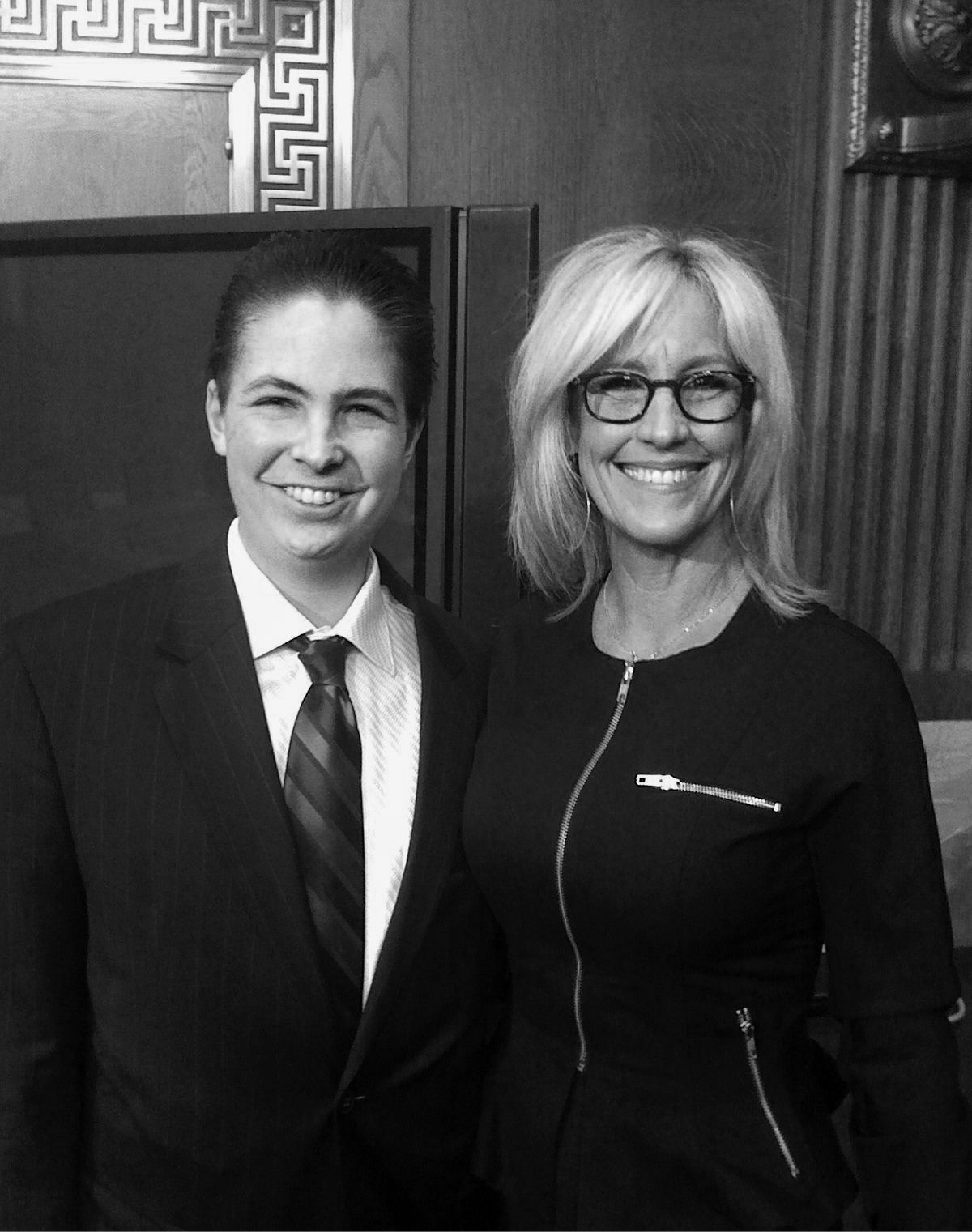
Trevor Schaefer survived a brain cancer diagnosis at the age of thirteen. Erin with Trevor on Capitol Hill in 2013 to testify for his bill requiring the federal government to document and track childhood and adult cancer clusters throughout the country
“If we don’t show up for work, we get fired, but in Washington, it’s just business as usual,” Trevor said to me in a recent conversation. “If they don’t act on a bill for the betterment of this country and our children, nothing happens. I think it comes down to accountability. What happens to anyone in Washington if they don’t follow through? Nothing. How do we change that? We need to hold them accountable.”
Thankfully, Trevor is still on the case. He created a foundation, Trevor’s Trek Foundation, dedicated to promoting the awareness of childhood cancer and cancer clusters that exist in America’s communities as well as supporting the implementation of Trevor’s Law through advocacy, collaboration, and coordination. Right now, they have a bigger role to play than he originally intended—mostly to stay on top of the federal government to do their job. He’s still in constant communication with his home-state senator, Mike Crapo, working to get a coordinator appointed within Health and Human Services for Trevor’s Law. He continues at the grassroots level to keep building awareness and researching these issues. If a young boy can beat cancer, stand up and use his voice, and keep fighting, so can you.
WANT TO GET INVOLVED?
Community Healthbook
Share your story! Go to the Community Healthbook website, www.communityhealthbook.com, and start an account. Once registered, you can report an issue by choosing a questionnaire and topic that best describes the issues you’re facing and provide the details. We will review your submission and learn more about your circumstances. If further investigation is needed, I may even visit you to see what’s happening in your neighborhood. You can visit the Community Healthbook as often as needed to report an issue, see what’s happening in your community, or participate in new questionnaires.
Trevor’s Trek Foundation
Go to the Trevor’s Trek Foundation website, www.trevorstrek.org, to donate your time or resources to this worthy cause. Ask your local officials how they are tracking cancer cases and demand that more resources go to research and understanding how toxic pollutants are impacting our children.