
2. The Entrepreneurial Decade - Capitalism with Chinese Characteristics: Entrepreneurship and the State
By Yasheng Huang
Chapter 2: The Entrepreneurial Decade
In 1982, there was a commercial sensation in Shanghai – sunflower seeds. Sunflower seeds, stir-fried and salted, are one of the most popular snack foods in China. People munch on them when watching TV or playing cards, not unlike the way potato chips are consumed in the United States. But this sensation in Shanghai had a distinct flavor as well as a distinct brand-name – Idiot's Seeds. Idiot's Seeds was the invention of Nian Guangjiu, a farmer in the agricultural and impoverished province of Anhui. Nian held a rather low opinion of himself. He thought that he was good at nothing but making sunflower seeds, hence the brand-name.1
Nian's sunflower seeds caught on, not just in Shanghai but also nationwide. This is a fascinating story about how a humble rural entrepreneur succeeded within a few years of the reforms. First, Mr. Nian came up with a brand-name. Whether conscious or not, he introduced the most rudimentary idea of marketing to China. Until Mr. Nian, sunflower seeds had been viewed as an undifferentiated product. The labeling in Chinese stores was by product – sunflower seeds, peanuts, walnuts, and so forth. There was no recognition that the same products might have been made differently. (Nian's brand-name was not always helpful. In 1987, he was considering setting up a scholarship fund at a local school. The teachers balked at the idea of awarding students with an “Idiot's scholarship.”)
Second, Mr. Nian was a poor farmer in what was a poor province at the time. Anhui province in 1980 had a per capita GDP of 291 yuan, ranking 27th in the country out of 29 provinces. The province was heavily agricultural, and 88 percent of its population resided in the rural areas.2 Yet, with a good product, Mr. Nian was able to access the state-controlled distribution system. His Idiot's Seeds were sold in many major cities, including Beijing, Shanghai, and Dalian.
Third, the scale of Mr. Nian's operations was phenomenal. He hired hundreds of workers at a time when private-sector employment was supposedly capped at seven workers per firm. In 1981, he started with four employees and in 1983 he had 103. By 1986, his business was netting 1 million yuan in profits. To put this number in perspective, in 1985, the average profit per SOE – the largest of the businesses in the country at the time – was only 1.1 million yuan.3 There is another way to illustrate just how substantial Mr. Nian's operations were in 1986: 1 million yuan in 1986 is roughly equivalent to 3.14 million yuan in 2003. We have profit data on about 3,000 large private-sector firms as of 2003 from a private-sector survey conducted in 2004. (The survey is hereafter referred to as PSS2004. The Appendix to this chapter contains more details about PSS2004.) With 3.14 million yuan in profit, Mr. Nian's business would have been considered a corporate giant in 2003 and it would have been larger than 90 percent of the firms covered in the survey. (In PSS2004, a firm in the 90th percentile had a profit of 2.45 million yuan.) Considering that 1986 was only a few years into the reform decade and that China in 1986 was much poorer than China in 2003, this is a remarkable achievement indeed.
Mr. Nian was not alone. The idea of this chapter is to present a perspective on the China of the 1980s that is largely missing in economic research on China. China in the 1980s witnessed an explosion of indigenous, completely private entrepreneurship, but almost all of this entrepreneurship occurred in the rural areas of the country (which might explain its relative obscurity in scholarly research). Although it was a largely rural phenomenon, entrepreneurship in the 1980s was not an agricultural phenomenon. This is an important insight. As the case of Mr. Nian shows, the entrepreneurs were rural residents but they engaged in industrial production and service provision activities. This has important implications for how China managed to rapidly reduce poverty and how the country achieved a virtuous cycle between economic growth and social performance in the 1980s.
The decade of the 1980s deserves far more analytical attention than it has received. Economic research on China is heavily colored by the developments in the 1990s. This is because the Chinese economy became sufficiently important in the 1990s to attract considerable analytical attention. Conducting in-depth economic research was feasible in the 1990s. With better and more data, we know vastly more about China in the 1990s than we do about China in the 1980s. Furthermore, our views of the 1980s are often based on inferences rather than on direct empirical observations. Here, the gradualist framework – that China moved to a market economy progressively and steadily over time – exerted a powerful influence on how scholars framed the issue. Whatever progress China was supposed to have made during the reform era, there are still substantial distortions in the economy today. If so, it must be the case, as the gradualist reasoning would suggest, that the distortions in the 1980s were more severe.
In this chapter and the following chapter, I offer a direct and detailed account of one of the most remarkable phenomena in Chinese economic history – the rapid rise of rural entrepreneurship in the 1980s. In the 1980s, small and impoverished rural entrepreneurs such as Mr. Nian started businesses easily, operated their stalls in urban areas with freedom, accessed bank credits, and had growing confidence in the security of their assets. There was also financial liberalization and even some privatization. I return to this issue in greater detail in the next chapter, but suffice it to say here that some of the rural reforms in the 1980s were quite far-reaching and that in the 1990s there was a reversal of some of the key elements of the reforms that had allowed for a flourishing of rural entrepreneurship in the 1980s.
Another aspect of China of the 1980s is worth mentioning. Private entrepreneurship was developing most vibrantly in the poorest and the most agricultural regions of the country. Yes, the entrepreneurship of the 1980s was exclusively a rural phenomenon, but keep in mind that China in the 1980s was a predominantly rural society, with 80 percent of the population living in the rural areas. Thus, private entrepreneurship had a huge impact on the largest segment and the poorest of the population.
Although the agricultural success is widely believed to have been the result of private-sector development, such as the household contract responsibility system, the consensus among academics is that township and village governments spearheaded China's massive rural industrialization. This is the famous TVE phenomenon. I would argue that this is an incomplete perspective. I show in this chapter that purely private entrepreneurship contributed substantially to the nonagricultural success of rural China in the 1980s. One indication of this is the increasing importance of nonagricultural business income for Chinese rural households. Business income refers to the profits derived from owning and operating a business. It corresponds roughly to the returns from entrepreneurship. In the 1980s, business income was the fastest growing segment of rural household income. As a share of total rural household income, business income rose from 8.1 percent in 1983 to 14.9 percent in 1988, a level that was exceeded only in 1998 and 2000. Rural entrepreneurship thus played an enormous role in contributing to the rapid income gains during the 1980s.
There are two important analytical reasons for why we should get the story right about the 1980s. One is that the gradualist view of the Chinese reforms leads to the logical conclusion that the reforms in the 1990s were more radical. This assumption tilts research attention to those policy developments that were the hallmarks of the 1990s. In the 1990s, China experienced a rapid growth in FDI and international trade. In part because globalization fits well with mainstream economics, many came to view globalization as a critical factor in China's broad economic success. World Bank economists are the most vocal in touting the benefits of globalization. David Dollar, the director of development policy for the World Bank, has referred to China as a hugely successful globalization story. The World Bank cited from official Chinese sources that the number of rural poor in China fell from 250 million in 1978 to 34 million in 1999.4
As in all aspects of the Chinese economy, details matter. The two data points cited by the Bank convey the impression that poverty reduction was a smooth, continuous process between 1978 and 1999. Nothing is further from the truth. Let's look at the same official data used by David Dollar.5 In 1978, the number of rural poor stood at 250 million (as defined by the Chinese poverty line) but, in the first 10 years of reforms, this number already declined to 96 million in 1988. The poverty headcount declined by 154 million. In the next 10 years of reforms from 1989 to 1999, the poverty headcount declined by only 62 million. This was a fraction of what China achieved in the 1980s.
One may argue that poverty reduction in the 1980s was faster because it was easier. It was a case of “picking the lowest-hanging fruits,” one may say. In the 1990s, by contrast, the residual poverty was entrenched and permanent. A standard explanation is that the currently poor people are ethnic minorities living in mountainous regions. The poverty in China now is structural and therefore persistent. It is very resistant to the effects of policies and of economic growth.
There is some truth to this structural explanation but it cannot be the entire truth. One indication is that the Chinese poverty figures are highly sensitive to the definition of poverty line. At the poverty line of US$1 per day, in 2002, 7 percent of the Chinese population lived in absolute poverty, but when the poverty line was redrawn at US$2 a day, this fraction increased to 45 percent (World Bank 2003). The ethnic and geographic explanation is unable to explain this high level and wide spread of poverty incidence. Also, the structural explanation oddly assumes that it was easier to tackle poverty in the 1980s than in the 1990s. In the 1990s, the Chinese government commanded substantially more resources than in the 1980s.
I return to this question in more detail in Chapters 3 and 5 but suffice it to mention here that the policy model of the 1990s may have contributed to the persistent poverty in rural China. The essence of the policy model of the 1990s was to tax the poorer rural China to benefit the richer urban China and to restrict rather than expand the opportunities for small-scale and humble entrepreneurs like Mr. Nian. There is another facet about the poverty reduction record of the 1990s – it was partially a result of statistical manipulations. In 1998, 1999, and again in 2002, the Chinese authorities lowered the official poverty line, making it easier for a statistical reduction of poverty. In 1997, the rural poverty line was drawn at 640 yuan per person; by 2002, it was 627 yuan per person (NBS 2007b). (I return to this issue in Chapter 5 but let me note here that during the same period, the Chinese state increased the salaries of its civil servants five times, each time by a double-digit rate.)
The record of FDI and globalization in poverty reduction does not even come close to matching the record of rural reforms.6 This is not a criticism of globalization but rather a matter of framing the issue with the right perspective. Globalization is the story of the 1990s, not of the 1980s. In the 1980s, FDI and international trade were minuscule. In 1988, China received just 3 billion dollars in FDI, half of what India – widely viewed as an FDI laggard – receives today. And yet, China's record in poverty reduction in the 1980s is substantially more impressive than its record in the 1990s. Other social indicators, such as literacy performance, also show the 1990s in a poor light. By loosely referring to China's poverty reduction during the entire reform era, the World Bank economists vastly understate the achievements of the 1980s and overstate the achievements of the 1990s by the same margin. They also exaggerate the effects of FDI and trade on poverty reduction and completely neglect the role of indigenous private entrepreneurship.
The second analytical reason to get the story right about the 1980s is to resolve what can be described as the “China puzzle.” The “China puzzle” is that China's economic development does not seem to fit with a standard economic framework. Qian (1999) succinctly summarizes the sense of this puzzle: “[T]he Chinese path of reform and its associated rapid growth seemed to defy the necessity part of the conventional wisdom: Although China has adopted many of the policies advocated by economists, such as being open to trade and foreign investment and macroeconomic stability, violations of the standard policy prescriptions are also striking.” The World Bank's 1996 annual report – devoted to economic transition – proposes a number of analytical categories, such as economic liberalization, private-sector development, and political transition, for all transition economies. Unable to categorize China, the report placed China in a geographic grouping. China was a part of the “East Asian group” along with Vietnam, and the report made no attempt to explicitly benchmark China against the various liberalization measures.7
There is no China puzzle at all. The true China miracle is a classic and conventional one – the country grew because of private-sector dynamism, a relatively supporting financial environment, and increasing property rights security. These are the three institutional conditions that mainstream economists hold to be critical to economic growth, as summarized in Chapter 1. (The present chapter focuses on private ownership and security of property rights. I take on the third institution – finance – in the next chapter.) In the 1980s, directional liberalism reached far and wide. I formulated this view of the 1980s based on direct, empirical, and – as much as possible – systematic observations of the 1980s.
This chapter begins with an account of what I call the true China miracle – the vibrant rural entrepreneurship and its virtuous effect in the 1980s. In the second section, I analyze an institution that has fascinated and puzzled many Western social scientists – the township and village enterprises (TVEs). TVEs are widely believed to be a public-sector institution. Not so. On the basis of detailed archival research of government documents and contemporaneous accounts, I show that the vast majority of TVEs in the 1980s were completely private. I close with a concluding section on a few broad implications of this new perspective on the 1980s.
1 The True China Miracle
As is clear to everyone, the spontaneous forces of capitalism have been steadily growing in the countryside in recent years, with new rich peasants springing up everywhere and many well-to-do middle class peasants striving to become rich peasants.
– Mao Zedong, 1955
The countryside has a vast number of skillful craftsmen and capable producers, educated youth and retired soldiers. Their expertise should be put to full use and [we] should support their efforts to establish technical-service organizations and allow any rural economic organizations to recruit them into their workforce.…
– Central Committee of the Chinese Communist Party – (Central Committee 1992 <1983>, p. 176)
Mao Zedong and the leadership of the 1980s had something in common: They both recognized the huge entrepreneurial potential of China's rural residents. Mao went to great lengths – through the commune system and the Great Leap Forward – to destroy those potentials because he understood the political ramifications of unleashing them. In 1955, as quoted previously, Mao recognized two fundamental attributes of the Chinese peasantry. One is that Chinese peasants are very entrepreneurial – “spontaneous” – and that they stand ready to be providers of capital and business capabilities as business owners and operators. The second attribute is that Chinese peasants are very motivated – “many well-to-do middle class peasants striving to become rich peasants.”
In a political system laden with urban biases, the Chinese reformers in the 1980s recognized these same potentials and created a policy environment to permit and to encourage their realization. The result was that the 1980s was a decade of vibrant, grassroots, bottom-up entrepreneurship in China's massive countryside.
The speed of entrepreneurial development was breathtaking. Because the Chinese statistical system in the early 1980s was not well equipped to track the output production in the private sector, we instead use tax data as an indicator. According to the Ministry of Finance (1989, pp. 23–24), the tax receipts from self-employment businesses – most of which were rural – increased from 884 million yuan in 1981 to 3.5 billion yuan in 1982, a more than fourfold increase in just one year.
In the 1980s, Chinese peasants experienced the most rapid income gains in history. Per capita rural income between 1978 and 1981 grew at a real rate of 11.4 percent; the urban/rural ratio of the purchase of consumer goods fell from 10 to 1 in 1978 to 6 to 1 in 1981. According to a rural survey, rural per capita income more than doubled between 1978 and 1984, and real rural per capita consumption increased by 51 percent between 1978 and 1983 (Riskin 1987, p. 292). Rural poverty also declined dramatically in the 1980s, as indicated before.
China scholars have researched this phenomenon extensively. The consensus view is that the rural reforms accounted for the largest segment of the income gains. Administrative measures, such as price increases, played a smaller role. According to one analysis, one-fifth of the increase was due to price increases; the rest, by implication, came from improving allocative efficiencies (Riskin 1987, p. 293). These include improving labor productivities, as evidenced by the fast growth of per capita production of food grains and edible oil, and income diversification opportunities to become involved in nonagricultural activities. Let me add another factor – the flourishing of rural entrepreneurship.
Chinese capitalism is heavily rural in origin. The reasons are complex but one hypothesis is that central planning was always weaker in the countryside than it was in the cities. As I show in this section, even at the height of the Cultural Revolution, rural residents engaged in private commerce and industry in ways that would have been unimaginable in the cities. This may explain the explosion of rural entrepreneurship just a few years into the reform era as the policy and business environment became more permissive. Rural entrepreneurship was also virtuous because it emerged first and developed fastest in the poorer regions of China.
1.1 The Rural Origins of Chinese Capitalism
Today, we can still observe one lasting legacy of the rural origins of Chinese capitalism: Many of the largest manufacturing private-sector firms hail from the backward, predominantly agricultural provinces of China. This is a striking empirical regularity. Kelon Group, until 2005 China's largest refrigerator maker, was founded by Wang Guoduan, an entrepreneur in rural Shunde county in southern Guangdong province. Huanyuan, China's largest air-conditioner maker, is based in the agricultural province of Hunan. China's first automobile exports will not come from Shanghai but more likely from the agricultural hinterland of Anhui province where Chery is located. The Hope Group is even more interesting. The four brothers who started a business in quail eggs abandoned their urban residency and founded their company in a rural part of Sichuan province. Today, it is China's largest agribusiness firm.
Very few of China's successful corporate giants in the competitive manufacturing industries are based in the metropolitan, industrial centers such as Beijing, Shanghai, and Tianjin. (Firms in politically connected sectors such as real estate are another story altogether.) This is puzzling. One would have thought that these urban centers possessed ample and propitious conditions for the growth and development of businesses. They have human capital, agglomeration economics, export market linkages, and high incomes. But none comes close to producing the microeconomic success stories that have come out of some of the initially poorer agricultural provinces. The reason is that the economic policies in rural China were far more liberal than those in urban China.
Zhejiang province is widely acknowledged to be a huge economic success. The province, located south of Shanghai, is home to half of China's largest private-sector firms. It is also rich, especially as measured in asset terms. In 2004, an average urban Zhejiang resident earned an income from owning stocks and bank deposits that was multiples of what an average Shanghai resident earned. But what is often lost in the Zhejiang story is that the province was poor and deeply agrarian in the 1970s. It was ranked No. 13 in per capita GDP in the late 1970s. In 1978, 32.2 million out of a population of 37.5 million resided in the rural areas.
Wenzhou region of Zhejiang province is typical of the province. Today, Wenzhou is the bastion of Chinese capitalism. Its businesses dominate European markets in garments, shirts, and cigarette lighters and the region has begun to venture into electronics and petrochemical products. Wealthy individuals from Wenzhou export a massive amount of capital to the rest of the country, making or breaking real estate markets in Shanghai, Beijing, and Guangzhou. In the entire country, only in Wenzhou have the highways and airports been financed by private capital. All of this private wealth was built on a rural foundation. Of 5.6 million Wenzhou residents, only 550,980 had an urban registration in 1978, just below 10 percent. The region was poor and inconvenienced by high mountains on three sides and ocean on the fourth. For years, Wenzhou lacked basic transportation infrastructures such as a seaport, an airport, and highways to nearby locations.
A universally accepted definition of entrepreneurship is self-employment business. Self-employment businesses are single proprietorships, and in China they are formally known as individual businesses (geti hu) or individual economy entities (geti jingji) in the Chinese statistical reporting system. By this measure, rural China in the 1980s was extraordinarily entrepreneurial.
We go first to the business registration data maintained by the Bureau of Industry and Commerce Administration (BICA). We then go to two large-scale surveys on private businesses conducted in the early 1990s. The first is a self-employment business survey conducted in 1991 (SEBS1991). Although it was conducted in 1991, it was sufficiently close to the decade of the 1980s to reflect the dynamics of that era. Also, the survey includes retrospective questions about the 1980s. Altogether, 13,259 self-employment business people participated in SEBS1991. It is the only large-scale survey that I know of that was conducted on these self-employment businesses.
We then supplement our findings from a private-sector survey conducted in 1993 (PSS1993). This survey was administered on the larger and more established private-sector firms. These are known formally as the private-run firms in the Chinese system (siying qiye). The formal difference between the self-employment businesses and the private-run firms is that the former employ seven or fewer than seven workers, whereas the latter employ more than seven. PSS1993 sampled 1,421 private-sector firms. Like SEBS1991, PSS1993 also contains retrospective questions about the 1980s. We use these questions to gauge the situation prevailing in the 1980s. The Appendix to this chapter contains more details on these two surveys.
According to the BICA registration data, in 1981 there were comparable numbers of registered rural and urban self-employment establishments: 868,000 in the urban areas and 961,000 in the rural areas.8 Thereafter, the rural number increased rapidly. By 1986, there were 9.2 million registered rural self-employment businesses as compared with 2.9 million urban ones, a rural/urban ratio of 3.2. By 1988, the rural self-employment businesses numbered 10.7 million compared with 3.8 million in the urban areas (a ratio of 2.8). In terms of employment size, the ratios were even more skewed in favor of the rural areas. The rural-to-urban employment ratios for these self-employment businesses were 3.6 in 1986 and 4.5 in 1988.
But is this surprising? After all, China was predominantly rural in the 1980s and there should have been more rural entrepreneurs. However, a more meaningful fact is that the rural entrepreneurs in the 1980s no longer operated in the agricultural sector, not that the absolute number of rural entrepreneurs was large. In the BICA registration data for 1988, commerce claimed the largest share, about 50 percent, followed by industry (13 percent). Altogether, 17 million people were engaged in these nonagricultural activities. This is not a trivial number; it is about 5 percent of China's very large agricultural workforce. There is nothing automatic or natural about such an arrangement. Rural residents did not have an automatic advantage over urban residents in terms of expertise or market access in these nonagricultural activities.
SEBS1991 and PSS1993 also confirm the heavily rural origins of Chinese capitalism. One advantage of these two surveys over the BICA registration data is that we have information about whether the rural entrepreneurs operated in cities or in rural areas. The BICA data tell us only where the business was registered, not the location of its operations. Arguably, it is more meaningful to know that many rural entrepreneurs operated in the cities as opposed to the fact that there were more registered rural entrepreneurs. Here, SEBS1991 and PSS1993 are especially helpful because they targeted private businesses located in the cities.
Both SEBS1991 and PSS1993 contain questions about the prior residential status of the respondents. I thus classify those entrepreneurs who had a rural residential status as rural entrepreneurs. Both surveys give the years in which the business was founded. For those businesses founded between 1979 and 1990, in SEBS1991, 59 percent were rural entrepreneurs. Certain years had an extraordinarily high rural entry; for example, 1980 (63.6 percent), 1984 (65.5 percent), and 1986 (63.9 percent). The figures in PSS1993 are lower. Of those surveyed firms founded before 1990 in PSS1993, 30 percent were run by rural entrepreneurs. It should be emphasized that this finding means that 30 percent of the private-sector firms based in the urban areas were run by rural entrepreneurs, not that only 30 percent of the private entrepreneurs in China were rural. In fact, based on the registration data, a Ministry of Agriculture report estimates that private-run firms in the rural areas accounted for 81 percent in terms of establishments, 83 percent in terms of employment, and 84 percent in terms of registered capital (Editorial Committee of TVE Yearbook 1989a, p. 138). At both the small and large ends of the spectrum, capitalism was an overwhelmingly rural phenomenon.
PSS1993 reveals another intriguing finding. Those private-sector firms run by rural entrepreneurs were substantially larger than those run by urban entrepreneurs. For example, their average employment per firm in the first year of business was 22, as compared with 17 for firms run by urban entrepreneurs. (All the data here refer to those firms founded before 1990.) They also had more investors per firm (2.4 compared with 1.8). In the first year of operations, they had more registered capital (208,900 yuan per firm compared with 120,500 yuan per firm) and larger fixed assets (133,800 yuan compared with 87,330 yuan). These figures may be a result of a survivor-of-the-fittest dynamic. The urban areas must have been a tougher environment for rural entrepreneurs and, thus, only the best of the rural entrepreneurs were able to maintain operations there.
Readers may wonder why capitalism in China was rooted in the rural areas. There is a demand-side dynamic – rapid income growth in rural China creating the derived demand for more consumer goods and services (Naughton 2007). The more interesting explanation is on the supply side – why rural entrepreneurs were able to respond to the market changes so quickly and on such a massive scale. One important reason is the radical and market-conforming nature of the reforms initiated by the Chinese leadership in the 1980s. I go into more detail about this later in this chapter. Let me offer two other postulations here. Economic research on entrepreneurship consistently shows that education is a key factor in explaining who becomes an entrepreneur. In this respect, rural China was well positioned in the early 1980s. For whatever its faults, the Maoist leadership invested heavily in the health and educational sectors of rural China. Here, a comparison with India is illustrative. As early as the mid-1960s, China led India across a host of social indicators, including life expectancy, school enrollment, and literacy.9 The greatest contrast with India is that in China, rural entrepreneurship was able to grow out of the traditional agricultural sector on a massive scale. The rural Indians, in contrast, hampered by a poor endowment of human capital, were not able to start entrepreneurial ventures remotely on the scale of the Chinese. (I revisit this theme in Chapter 5.)
Micro data show that the first generation of Chinese rural entrepreneurs was very well educated. In SEBS1991, few of the rural entrepreneurs – 8 percent – said that they were illiterate; 85 percent of them reported having finished at least middle school (and 14 percent of them finished high school.) Interestingly, there is not much difference in the educational levels of the rural and urban entrepreneurs in SEBS1991. Because educational attainments were higher in the cities than in the countryside, this finding suggests that the rural entrepreneurs came from a better-educated group in their own cohort.
The second reason is that even at the height of the Cultural Revolution, there was still some residual capitalism in rural China. This is, in part, due to a structural factor – agriculture is much harder for the government to plan as compared with industry. Soil conditions vary substantially, even within the same geographic region, and weather changes can be very unpredictable. For this reason, the agricultural sector in some of the centrally planned economies (e.g., Poland and Hungary) was only partially nationalized and limited private plots were allowed in the Soviet Union.
There was also a political factor. The Cultural Revolution, however sweeping and penetrating, was largely an urban affair and it may have undermined the urban political control of the countryside. In a planned economy, the urban centers are always more state-owned than the rural areas and thus a diminution of urban control would inadvertently allow for some breathing ground for capitalism. The Cultural Revolution also inflicted a severe political shock on China's urban economy, seriously constraining the supply side of the economy. The massive supply constraints, in turn, created shortages that the rural entrepreneurs rose to fulfill. Thus, ironically, the Cultural Revolution, however disruptive to the Chinese economy as a whole, might have laid the foundation for the post-reform takeoff of rural entrepreneurship. This dynamic explains an otherwise puzzling phenomenon noted by a number of scholars – even at the height of the Cultural Revolution, some rural residents were engaged in fairly large-scale private-sector activities.
By its very nature, we do not have systematic evidence of the aggregate scale of the private economy during the Cultural Revolution period.10 However, Chinese academics have assembled some very interesting accounts of the informal economy in the 1960s and 1970s. In one notorious case, Shishi (Stone Lion) township of Fujian province boasted a vibrant private market consisting of more than 600 merchants during the most feverish years of the Cultural Revolution – the second half of the 1960s. The market was closed down in 1971. The authorities discovered that one entrepreneur, Wu Xiayun, was making an income of 7,000 yuan a year, an enormous amount of money at that time. Another entrepreneur in the same township had raised 6,000 yuan from 36 investors and had started 30 small factories producing Mao Zedong pins (for which a market of considerable size existed during the Cultural Revolution).11
Another famous case concerns a village leader of Huaxi village in Jiangsu province. The village leader, while featured in a 1975 article in the People's Daily as a model, revolutionary Dachai-type cadre,12 operated a clandestine hardware-tool factory. He pooled 20 investors and ran a highly profitable business. By 1978, Huaxi village had accumulated fixed assets worth some 1 million yuan and another 1 million yuan in bank deposits. The agricultural output of the entire village was only 240,000 yuan.13
1.2 The Scale of Rural Entrepreneurship
We know from the previous section that entrepreneurship in the 1980s was heavily rural in nature. But how substantial was the rural entrepreneurship phenomenon? And how large were the household businesses as individual units? A common measure in economics literature of the size of individual business units is employment. This is an appropriate measure here. We want to know whether the rural entrepreneurial businesses were mainly single proprietorships without any hired labor or whether they were of a size sufficient to have recruited and hired outside employees.
This is an important question from both a political and an economic perspective. Politically, it is widely believed that China in the 1980s imposed employment restrictions on private businesses. This is the so-called seven-employee rule.14 We want to know how exacting and binding these restrictions were. From an economic perspective, it is important to know how substantial the rural entrepreneurship was in terms of creating employment opportunities outside of agriculture. As agricultural productivity improved, there was a greater pool of rural labor available for nonagricultural activities. From a welfare point of view, it is important to know whether rural businesses generated employment opportunities in nonagricultural sectors for the rural surplus labor.
We have several sources of information that indicate the substantial scale of rural entrepreneurial businesses only a few years into the 1980s. I first provide the findings based on government reports. Apart from the insight and data that we get from them, the very fact that they were recorded in the government reports means that the Chinese government was fully aware of the scale of such entrepreneurial ventures. In other words, these were not back-alley businesses operating in the shadow of an informal sector.
Despite the nominal restrictions of seven persons employed per firm, some of the rural businesses – such as that operated by Mr. Nian – were very large in scale. According to official sources, which might very well have under-counted them, some of the largest rural household businesses in the mid-1980s employed more than 1,000 workers each (State Council 1986, p. 6). The Jiangsu Statistical Bureau has compiled data on the largest private operations in the province. In 1986, for example, the largest employer was Mr. Qian Taiping, who hired 210 workers and earned an income of 600,000 yuan. (Mr. Qian apparently was not the richest person in Jiangsu; that title went to Chen Yubing, who operated a paint business. His income for 1986 was 1.3 million yuan.) In 1987, the largest employer in the province was Chen Tongyin, who employed 270 workers and earned an income of 2.75 million yuan.15
These anecdotal stories show that the ceiling effect of the employment restrictions was not as stringent as the seven-employee rule suggests. There were numerous cases of private businesses employing far more than seven persons.16 An entrepreneur in Shaanxi, Chen Changshi (“a man who can make everything except babies”) started a construction-material business in 1986 by employing 50 workers. Song Taiping of Hubei province started a bra production line in the early 1980s. He lined up a sales contract worth some 200,000 yuan in 1983 (an enormous amount of money at the time) and was able to sell in the Shanghai market, as well as landing an export license to sell to the European market. In 1983, he hired 50 workers, but by 1988, his workforce had increased to 700 workers. In addition, he outsourced work to 300 additional workers.
More systematic data based on PSS1993 confirm that rural China had some very large private employers. PSS1993 provides data on the number of investors and workers in the founding year of the business; we use these data to assess the size of rural private-sector firms in the 1980s. Of all firms founded between 1980 and 1990 by rural entrepreneurs, only one year, 1980, had an average size of private-sector firms close to the seven-employee rule. In that year, the average number of employees was 8.89. The largest average employment was 37 persons in 1983, and it was 30 persons in 1985.
Another way to illustrate the large employment size of rural private businesses is to look at those firms in the top tier. After all, if the seven-employee rule was truly binding, it should have been most binding on the largest firms. Again, the year 1983 had the largest firms. The firm at the top 10th percentile employed 106 persons in that year. The fewest employees were in 1981 when the firm at the top 10th percentile had only 21 workers. In most other years, the number ranges from 50 to 100 persons. These findings are not meant to suggest that there were no ceiling effects as a result of the seven-employee rule. Without the seven-employee rule, China doubtlessly would have had private firms employing thousands of employees in the 1980s. So, the ceiling effect was there but its restrictiveness was not nearly as crippling as the letter of the rule suggests.
The aggregate size of rural private entrepreneurship was also substantial. This is our second measure of the scale of rural entrepreneurship. Chapter 1 shows that the private share of fixed-asset investments was already more than 20 percent in the first few years of the 1980s. There is other supporting evidence as well. A carefully designed study based on surveys on 37,422 rural households (supplemented by interviews) shows that those rural households primarily engaged in nonagricultural activities comprised 11 percent of the total rural households as of the mid-1980s.17 This translates into 21 million rural households nationwide. The entire number of urban households at that time was 50 million. This thus gives an idea of the magnitude of rural entrepreneurship only five years into the reform decade.
1.3 Rural but not Agricultural
Rural entrepreneurship was a method of choice on the part of rural residents to transition out of agriculture in the 1980s. (I show in the next chapter that paid employment at decreasing returns became a dominant option in the 1990s.) We saw in the BICA registration data more than 50 percent of the rural self-employment businesses were engaged in commerce. In SEBS1991, 72 percent of the surveyed entrepreneurs with a rural background were in manufacturing. In the construction business, for example, rural construction firms – not just rural construction workers – began to bid successfully for some large projects in the major cities. In Beijing, the International Hotel and the Bank of China buildings were awarded to a rural construction company based in Henan province (Zhang Houyi and Ming Lizhi 1999, pp. 180–181). As early as 1986, private entrepreneurship had already gained a substantial foothold in the transport sector. Outside the traditional state sector, in 1986, private businesses accounted for 67.6 percent of shipments and 77.6 percent of sales (Editorial Committee of TVE Yearbook 1989b, p. 84).18 Rural entrepreneurs from Evergreen township in Beijing even began a direct flight from Beijing to Shantou of Guangdong province (Editorial Committee of TVE Yearbook 1989b, p. 84).
All of these developments reveal an important dynamic of the era – there was a great deal of arbitrage activities intermediated by the rural entrepreneurs. One indication is that many of the rural entrepreneurs operated a business in the urban areas. The SEBS1991 asked respondents whether they operated in the urban areas. Of those who answered in the affirmative, 55 percent came from a rural background. Also, many of the rural entrepreneurs with an urban operation appeared to have established a permanent base there. When asked whether or not they “owned” their facilities, 41 percent of the rural entrepreneurs with an urban establishment said yes.
The SEBS1991 data suggest that barriers to rural/urban mobility may have come down in the 1980s, earlier than many Western academics have assumed. Based on SEBS1991, the earlier years of the 1980s had a surprisingly higher rural entry in urban areas than the later years of the 1980s. In 1980, for example, of those entrepreneurs operating in urban areas, 55.6 percent were rural. However, the reason that Western academics assume that rural/urban mobility was greater in the 1990s than in the 1980s is that there were more labor migrants from the rural areas in the 1990s. But here is a critical difference between the two decades. In the 1980s, as SEBS1991 shows, it was the rural entrepreneurs who came to the cities and established operations there. In the 1990s, it was mainly the rural laborers who flooded the cities in search of jobs. Both were engaged in arbitraging activity between the rural and urban areas, but the underlying activities were very different. In the 1980s, the rural entrepreneurs were engaged in arbitraging the rural/urban differences in the returns to their investments, whereas the rural laborers of the 1990s were arbitraging the rural/urban differences in the returns to their labor.
1.4 Rags-to-Riches Entrepreneurship
We saw earlier that the rural income gains were substantial following the reforms and that there was a reduction in rural/urban income inequalities during the first half of the 1980s. Did rural entrepreneurship play a role in the huge poverty reduction of the 1980s?19 A particularly virtuous aspect of the rural entrepreneurship in the 1980s is that it occurred among the low socioeconomic groups of the society. SEBS1991 shows that only 12.3 percent of the rural respondents had held a prior village or enterprise leadership position before becoming an entrepreneur. SEBS1991 asked about motivations for going into entrepreneurship. In response to this question, 62 percent of the rural entrepreneurs cited “to make a living” as their motivation for going into business, compared with 19.8 percent who answered “to make additional money.” Thus, their entrepreneurial motivations were grounded on subsistence needs.
In the 1980s, there were two cross-cutting dynamics in the income distribution trends. One was a rise of within-rural inequality; the other was a decrease in rural/urban inequality.20 The case of Mr. Nian of Idiot's Seeds illustrates why this was happening. Nian came from a very poor region and yet he was able to develop a sizeable business by the mid-1980s. Relative to others in his village, his income gains were substantial, but relative to urban residents, Mr. Nian brought down the income gap. In the 1980s, especially in the first half of the decade, the overall income disparity lessened because the improvement of rural/urban income distribution sufficiently offset the deterioration in the rural income distribution.
This is a little-known fact but one with monumental significance: In the 1980s, private-sector development and entrepreneurship were growing fastest and most vibrantly in the poorest parts of the country. Entrepreneurship was a poor man's affair. Let me use Guizhou, China's land-locked and poorest province with a large rural population, as an example. We go to SEBS1991 for a more detailed look. We use the amount of registered capital as a measure of the size of the entrepreneurial ventures. Surprisingly, the size of the entrepreneurial ventures in Guizhou was very large compared with those in the more developed regions of the country. During the 1979–1983 period, the average amount of registered capital of self-employment businesses was 1,717 yuan in Guizhou, compared with 2,145 yuan in the city of Shanghai and 1,813 yuan in the city of Chengdu. Guizhou had exactly the same median registered capital as these two much richer cities (500 yuan).
Given how poor Guizhou was, the scale of private businesses in Guizhou was considerable. We can demonstrate this point by calculating the ratio of the registered capital of these entrepreneurial ventures to the per capita GDP of the region. This is a proxy for the state of private-sector development in a province relative to the general level of economic development. By this measure, the private sector in Guizhou was “over-developed.” We compare the average value of the registered capital for the 1984–1989 period with the per capita GDP for 1988. In 1988, Shanghai's per capita GDP was 3,471 yuan, the highest in the country. Guizhou's 406 yuan per capita GDP was the lowest in the country. The ratio of the average registered capital to the per capita GDP was 8.31 for Guizhou and only 1.27 for Shanghai. Interestingly, Guizhou's ratio was quite similar to that of Guangdong (8.55), a province that is widely acknowledged to be a pioneer of the reforms in China (Vogel 1989).
This is another lesser known story: Some of the poorest provinces in China undertook far-reaching reforms in the 1980s.21 In Guizhou, agricultural household contracting was adopted at a faster pace than in the country as a whole. According to one source, by the end of 1981, 98.2 percent of households were already operating on a contracting system. (China as a whole reached this ratio by 1984.) Guizhou had a very liberal private-sector policy. In Guizhou, almost the entire TVE sector was private. In 1987, there were more than 405,000 TVEs in the province, of which 395,000 were completely private. These were labeled as “household” TVEs and, as of 1987, the household TVEs in Guizhou accounted for more than 97 percent of the total number of TVEs, 77.4 percent of the TVE employment, and 66.2 percent of the output value. The few remaining collective firms were put on performance contracts and, in effect, were rendered private in terms of their control rights. As of 1988, according to a survey of seven regions in Guizhou, 1,033 out of 1,516 collective TVEs were leased to either managers or outsiders. The provincial government openly sanctioned the conversion of the “official sponsorship” of firms to “civilian sponsorship” (Editorial Committee of Ten Years of Reforms in Guizhou 1989, p. 262). This was a code word for privatization.
The liberal policy enabled private businesses in the province to scale up their operations. By the mid-1980s, private TVEs had already developed to a level whereby they began to source capital and technology from other regions. In 1984 and 1985, Guizhou's TVEs imported 100 million yuan, entered into 300 technology licensing agreements, and recruited 3,000 technicians and managers from other provinces (Editorial Committee of Contemporary China Series 1989, p. 206). According to a detailed province-by-province study, some of the rural businesses in Guizhou reached a substantial scale.22 One family founded an agricultural service business and contracted with the local government to run an agricultural machinery station. From that base, the family branched out into manufacturing and established seven factories, producing everything from alcohol to vinegar. The family business employed some 342 workers and realized sales of 51,000 yuan in 1984. It accumulated 200,000 yuan in fixed assets.
What is interesting is that this business was located in the poorer part of Guizhou – in Zunyi county. Zunyi county's per capita annual income was even smaller than that in Guizhou as a whole, about 200 yuan. To appreciate how substantial fixed assets valued at 200,000 yuan were, let me point out that in 1984, the entire fixed-asset investment credit line of Zunyi's banking system was slightly more than 3 million yuan.23 It is quite impressive that this one household was able to accumulate such a large quantity of capital equipment so soon after the reforms began and this household was not alone. Some rural entrepreneurs, even in this most impoverished province, had already begun to venture into capital-intensive businesses. An entrepreneur in Zunyi county ran a trucking operation. His long-distance trade netted some 20,000 yuan per year, a huge sum of money in a province where the average rural income was 260 yuan (NBS 1986). Another rural entrepreneur operated a flour mill and earned an annual income of 10,000 yuan.
In this poor province, the purchase of capital equipment, such as a milling machine or a long-haul truck, necessarily required external financing. This gets to one of the least known stories about rural China in the 1980s – private-sector financing from the Chinese banks was sizeable. (I provide more details on this issue in the next chapter.) In Zunyi county, the rural credit cooperatives (RCCs) – a critical financing vehicle for private-sector development in the 1980s – increased their lending by 65 times in just three years between 1979 and 1982. In 1979, lending to rural households was 4.53 percent of that to collectives. In 1982, the lending to rural households was 3.5 times of that to collectives. Between 1982 and 1988, lending to households rose sharply, from 14.6 million yuan to 22.8 million yuan, while lending to collectives – including collectively run firms – remained roughly constant during this period.
There was also some nascent financial liberalization. The provincial branch of the People's Bank of China – an institution that in the 1990s would crack down harshly on informal rural finance – described an increasingly diverse financial scene in Guizhou in very positive terms: “A large number of shareholding and collectively owned financial institutions emerged, while informal finance and individual borrowing and lending developed rapidly.”24 The rapid rise and the scaling up of the private economy in Guizhou provide one answer to the question of why rural poverty declined so rapidly and so substantially in the first five years of the 1980s – this was not just an agricultural success but also a broad veritable entrepreneurial revolution.
2 What Exactly Is a TVE?
Nobel laureate in economics, Joseph E. Stiglitz, an eminent professor at Columbia University and a former chief economist of the World Bank, is probably one of the most prominent proponents of China's development strategy. In particular, Professor Stiglitz is enamored with the corporate organization known as township and village enterprises. TVEs, he argues, are a unique form of public enterprise that can solve what he views as an extremely serious problem afflicting transitional economies – the stealing of assets by private investors. Monitoring institutions are under-developed, he goes on, and therefore public ownership is needed to minimize stealing. TVEs seem to have the best of two worlds – they prevent asset stripping and they mimic the efficiency of private enterprise.25
Professor Stiglitz apparently formed this impression of TVEs during a field trip to Guangdong in 1992. In Shunde county of Guangdong province, Stiglitz – accompanied by Yingyi Qian, then a professor at Stanford – visited what was described to him as a TVE – the Pearl River Refrigerator Factory. He was deeply impressed by this firm. According to Stiglitz, this TVE had only 2 percent of the market share in 1985 but it was able to capture 10 percent in 1991, becoming the largest refrigerator maker in China (Qian and Stiglitz 1996). For Stiglitz, this TVE represented the virtues of local government ownership in a transitional context.
Just as in the case of Lenovo in the last chapter, the devil is in the details. The details about the Pearl River Refrigerator Factory, better known as the Kelon Group in China, directly contradict the postulations by Stiglitz. Exactly contrary to the idea that TVEs prevented asset stripping, as a collective TVE, Kelon actually represented a massive expropriation of what would have been straightforward private assets in any market economy. Kelon performed well as long as the township treated the firm as de facto private. It collapsed immediately after the township began to exercise its control rights.
First, Kelon was not started by the township government of Rongqi (where Kelon was based).26 The idea of going into refrigerator production came from a rural entrepreneur by the name of Wang Guoduan. Wang was running a transistor radio factory at the time. Pushed by the competition, he began to look for other products to produce. He observed many Hong Kong people carrying refrigerators to their relatives across the border. This gave him the idea to go into refrigerator production. He asked his Hong Kong relatives to bring him two refrigerators from which he built a prototype.
The start-up equity capital did not come directly from the government. As was common among the large entrepreneurial businesses in the 1980s, financing by the government took the form of a loan. The Rongqi township provided Mr. Wang with a 90,000-yuan technical assistance loan and arranged for a credit line of 4 million yuan for his firm. In return, the township took over nominal control of the firm and assigned an official, Pan Ning, to be the general manager. The loan was quickly repaid to the township, but the firm remained registered as a collective TVE.
The point of the story is that Kelon would have been registered as a straightforward private business in any market economy. But China at that time did not have a legal framework to accommodate a private enterprise the size of Kelon and a firm operating in what was viewed then as a modern industry.27 Township and village governments assumed controls of these firms as a matter of political prerogative rather than on the basis of their share of capital contributions. The logic of township control had nothing to do with economics; it was deeply political.
Stiglitz was correct that Kelon performed impressively. The firm won market shares not only from state-owned refrigerator producers (e.g., Snowflakes in Beijing) but also held its own against Whirlpool, the huge US home appliance company. In 1997, Whirlpool announced that it would exit the China market after having lost some 100 million dollars there.28 The reason for Kelon's success is precisely because Rongqi township understood the private origins of this firm and for a long period of time it entrusted the control rights of the firm to its private founders. The first group of employees of this firm was later given the title of founders and they stayed on as top managers from 1984 to 2000, an usually long tenure in a country where the average tenure at a SOE was 5.5 years.29 As an implicit acknowledgment of the private origins of this firm, the Rongqi township yielded 20 percent of the shares of the firm to the founders and employees in 1992.
But, the entire arrangement that gave rise to the private control rights of Kelon was completely tacit and without any legal foundation. Kelon prospered as long as Rongqi township was benevolent, but this benevolence was not to last forever. In December 1998, Rongqi township, without any advance warning, announced the resignation of Pan Ning. In effect, Rongqi chose to exercise its legal control right over Kelon and abruptly dismissed the entrepreneur who had single-handedly created the Kelon miracle. The background to this decision remains murky to this day. But, apparently, Pan had resisted an order by Rongqi to take over a loss-making air-conditioner firm, Huabao, and might have provoked the township that was eager to shed a poorly performing asset.30
The exercise of legal control rights by Rongqi was the beginning of the rapid demise of Kelon. In 2000, Rongqi township replaced all the founding members of the firm. The head of Rongqi township was dispatched to run the firm and he promptly implemented strategic changes that proved to be destructive. Kelon departed from its previous core competence of producing energy-efficient refrigerators and embarked on fanciful and ultimately unfruitful ventures, such as home appliances with artificial intelligence, driverless vehicles, home security, and educational software for online research. None of these turned into anything useful (Huang and Lane 2002).
Even more troubling is that there might have been a massive plundering of Kelon's assets by the state-owned holding company under Rongqi. Kelon, which issued shares on the Hong Kong Stock Exchange and the Shenzhen Stock Exchange, was itself majority controlled by a state-owned holding company 100 percent owned by Rongqi township. Between 1984 and 1998, Pan Ning had built up a formidable Kelon brand and, by the late 1990s, Kelon controlled 25 percent of the world's second-largest refrigerator market. One estimate put the worth of the Kelon brand at 5.5 billion yuan (Leung 1999). But neither Pan nor Kelon itself owned the Kelon brand. The Kelon brand was registered with Kelon's state-owned holding company. That all the business value was located in Kelon but all the corporate control was located in the state-owned holding company created an opportunity to expropriate Kelon's assets. As soon as Pan Ning exited the scene, Kelon suddenly began to record massive payables to its holding company (most likely due to engaging in overpriced related transactions). Net cash flows plunged from a positive 804 million yuan in 1998 to a negative 545 million yuan in 1999. In an interview years later, a former consultant working at Kelon during this period made an oblique reference, “I could turn a bad thing such as losses into a good thing and I could turn a bad thing such as frequent management changes into a good thing. But I was not able to turn a bad thing such as the stealing of money into a good thing” (quoted in Wu Xiaobo 2007, p. 43).
The bleeding continued until 2002 when a little-known Hong Kong–listed firm, Greencool, acquired Kelon. This transaction would begin another tangled saga for the firm. Amid charges of plundering state-owned assets, the head of Greencool, Gu Chujun, was arrested in 2005. In his prison cell, Gu signed the paperwork transferring Kelon to a firm based in Qingdao. In 2006, it was determined that Kelon had incurred losses of 3.7 billion yuan in 2005, it had −1.09 billion yuan in net assets, and there were 93 pending lawsuits against the firm (Wu Xiaobo 2007, pp. 56–58). An excellent business, built by Pan Ning from scrap metals into a 5.6 billion yuan refrigerator empire, was completely destroyed.
Just as in the examples of Lenovo and Huawei, it is hazardous to form a view of this firm without detailed factual knowledge. Kelon was financed by private share capital and built by smart entrepreneurs such as Pan Ning and Wang Guoduan. It succeeded as a de facto private firm and it collapsed almost immediately after the township decided to exercise its control right. The story of Kelon turns on its head the theory that TVEs prevented private plundering of public assets. Exactly the opposite was the case. Through the TVE mechanism, Rongqi township or its subsidiary tunneled the assets out of Kelon and robbed what ought to have belonged to Pan Ning and the other founders. (After he left Kelon, Pan, who now lives in Canada, would visit Rongqi only once every year to sweep his ancestors’ tomb. He has never visited or talked about Kelon.) Stiglitz's high praise of the township government is miles away from Pan Ning's own view. In a private conversation with a Peking University professor, Pan Ning remarked that he never had to cultivate ties with government officials in Hong Kong so he devoted 100 percent of his time to marketing and management. In China, he was resigned to an untold amount of obligatory time with the government (Wu Xiaobo 2007, p. 58).
The story of Kelon suggests that we need to examine the entire TVE phenomenon carefully rather than accepting the received wisdom among Western economists. Because the TVEs drove much of China's economic dynamism in the 1980s and the early 1990s, an understanding of the true ownership nature of the TVEs entails important analytical implications for how we interpret the role of the private sector in China's growth experience. Many have hailed the TVEs as a tremendous public-sector success story.31 I show in this chapter that this is far from the case. The TVE story can plausibly be shown to be a substantial private-sector success story.
Understanding the real ownership nature of the TVEs also helps us interpret the policy developments in the 1990s. In the 1990s, the TVEs began to fail. Conventional wisdom holds that the TVEs failed because their public-sector ownership became a liability in the more competitive environment of the 1990s. Thus, their failure in the 1990s was taken as a sign that the Chinese reforms were working. I again disagree. Chapter 3 details the facts and the argument, but suffice it to mention here that in the 1990s the TVEs were almost completely private. The very reason for their failure is that the business environment for rural entrepreneurship turned dramatically adverse in the 1990s. The successes of the TVEs in the 1980s and their failures in the 1990s reflect not firm characteristics but rather policy differences between the two decades. This is the tale of the two decades.
As Professor Stiglitz's writings and views on TVEs show, the TVE phenomenon has powerfully shaped Western economists’ interpretation of China's growth experience. In the following paragraphs, let me first summarize how TVEs are commonly portrayed by Western economists. I then present documentary evidence – based on a close reading of numerous government reports and data going back to the early 1980s – that shows that this view of TVEs bears very little resemblance to the real TVE phenomenon.
2.1 What Is a TVE?
Many China economists and other social scientists believe that TVEs have a distinct ownership structure. This consensus view is summarized by Naughton (2007, p. 271) in his textbook on Chinese economy: “TVEs had a special distinction during this period [1978–1996] because of their unusual ownership and corporate governance setup. Originating under the rural communes, most TVEs were collectively-owned.…” This view is widely accepted by other scholars.32
This special feature of TVEs, according to Roland (2000), poses a challenge to researchers because, given their public ownership, they are not supposed to perform well. The strong theoretical priors of mainstream economists are that private ownership rights motivate entrepreneurs to invest and to take risks. The lack of this incentive device as embedded in a public ownership structure is why the TVE phenomenon was so puzzling.
Elaborate theories – some backed up by mathematically derived formal proofs – have been proposed to explain the performance of TVEs as public-sector businesses. One prominent theoretical strand models TVEs as an efficient substitute in a weak environment.33 In particular, the public ownership of TVEs is supposed to perform two economically useful functions. One is that it aligns the interests of the central government with those of the local governments.34 The second function of TVEs, supposedly, is that they are an effective mechanism to prevent private stealing of public assets (Stiglitz 2006). Roland (2000, p. 282) hails this explanation of TVEs as an important application of the path-breaking work in economics on the incomplete contracting framework. This is high praise indeed. The TVE research not only enhances our understanding of China, but it may also represent an advance in economic theory.
All of these theoretical conceptualizations about TVEs are predicated on one empirical detail – that TVEs are public. Let me step back and ask a question that economists should have asked before they began to model: Are the TVEs really public?
The TVE label owes its origins to the commune and brigade enterprises created during the Great Leap Forward. In part because of this lineage, some Western scholars came to believe that the Great Leap Forward laid the foundation for the TVEs in the 1980s.35 This is not really the case. In 1978, there were only about 1.5 million commune and brigade enterprises (Zhang Yi 1990, p. 25), but by 1985, there were already 12 million businesses labeled as TVEs (Ministry of Agriculture 2003). Clearly, the vast majority of TVEs had nothing to do with the Great Leap Forward. As a product of the reforms, they were completely new entrants during the first half of the 1980s. This is an important observation because the supposed Great Leap Forward lineage of the TVEs implicitly reinforced the view that the TVEs were a collective institution.
The term TVE first appeared in a policy document issued by the State Council on March 1, 1984. (There is a semantic issue involving the term. The details need not detain us here except to note that the English usage of the term is actually quite different from its Chinese usage. The English term lumps together two very different types of rural firm. I provide an explanation of this issue in the Appendix.) The full title of this document is “Report on creating a new situation for commune and brigade enterprises.” The document coined the term TVE. This coinage was to replace the previous term, “commune and brigade enterprise.” The new term was necessary, as this historic document pointed out, because many new forms of rural businesses had arisen in the first half of the 1980s. This was not just a semantic change. The label, “commune and brigade enterprise,” was used to refer to the collective rural firms from the Great Leap Forward era. But, only a few years into the reform era, a large number of private businesses entered into China's rural corporate landscape. This raised two complications. First, the TVEs began to compete with SOEs on the product and factor markets, which created a sense of unease on the part of planning bureaucrats. The 1984 document was to affirm the high-level political support for the new entrants.
The second complication is that the old label was no longer accurate. So, the 1984 document dropped the old label of commune and brigade enterprises and provided a concise working definition of TVEs. The second paragraph of the document – known famously in China as document No. 4 – defined TVEs as follows (Ministry of Agriculture 1985, p. 450): “TVEs include enterprises sponsored by townships and villages, the alliance enterprises formed by peasants, other alliance enterprises and individual enterprises.”36
Enterprises sponsored by townships and villages are the collective TVEs, the kind the Western economists assume to represent the entire TVE sector. The rest of the firms under the TVE label are all private businesses or entities. Individual enterprises refer to household businesses that typically have fewer than seven employees. The alliance enterprises – in Chinese, lianying – are a 1980s euphemism referring to larger private-sector enterprises. These are private-sector firms with multiple investors and with more than seven employees. In the official documents adopted in the late 1980s, references to alliance enterprises were gradually replaced by the term private-run enterprises, siying qiye, after a major 1987 Politburo document began to explicitly use the term private-sector firms (Editorial Committee of TVE Yearbook 1989a, p. 138). (Siying qiye is the standard term for large private-sector firms employing seven or more employees.)
Let me stress that the private TVEs discussed here are not “red-hat” firms. Red-hat firms are typically those very large private-sector firms that are registered falsely as collective firms. Kelon is a classic example. When it began operations, it recruited 4,000 workers. Even though there was more employment flexibility than suggested by the seven-employee rule, in the 1980s it would have been difficult to register a firm with thousands of workers explicitly as a private-sector firm. The private TVEs were fully private and their private ownership identity was fully known to the government. The issue here is one of definition: The official definition and the official data include both TVEs controlled by townships and villages and TVEs controlled by private entrepreneurs.
Let me quote from Chinese officials, policy documents, and references to show that the official definition of TVEs has been remarkably consistent in its inclusion of private businesses. The following excerpts are extensive and detailed because I want to illustrate just how consistent this definition is across different and multiple sources and to underscore the authenticity of the TVE definition inclusive of rural private-sector businesses. Excerpts follow:
- Wan Li, the reformist vice premier in charge of agriculture in the 1980s, criticized those officials whom he said had “an incomplete understanding of TVEs.” Following is an excerpt from a speech he gave in 1984: “[Some officials] only include the original collectively-owned enterprises of townships and villages started by the masses as TVEs, but do not include those businesses later established by peasants on their own or those alliance enterprises financed from pooled capital as TVEs. [They] even discriminate against them. This is not correct.”37
- An official from the Ministry of Agriculture provides the following assessment, “In the 1980s, Chinese peasants finally broke free from the long-standing straitjacket that restricted enterprise sponsorship at two levels (township and village).…Their own alliance enterprises and household businesses sprung up like mushrooms and they became an important part of the TVEs” (Editorial Committee of TVE Yearbook 1989b, p. 29).
- A manual prepared by the Shanxi TVE Management Bureau (1985, p. 1) defines a TVE as follows, “[A TVE] belongs to collective ownership or individual ownership” (italics added by the author for emphasis).
- A 1989 Ministry of Agriculture report to the State Council summarizing the state of TVE development: “Nowadays a large portion of TVEs comprises individual businesses and alliance enterprises.…Currently, individual businesses and alliance enterprises account for a large share of the TVEs in the northwest, southwest, and other economically backward regions” (Editorial Committee of TVE Yearbook 1990, p. 4).
- A 1987 document by the Agricultural Bank of China instructing its regional branches not only to lend to enterprises at the township and village level but also to pay attention to alliance enterprises and household businesses in their TVE loan programs (Editorial Committee of TVE Yearbook 1989b, p. 524).
- The following is from a report by the Ministry of Agriculture: “In 1996, the total profits of TVEs amounted to 388.6 billion yuan, an increase of 63.5 billion from the year before and a growth rate of 19.53 percent. Of this amount, 173.1 billion yuan was in the collective xiangcun [township and village] enterprises” (Ministry of Agriculture 1997, p. 3).
- This is how an analysis in the China TVE Yearbook (1978–1987) portrays the TVEs: “Compared with an SOE, a TVE has the following characteristics. First, it is a collective-ownership and individual-ownership enterprise with a lot of autonomy and able to make decisions concerning its own fate” (Editorial Committee of TVE Yearbook 1989b, p. 3).
Because the default definition of TVEs automatically covers rural private businesses as well as collective TVEs and because there are policies that treat collective and private firms differently, some of the official documents and regulations always delineate their applicable scope. This is another way to illustrate the same point – that the Chinese TVE definition and, therefore, the TVE data incorporate private-sector activities in rural China. Consider the following examples:
- Compare the 1990 “PRC Township and Village Collective Enterprise Regulation” with the 1997 “PRC Township and Village Enterprise Law.”38 Provision 2 of the 1990 law, which specifically covers collective TVEs, states that the law only applies to “rural enterprises sponsored by townships and villages.” However, the 1997 law, which is meant for all TVEs, defines its applicable scope as “rural collective enterprises or enterprises with the main investments by peasants located in townships and villages.”
- In 1986, the Ministry of Finance and Ministry of Agriculture promulgated a “TVE Accounting Regulation.” It was designed only for collective TVEs, not for private TVEs. Thus, Provision 2 of the regulation states that regulations for rural alliance enterprises and household businesses “will be promulgated separately” (Editorial Committee of TVE Yearbook 1989b, p. 513).
- As a way of contrast with the previous, the TVE labor and TVE health regulations cover both collective and private TVEs. Provision 2 of each of these two regulations stipulates its applicable scope as “all” TVEs (Editorial Committee of TVE Yearbook 1989b, pp. 530–532).
- Mindful of the ownership differences between collective and private TVEs, the Chinese state adopted different profit-retention regulations for these two types of TVEs. For collective TVEs, the regulations are quite specific and stringent. For example, 60 percent of the after-tax profits of the collective TVEs cannot be distributed as dividends and must be retained by the enterprise (Editorial Committee of TVE Yearbook 1990, p. 12). In comparison, a 1988 policy document on private TVEs does not specify a profit-retention target even though it states a preference for profit reinvestments by these firms (Editorial Committee of TVE Yearbook 1989a, p. 139).
2.2 How Large Were Private TVEs?
TVEs, as used by the Chinese, are a locational concept – enterprises located in the townships and villages. Western economists, on the other hand, understand the term from an ownership perspective – that they are owned by townships and villages. This huge gulf between the two understandings of TVEs has contributed to massive confusion in writings about TVEs.
There is confusion even about some basic facts; for example, how many TVEs there were. Brandt, Li, and Roberts (2005, p. 524) remark that by the early 1990s, “there were more than 1.25 million of these local government-owned and run enterprises, employing 135.1 million individuals.…” The data the three economists refer to are for 1996. In that year, there were actually 23.4 million TVEs, of which 1.5 million were collective. (The 1.25 million figure cited by the three economists apparently refers to collective TVEs at the village level only.) It was the entire TVE sector of 23.4 million firms that employed 135.1 million individuals. The collective TVEs employed only 59.5 million individuals.39
In terms of establishments, the overwhelming majority of TVEs, even at the early stage of the reforms, were actually private TVEs. In 1985, according to Ministry of Agriculture data, there were more than 12 million TVEs, of which 10.5 million were private. (A careful and well-versed reader may point out that the data from the Ministry of Agriculture reported here seem to be different from the data reported by the NBS. There is no inconsistency, but the two data series are organized differently. I explain this in the Appendix.) In addition, a huge portion of the collective TVEs were concentrated in a few rich, coastal provinces. In many other provinces, the private TVEs completely dominated the TVE pool.40
In this section, I present the data on TVEs according to the Chinese definition. One effect of the No. 4 document is that it changed the statistical reporting procedure by the Ministry of Agriculture,41 the agency in charge of collecting and reporting on TVE data. The Ministry of Agriculture began to consolidate all the rural firms under the category of TVEs in its statistical reporting starting in 1985. The Ministry of Agriculture data provide detailed ownership breakdowns of the TVEs: (1) collective TVEs, (2) privately run TVEs, and (3) self-employment household businesses. The data on the ownership composition of TVEs in terms of establishments and employment from 1985 to 2002 are presented in Table 2.1.
Table 2.1. Ownership composition of TVEs, 1985–2002
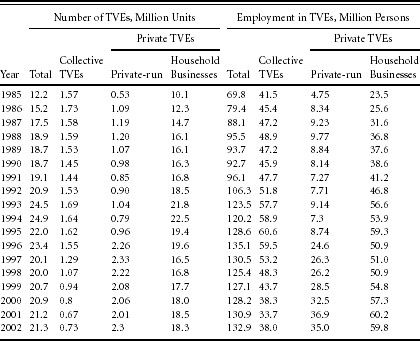
Source: Data are from the Ministry of Agriculture (2003).
Even a casual glance at Table 2.1 reveals that private TVEs absolutely dominated the total pool of TVEs. The highest number of collective TVEs in 1986 is 1.73 million. In contrast, the lowest number of household TVEs in 1985 is 10.1 million. It is true that before the mid-1990s, there were more collective TVEs than private-run TVEs. In the four years between 1985 and 1988, the number of private-run TVEs more than doubled, from 530,000 in 1985 to 1.2 million in 1988, whereas there was almost no change in the number of collective TVEs (from 1.57 million in 1985 to 1.59 million in 1988). In 1988, the collective TVEs outnumbered the private-run TVEs by only 300,000. In subsequent years, the number of private-run TVEs would decline, due to the Tiananmen effect. Without the 1989 Tiananmen interlude, the private-run TVEs would have surpassed the collective TVEs within three to four years.
Stiglitz (2006), for example, believes that the rise of TVEs challenges the standard claims of economics. He explains: “Many of the new enterprises were created in the 1980s and early 1990s by township and village enterprises (TVEs). These were public enterprises and the standard ideology would have said that you cannot succeed with public enterprises; but they were enormously successful.” His assessment is not even remotely close to reality. In 1985, there were 1.57 million collective TVEs; by 1996, as pointed out before, the number of collective TVEs was still 1.5 million. But, during this period, the total number of TVEs increased from 12 million in 1985 to 23.4 million in 1996. Assuming that the entry and exit rates of collective and private TVEs were similar, every single new entrant during the reform era was a private firm.
However, as both Oi (1999) and Naughton (2007) stress, the private TVEs were individually smaller than the collective TVEs so their employment and output shares were smaller as well. Household businesses are single proprietorships, with a very small number of employees. Although some private-run TVEs were large, they were fewer in number. Table 2.1 illustrates this point. Employment in the collective TVEs was larger than employment in the private TVEs. In 1985, the collective TVEs employed 41.5 million people as compared with 4.75 million in the private-run TVEs and 23.5 million in household businesses.
There is nothing surprising or unusual about the statically large collective sector. Collective TVEs were founded in the late 1950s and had more than 20 years of development. Private TVEs were a result of rural reforms and began only in the early 1980s. Despite their statically small size, the dynamism was on their side, not on the side of the collective TVEs. Private TVEs were growing rapidly to claim an ever larger share of employment. In 1989, private TVEs accounted for 49 percent of employment, and in 1990, they accounted for 50 percent. In 1989, the private TVEs claimed 58 percent of the after-tax profits and 45 percent of the total wage bill of all TVEs. By the end of the 1980s and just within a single decade of reform, the private TVEs were on the verge of overtaking the collective TVEs across a number of dimensions. The static advantage of the collective TVEs quickly eroded as private TVEs accumulated growth momentum. From a dynamic perspective, the TVE miracle took place entirely in the private sector, not in the collective sector.
Some scholars cite the smaller share of private TVEs in industrial output value to support their view that the main source of growth came from collective TVEs. Apart from the static and dynamic stories, there is an inherent data bias in this view. As mentioned before, in the 1980s, private businesses first ventured into the service sector rather than into industry. By definition, the industry data will understate the importance of the private TVEs. By 1987, private TVEs already accounted for 32.1 percent of the gross output value in the entire TVE sector, compared with 23 percent of the industrial output value.42 Private TVEs were still smaller than collective TVEs by the output measure, but their share was by no means insignificant as of the mid-1980s.
In fact, even the 32 percent of the output value by private TVEs understates the economic importance of private TVEs. The 32 percent is the average of the private shares of TVEs in all provinces implicitly weighted by the economic size of the provinces. This introduces a subtle bias. Private entrepreneurship and private TVEs first started in the poorer provinces, an issue I go into in greater detail next. Poorer provinces have a smaller GDP and, therefore, their economic weight is small in the calculation of the national means. The weighted average shares of private TVEs in the output value reflect the size of the private TVEs but also reflect the size of the provincial economies. Private TVEs would necessarily thus appear small simply because they were clustered in the poorer provinces.
The weighted average figure is the correct statistical measure of private TVEs, but it may not be the correct economic measure. Private TVEs were sizeable in the poor provinces and, if so, we need to know how big they were in those provinces. Because the poor provinces lacked many alternatives as compared with the rich provinces, it is important to examine the role of private TVEs in those provinces. The unweighted average of the private TVEs’ share of gross output value in 1987 is 40 percent, 8 percent higher than the weighted average. This is because the poorer and smaller provinces in the 1980s had a larger private sector.
Table 2.2 presents the percentage of private TVEs in the gross output value of the entire TVE sector across all 29 provinces in China. In addition, the table presents provincial data on per capita GDP, provincial shares of China's GDP, and percentage shares of agricultural population in the provincial population. The data refer to 1987. The table arrays the provinces from high to low according to their shares of private TVEs in the provincial gross output value. The highest share is Hebei, at 70.4 percent; the lowest share is Shanghai, at 6 percent. This is an extraordinary range. At the bottom of the private TVE output shares, three out of the five provinces are cities – Shanghai, Beijing, and Tianjin. The other side of the argument that capitalism is rural in origin is that socialism is urban in China. Another interesting finding is that the province that became a private-sector success story in the 1990s, Zhejiang, in fact had a fairly small private TVE sector in 1987. Its output share of private TVEs was only a bit larger than that of Jiangsu: 16.3 percent in Zhejiang compared with 10.7 percent in Jiangsu. The basic difference between Zhejiang and Jiangsu is that Zhejiang continued with the 1980s’ model of incremental and spontaneous private-sector development in the rural areas, whereas in the 1990s, Jiangsu adopted the urban-centric development model.
Table 2.2. Geographic and economic distributions of private TVEs, 1987

Source: The calculation is based on the data provided by the Ministry of Agriculture (2003).
As of 1987, private TVEs already contributed more than 50 percent of the TVE output in eight provinces. In another 15 provinces, private TVEs accounted for between 30 and 50 percent of the output value. Although we do not have data, in the late 1970s, the private share would have been close to zero. This is indicative of the rapid private-sector development in the 1980s. Within only eight years of the reform era, private TVEs already produced the majority of the rural output in one third of the Chinese provinces and accounted for a sizeable share of the rural output in another half of the Chinese provinces. It is difficult to reconcile this finding with the view that the TVE miracle occurred exclusively in the public-sector domain.
2.3 Virtuous Capitalism
Although it is seldom cited by academic economists writing about TVEs, by far the best study of TVEs in the English language is China's Rural Industry, a collaborative research project between World Bank economists and Chinese researchers from the Chinese Academy of Social Sciences (referred to hereafter as the World Bank TVE study).43 A key insight from the World Bank TVE study is that collective ownership of TVEs prevailed in a few rich regions of the country whereas private TVEs tended to be dominant in the poorer regions.
This is in part because the poor regions lacked a viable collective alternative and in part because the poorer regions by definition were also more rural. Herein is the connection with the rural origins of Chinese capitalism: More rural regions had a stronger version of residual capitalism. For example, in Jieshou, one of the poorer research sites in the World Bank TVE study, 73 percent of the TVEs were private, despite their TVE designation (Luo 1990, p. 147). As was true elsewhere in the country, private TVEs were individually smaller so their employment share was smaller, at 49.4 percent of the TVE workforce, but still a substantial size.
The aggregate data presented in Table 2.2 corroborate exactly the findings in the World Bank TVE study. The bottom rows of Table 2.2 present summary statistics. The average of the 10 provinces with the largest shares of private TVEs is 56.8 percent, compared with 21.4 percent for the bottom 10 provinces. The 10 provinces with the largest shares of private TVE output were substantially poorer and much more agricultural as compared with those 10 provinces with the smallest shares of private TVE output. The average per capita GDP among the top 10 provinces was 855 yuan in 1987, compared with 1,946 yuan among the bottom 10 provinces.
The provinces in the top 10 also had a smaller GDP, less than half of those of the bottom 10 provinces. They were far more agricultural. The agricultural population accounted for 81.3 percent among the top 10 provinces but only 67.2 percent among the bottom 10 provinces. The last row of the table presents simple two-way correlation statistics between the percentage shares of private TVEs and the various other indicators. The private TVEs are negatively correlated with per capita GDP and with the provincial shares of Chinese GDP and positively correlated with the agricultural share of the population.
These are specific illustrations of a central point in this book – Chinese capitalism is an overwhelmingly rural affair. A related point is that Chinese capitalism – in the 1980s – was also a poor man's affair. As the case of Mr. Nian shows, poor people and poor provinces went into the rural entrepreneurship in the 1980s. This is one of the most remarkable and under-rated attributes of rural entrepreneurship in the 1980s. Capitalism in the 1980s was not only vibrant, it was also virtuous. Rural entrepreneurship was one of the few feasible mechanisms to transition out of low value-added agriculture and to move beyond the abject poverty. In this sense, it is much more meaningful to study the development of private TVEs in poor regions of China than to study the development of collective TVEs in the rich regions of the country heavily researched by Western academics, such as Jiangsu and Shandong. The policy implications are far more significant.
Private TVEs also affected a large number of Chinese people. As mentioned before, in 1987 there were nine provinces in which private TVEs accounted for more than 50 percent of output in the TVE sector and another 15 provinces in which they accounted for between 30 and 50 percent of TVE output. Those nine provinces were home to 260.2 million rural Chinese (30 percent of China's rural population); the additional 15 provinces accounted for another 427.8 million rural Chinese and 49.7 percent of the rural population.
This book examines Guizhou at close range. Completely land-locked Guizhou is China's poorest province. Yet, it had many private TVEs. Table 2.2 shows that Guizhou had the second highest private TVE output share in the country, at 63.9 percent in 1987. Guizhou managed to have doubled this share in just three years. In 1984, the private TVEs accounted for 31 percent of the output value in the TVE sector in Guizhou. (In the 1990s, as I show in the next chapter, the private TVEs in Guizhou, relative to the collective TVEs, stagnated.)
By contrast, the richer provinces had far smaller private TVEs. In 1984, Jiangsu, a rich, coastal province, had only 4 percent of the private TVE output value (Zhang Yi 1990, p. 192 and p. 200) and in 1987, the share was 10.7 percent (see Table 2.2). The per capita GDP in Jiangsu was 1,462 yuan in 1987, almost three times that of Guizhou (546 yuan). Another example can be found in Shandong province, also a coastal and relatively well-off province (per capita GDP in 1987 was 1,131 yuan). Shandong also had a much smaller private TVE sector. As shown in Table 2.2, Shandong's private TVEs contributed to 23.2 percent of TVE output value. According to a survey of 84 villages in Shandong, in 1988, township-level enterprises dominated the pool of TVEs across the board – in terms of number of business establishments, employment, size, and so on. There were 350 TVEs among these villages, 283 of which were at the township level. These township-level firms accounted for the vast majority of employment and the stock of fixed assets.44
This contrast between Guizhou on the one hand and Jiangsu and Shandong on the other is deeply meaningful. In general, the developed parts of China – such as its urban centers and industrialized provinces – were more state-owned. The under-developed and agricultural parts of the country were more privately owned. If we accept the premise that welfare gains of GDP growth are greater in poor regions than in rich regions, then it is not so much the aggregate size of private TVEs at the national level that is of first-order importance. Rather, it is the size of private TVEs in poor provinces to which we should pay special attention. Private TVEs, more than collective TVEs, contributed to Guizhou's fast growth in the 1980s. Between 1981 and 1984, Guizhou's per capita GDP grew at a real double-digit rate. In other years of the 1980s, the per capita annual GDP growth was consistently around 7 or 8 percent (NBS 1996, p. 731). This is the true China miracle.
3 “Nothing but Revolutionary Reforms”
I remember that it was in 1978. There was an article in People's Daily about raising cows. I got so excited upon reading it. During the Cultural Revolution, every newspaper article was about revolution and class struggle, non-stop, only editorials. At that time, raising chickens or growing vegetables were viewed as capitalist tails to be cut. Now the People's Daily has an article about raising cows. Things have definitely changed.
– Liu Chuanzhi, founder of Lenovo, in 199845
Recall the puzzle I posed in Chapter 1 – how the pronouncement by a completely unconstrained state to honor its commitments to reforms could have been viewed as credible. The quote from Liu Chuanzhi, the founder of Lenovo, provides a clue. His statement helps establish the appropriate baseline benchmark against which we should assess the policy changes in the 1980s. What would strike anyone in the West as utterly mundane and inconsequential – raising cows – was a signal of deep significance to Mr. Liu. The baseline benchmark in Mr. Liu's mind was “revolution and class struggle.” Against this benchmark, publicity about raising cows in the People's Daily signaled a monumental change in policy. Deng Xiaoping would agree with Mr. Liu. The title of this section is a quote from a speech by Deng Xiaoping in 1984, “The rural reforms that were carried out in the past few years are nothing but revolutionary reforms.”46
Chinese economic policies – and its politics – in the early 1980s were a world apart from the standard prescriptions of neoclassical economics. Land was not private, prices were controlled, and the state chose not to privatize SOEs. In a famous paper, Hausmann, Pritchett, and Rodrik (2004) put forward the thesis that the initial triggers of growth can often be “humble” in nature. These reforms amount to nothing more than some relaxation of existing constraints on the private sector. No fundamental institutional reforms – those aiming at property rights protection, for example – are needed. Deng's agricultural reforms, according to these authors, fit with this model.
The Chinese themselves – including Deng and Liu – did not see the agricultural reforms as “humble” at all. The reason for the different perspectives is simple: The baselines are different. To Hausmann, Pritchett, and Rodrik, the baseline is the “Washington Consensus” – the famous template of the necessary conditions for economic growth, ranging from macroeconomic stability to private ownership. China in the 1980s – or China now – looks quite different from the Washington Consensus. But to Deng and Liu, the baseline is China of the 1970s during the radical leftist period of the Cultural Revolution. Relative to the Cultural Revolution, the bubbling rural entrepreneurship, the crowded rural market fairs, and the demise of the commune system represented a remarkable departure from the status quo ante. This is the essence of directional liberalism.
It is extremely important to make explicit this huge difference in perspectives for it helps us to identify the sources of Chinese incentives. One reason why standard economic analysis emphasizes the importance of the sanctity of property rights for economic growth has to do with incentives. Economic agents need to be confident that their future gains will be safe in order for them to be motivated to expend efforts and capital today. The security of property rights is an incentive device. It is here that the standard economic analysis finds China puzzling. This is a country without the conventional sources of property rights security, such as a constrained government, an independent judiciary, free media, and political power for the propertied class. Where, then, is the incentive for economic growth in this system?
Deng's perspective provides the answer. Property rights protection in China, now or in the 1980s, is very poor, but relative to the Cultural Revolution period, the marginal improvement was huge. Directional liberalism, not an exact match with the Washington Consensus, was the relevant modus operandi and was the source of Chinese incentive to go into entrepreneurship. To illustrate the size of the marginal change from the pre-reform order, keep in mind that an average commune – the decision maker before reforms – was 5,000 households (World Bank 1983, p. 30).47 Within just a few years after the reforms, it was replaced by a system based on household production. It is difficult to exaggerate both the incentive and economic effects of such a change.
The rapidity with which the household responsibility system (HRS) was adopted illustrates Deng's perspective on rural reforms. In September 1980, only three provincial Party secretaries supported the HRS (Rural Economy Research Team 1998). On the basis of this rather fragile political support, the HRS spread extremely rapidly. According to Naughton (1996, p. 141), at the end of 1979, only 1 percent of rural households had adopted the HRS; by the end of 1982, the percentage had increased to 80 percent. In another two years, in 1984, the percentage share of participating households reached 99 percent.
More recent Chinese estimates provide an even faster rate of adoption: 90 percent by early 1982, according to the Rural Economy Research Team (1998). Rural households claimed a rapidly rising share of production assets. By 1983, just four years after the reforms, 53 percent of plowing equipment and animals and 58 percent of vehicles were privately owned. In 1982, the private purchase of tractors reached 1 million units, equivalent to one third of the existing stock of tractors at that time.48 It was this type of changes that convinced entrepreneurs such as Lenovo's Liu Chuanzhi to leave the comfort of this job as a scientist and to venture into entrepreneurship. The incentive effect came from how far China departed from the Cultural Revolution of the 1970s, not from the proximity of China to the textbook version of Western economic and political institutions.
Recall from Chapter 1 that private fixed-asset investments (FAIs) grew rapidly in the 1980s. In this section, I provide a direct description of the policy developments that matched the fixed-asset investment data. If directional liberalism is the mechanism that motivated Chinese entrepreneurs, then asking whether China fits with the Washington Consensus is the wrong framing. The right framing is to ask whether China was moving in the right direction and, if so, by how much. Even more precisely, the right way to frame the discussion is to ask how far and at which speed China was moving from the rigid central planning – or a sort of Moscow Consensus, if you will. Within only a few years into the reform era, personal security was enhanced, microeconomic flexibility was increased, and individual incentives were augmented. Furthermore, these achievements were a result of a consistent, deliberate, and progressively liberal policy framework.
3.1 Moving Away from the Status Quo Ante
The reforms in China are often described as having occurred during the post-Mao era. Strictly speaking, this is incorrect. The reforms occurred in post-Hua China. Hua Guofeng was a faithful Maoist and he relinquished his power only in 1978. The reformist leadership established full control of the economic agenda at the historic Third Plenum of the Eleventh Party Congress concluded on December 22, 1978. The two strongest advocates of the rural reforms, Zhao Ziyang and Wan Li, were appointed premier and vice premier, respectively, in 1980. (Sichuan and Anhui, led by Zhao and Wan, respectively, had led the country in the pioneering agricultural reforms in the late 1970s.) It took China just six years between 1979 and 1985 to create a policy environment sufficiently liberal that a rural private sector with 10.5 million businesses strong, with 40 percent nonagricultural employment, had emerged. China may not have embraced the Washington Consensus, but it moved away from the Moscow Consensus at a rapid and purposeful speed.
Some China scholars believe that this development occurred spontaneously without much prodding from the government (Zhou 1996). This is not entirely wrong, but it is incomplete. Even if some of the specific initial reforms were spontaneous, they occurred against the backdrop of a relatively flexible political environment. The most famous example of spontaneous reforms is the household responsibility system. The HRS was not launched by the Chinese leadership from the top down but instead by a group of farmers in the poor village of Xiaogang in Anhui province. According to many accounts, farmers from 18 households in Xiaogang village secretly adopted the HRS on their own at a meeting in December 1978. They entered into a pledge – apparently written in blood – that they would contribute toward the costs of raising the children of the leaders of the reforms if the ringleaders were to be arrested.49
But, this action did not take place in a vacuum. The timing of the event – December 1978 – is highly significant. The 18 Anhui farmers entered into this pledge during the middle of the historic Third Plenum of the Eleventh Central Committee that launched the economic reforms. We do not know if the Xiaogang farmers knew about the deliberations at the Third Plenum, but they certainly would have had access to other information that suggested an imminent departure from the orthodox Maoist policy stance of Hua Guofeng. In the second half of 1978, several significant political events preceded the Third Plenum. During the summer, there was a famous debate on “seeking truth from practice” that explicitly challenged Hua's “two-whatevers” position on Mao Zedong. (The “two-whatevers” referred to support for whatever Mao supported and opposition to whatever Mao opposed.) On November 15, 1978, after Hua had repeatedly expressed his opposition, the CCP passed a resolution declaring that the April 5 Movement – during which hundreds of thousands of Beijing residents protested against the Gang of Four and, implicitly, against Mao himself in Tiananmen Square – was legitimate. The Party secretary of Beijing, who had overseen the suppression of the April 5 Movement, was summarily dismissed.50 If we assume that the Xiaogang farmers calculated the benefits and costs of their action, it is reasonable to argue that they might have rationally believed that the probability of the success of their action became nontrivial in late 1978.
The true implication of the action by the Xiaogang farmers is not that the policies did not matter; rather, the implication is that the policies accommodated the spontaneous actions on the ground.51 This is a hallmark of the reform policies in the 1980s. Probably the best illustration of this policy openness is a group of five policy documents famously known in China as the five No. 1 documents. Between 1982 and 1986, at the beginning of each year, the Central Committee of the CCP issued a No. 1 policy document about the rural reforms. The label, No. 1 document, was intended to signal that the rural reforms were a top policy priority of the government. Each No. 1 document addressed the questions of private-sector development and liberalization. They did so in a progressive manner: the later No. 1 documents provided solutions to problems and issues raised in earlier ones. These No. 1 documents are the best true example of the sequential, pragmatic, and learning-by-doing reforms.
The 1982 No. 1 document, the first of such documents, addressed private-sector development only in the context of agricultural production and marketing of agricultural products. The 1983 No. 1 document began to touch on the issue of private-sector development in nonagricultural activities, such as long-distance trade, rural processing of agricultural raw materials, access of rural residents to urban markets, and so on. The 1984 No. 1 document addressed the ideologically sensitive issue of employment by private-sector businesses, land contracting, reforms of rural credit cooperatives, deepening reforms of rural supply cooperatives, and rural industrialization. The 1985 No. 1 document abolished compulsory grain purchases by the state and instituted a contract system, permitted some interest-rate flexibility among rural financial institutions, allowed private mining, and opened infrastructural construction to private participation. The 1986 No. 1 document focused on some of the social consequences of the rapid private-sector development in the previous years, such as the rising income inequalities and the persistent rural poverty in some regions.
My claim is not that all the reforms were fully implemented. Rather, the claim is that the reforms moved progressively forward. Given the ideological environment in China so soon after the end of the Cultural Revolution, some of the early reforms were path-breaking. Consider the example of share issues. Many analysts believe that the concept was introduced in the 1990s. In fact, the 1982 No. 1 document already permitted the issuance of individual shares by some public-sector institutions (Central Committee 1992 <1982>). The specific context was the reform of the rural supply cooperatives, a critical institution linking the rural economy to the urban economy by procuring agricultural products from and selling industrial products to the peasants. The 1982 No. 1 document reformed the rural supply cooperatives in two ways. One is that the higher-level cooperatives – for example, at the county level – were decentralized to the “basic level” (township and village). The other is that the basic-level cooperatives were partially privatized by issuing shares to the peasants.
Several of these No. 1 documents explicitly recognized and supported the potential role of rural residents as providers of capital and business knowledge and expertise. The 1982 No. 1 document encouraged the pooling of capital and business formation among individuals and across different geographic boundaries. The 1983 No. 1 document went one step further: It allowed the pooling of capital from individuals not just in the production stages but also in the procurement and marketing stages of the rural economy (Central Committee 1992 <1983>). The 1984 No. 1 document removed the sectoral restrictions – now, rural residents were encouraged to invest in all types of enterprises and to pool their funds to jointly set up enterprises following the principles of voluntary participation and mutual benefit. The document also pledged government protection of the investors’ interests (Central Committee 1992 <1984>). The 1985 No. 1 document allowed what in essence amounted to “stock options” – issuing shares to those who contributed knowledge and expertise (Central Committee and State Council 1992 <1985>).
As I showed previously, the distribution sector claimed more than 50 percent of the rural private-sector businesses. This did not occur by chance. Service-sector reforms were launched very early on. Service-sector reforms are important because, by definition, the service sector touches on the rural–urban linkages. The essence of the service-sector reforms was to allow rural residents to directly source their industrial inputs and to directly market their products to urban residents. This was a significant move in a number of ways. One is because of the substantial rural/urban segmentation created by the hukou system. The other is because they allowed rural access to urban markets and thus multiplied the size of market opportunities available to rural entrepreneurs by several fold. Mr. Nian, our sunflower-seed entrepreneur from Anhui, was a direct beneficiary of these reforms because he was allowed to sell not only to consumers in Anhui but also to the much richer consumers in Shanghai and Beijing.
The 1982 No. 1 document permitted direct marketing by peasants, essentially breaking the marketing monopoly held by the rural supply cooperatives. This policy was reinforced in all subsequent No. 1 documents. In 1982, Wan Li, a senior vice premier, called for an end to the state monopoly in the distribution channels. Private entry into marketing activities was to be permitted immediately and rural supply cooperatives were to be run by their members, not by the government (Wan Li 1992 <1982>). To entice investments in the rural supply cooperatives, in 1984 the Chinese government authorized the rural supply cooperatives to issue what amounted to convertible bonds – potential rural investors could receive both a fixed-interest payment and a variable dividend payment (State System Reform Commission, Ministry of Commerce, and Ministry of Agriculture 1992 <1984>).
The service-sector liberalization was quickly followed by policies to reduce inter-regional trade. The 1983 No. 1 document endorsed private entry into long-distance trade between different rural areas as well as between rural and urban areas. “Peasants in their private capacity,” the document declared, “can engage in trade. They can go into cities and leave their counties and provinces.” A State Council circular issued in 1984 specifically authorized rural entrepreneurs to operate stores and service outlets in cities. The 1984 document also called for a reduction in the size of local governments in the rural areas and for instituting caps on fees and taxes levied on the peasants. The document tried to involve the local people's congresses in scrutiny of the enactment of rural fees and taxes.
3.2 Creating Policy Credibility
The reformist leaders made several moves very early on with a clear intention of signaling an improvement in property rights security. In 1979, the Chinese government returned confiscated bank deposits, bonds, gold, and private homes to those people who had been classified as “capitalists.” The number of people affected by this policy was around 700,000 (Zhang Houyi and Ming Lizhi 1999, pp. 29–30). Mindful of the frequent political reversals and cycles during the Cultural Revolution, the reformist leaders went out of their way to repeatedly stress the continuity and the durability of the reforms. The wording is strong and explicit. Consider the following paragraph from a major policy document on agriculture (Central Committee 1979):
Those policies that have proven to be effective in practice shall not be changed. Otherwise, credibility with the people will be lost and the incentives of the peasants will be undermined. At the same time, those policies that are harmful to the incentives of the peasants and to agricultural productivity must be resolutely revised and corrected…
The Chinese leadership sought to improve the property rights security of private entrepreneurs not through constitutional reforms but rather through enhancing the political status of the entrepreneurs. Many Western analysts believe that the political breakthrough for China's private sector occurred in 2001 with the promulgation of Jiang Zemin's “Three Representations” theory, which endorsed the idea that the CCP could recruit members from among private entrepreneurs. Again, as in so many other issues, this is simply not the case. As early as 1981, a major policy document, “Expanding channels and enlivening the economy, and solving employment problems in cities and townships,” already endorsed the idea of recruiting Party members from the private sector. The policy document referred to private entrepreneurs as individual households or individual laborers, which persisted in usage in the 1990s, and called for the same political treatment for individual laborers as for workers in the state sector (Central Committee and State Council 1982 <1981>). The term private enterprise (siying qiye) first appeared in a major policy document in 1987 (Editorial Committee of TVE Yearbook 1989b, p. 518).
These developments expose another myth – that the ideological stigma against private sector came down only in the 1990s. Yes, it is true that the Chinese leadership began to tone down this ideological stigma since the mid-1990s, but much of this ideological stigma was actually revived by the leadership of the 1990s in the wake of Tiananmen events. The explicit prohibition against recruiting CCP members from the private sector was instituted in 1989, by Jiang Zemin himself. In a speech dated August 21, 1989, Jiang (1991 <1989>, p. 584) remarked, “The document of this conference said that private entrepreneurs were not allowed into the CCP. I agree with this view.” (I come back to this topic in the next chapter.) The effect of Jiang Zemin's much-heralded “Three Representations” theory in 2001 was to lift the policy restriction his own leadership had instituted 12 years before.
My archival research uncovers at least five occasions when China's top leaders held public face-to-face meetings with private entrepreneurs in the 1980s. In the still rigid ideological environment of the 1980s, this gesture mattered enormously. In the first instance, in 1980, two vice premiers paid a visit and brought New Year's greetings to Ms. Liu Guixian in her restaurant. Liu was the first private entrepreneur to have been granted a private business license in Beijing (Wu Xiaobo 2006). In the second instance, in August 1983, Hu Yaobang, then CCP general secretary, attended a conference celebrating the employment achievements of collective firms and individual businesses.52 In the third instance, Zhao Ziyang, the premier at the time, came to the founding meeting of the Association of Individual Laborers. In the fourth instance, Zhao Ziyang visited a private entrepreneur in Hubei province whose bra business was able to enter the European market.53 In the fifth instance, on September 6, 1987, top Party and State Council officials invited 10 rural entrepreneurs to a meeting in Zhongnanhai (the official residence of the top Chinese leaders). The 10 were selected as the best rural entrepreneurs at what amounted to a business competition event organized by the Chinese Central Television station (Editorial Committee of TVE Yearbook 1989b, p. 359). In the 1990s, while it was customary for China's top leaders to attend forums with the CEOs of MNCs (e.g., the Fortune Global Forum), there is not a single documented case of top Chinese leaders attending similar functions organized by indigenous private entrepreneurs. This is so despite the fact that indigenous private businesses created employment opportunities several multiples that of the opportunities created by foreign firms.
The leaders in the 1980s sought to elevate the political status of private entrepreneurs but also they were harshly critical of the state sector. At the 1983 employment conference of the collective and private sectors, Hu Yaobang coined the term “glory project” (guancai shiye). He said that only business activities undertaken by the state sector were traditionally viewed positively – as “glorious” – and that activities undertaken by the private sector were automatically viewed with suspicion. To eradicate the ideological stigma of the private sector, he then went on to proclaim that the economic contributions by the private-sector were “glorious.” This was in 1983.
According to a biography, in 1984, Hu Yaobang issued the following instruction in reaction to a complaint by 20 peasants from Hebei about difficulties to enter the transportation business. The tone was remarkably harsh (Chai Hongxia, Shi Bipo, and Gao Qing 1997, p. 127):
There are two issues here. One is that some basic-level cadres and SOE managers took advantage of scarce supplies and engaged in hoarding and monopolistic practices. They jacked up prices and extorted and blackmailed the masses. The other issue is that SOE managers are incompetent and they use the name of SOEs to exclude and attack individual enterprises.
Recent revelations about internal policy deliberations during this period show that maintaining policy credibility and stability was a top concern of the Chinese leaders. Deng Liqun, the head of the Propaganda Department between 1982 and 1985 and a leading CCP theoretician, revealed some fascinating details about this period. One contentious issue at the time was employment by private-sector firms. The Party ideologues challenged the policy of permitting large-scale employment by private-sector businesses. They argued that the policy amounted to allowing exploitation of labor. When Deng Liqun proposed convening a conference to discuss the issue, the reformist leaders, Hu Yaobang, Zhao Ziyang, and Wan Li, vetoed the idea. Hu Yaobang, as quoted by Deng Liqun, said, “If you convene this conference, it is a signal to the people lower down that the policy will change.”54
3.3 Security of Proprietors vis-à-vis Security of Property
To be sure, none of the policy measures described previously amounted to a genuine institutional guarantee of private property rights. The CCP never allowed itself to be subject to any external constraints. What these documents reveal is that the reformist leaders were showing a degree of self-constraint and were fully cognizant of the reputational effects of their actions. In the early 1980s, such political self-constraint was reasonably credible. Again, the baseline benchmark matters here. Relative to the completely arbitrary behavior of Mao, these straightforward pronouncements of fairly specific policy rules by the top leaders helped establish a sense of confidence and stability on the part of those contemplating going into business in the 1980s.
The area where the policy changes matter the most is the sense of personal security on the part of first-generation entrepreneurs. Here, I draw a distinction between security of proprietors and security of property. The explicit and strong legal protection of private property was not promulgated until the 2004 Constitutional amendment and the 2007 Law of Physical Property. (Even with the passage of these legal documents, there is still a question of how they can be enforced fairly in a top-down, authoritarian system.) But, in the early 1980s, the appropriate benchmark is the baseline of the 1970s. Let me offer an extreme but nevertheless realistic scenario to illustrate this point. Imagine that during the Cultural Revolution, as soon as someone went into private commerce, he would be arrested. (This was especially true in the urban areas.) Now, imagine in the 1980s, a private entrepreneur simply in her capacity as a private entrepreneur no longer feared such a fate. The incentive effect between being arrested and not being arrested must have been massive. The cumulative effects of the policy changes in the 1980s resulted in an increase in the security of proprietors. The security of the proprietor is the necessary condition for the security of the property itself. In the 1980s, China completed the necessary conditions toward establishing property rights security.
The steady changes in policies and the business environment documented in the previous sections really mattered to the first generation of Chinese entrepreneurs who took calculated risks to go into business so soon after the Cultural Revolution. The following short cases show the intimate interactions between policies and the incentive effects of the first generation of Chinese entrepreneurs.
Table 2.2 shows that Hebei province had the highest output share of private TVEs in the country, already 70.4 percent in 1987. Hebei, about average in its economic development level, is a northern province (bordering both Beijing and Tianjin). Our first case comes from Qinhe county of Hebei province. This was a poor region with very few collective assets with which to start. In 1983, the county government launched a number of collective TVEs, but none of them was successful. Because of its poor financial situation, the county government ended up accumulating payroll arrears to its own staff. This experience led the county government to turn to the private sector for economic development. The first policy act by the county government was to rehabilitate more than 100 individuals who had been prosecuted during the “anti-capitalist tail” campaign of the Cultural Revolution. The county government also awarded the title of “model worker” to individuals who grew rich. The strategy seemed to work. By the late 1980s, Qinhe had developed a sizeable cluster of industries (all based on household businesses), and it was a large supplier of motorcycle components (Editorial Committee of TVE Yearbook 1989b, p. 233).
To be sure, there were policy setbacks in the 1980s, but how these policy setbacks were resolved is also telling of the era – some of the local officials publicly and proactively reversed their own mistakes. These quick corrections, rather than stubbornly persisting with policies that clearly did not work, established and consolidated a sense that the liberal policy environment was durable. Two episodes from the severe policy setback in 1982, when the central government cracked down on “speculation,” are illustrative of this point.
In 1982, the State Council issued a policy document decrying the poor quality of products produced by the emerging private firms and the price hikes supposedly due to the speculative activities by private traders. The 1982 campaign against market speculation bore the classic symptoms of an ailing state sector using its political power to shut out its more nimble competitors. One of the first victims of the 1982 crackdown was Han Qingsheng in Wuhan, the capital city of Hubei province in interior China.55 His crime was to have had received 600 yuan for providing technical assistance to a TVE. Mr. Han, an engineer at a SOE, like many engineers, also worked as a consultant for a TVE. Such engineers were known as “Sunday engineers” because they spent their Sundays at the TVEs. But, in 1982, with the adverse change in the environment, Mr. Han was sentenced to 300 days for engaging in “technological speculative activities.”
The fate of Mr. Han became a huge media event. (This is another lesser known fact about the 1980s: The Chinese media in the 1980s were quite free and active.) Intellectuals and scientists strongly objected to his treatment. The Wuhan government then backed down, and Mr. Han was released. Not just that: The mayor of Wuhan city, apologizing on behalf of the city, personally delivered the court's verdict and the 600 yuan that the government had confiscated to the home of Mr. Han.
The 1982 crackdown also reached Wenzhou in Zhejiang province. In 1982, the Ministry of Machinery Industry issued a ban prohibiting private firms from producing electric transformers. The official reason was that products made by private enterprises were poor in quality and lacked safety standards. The document singled out Wenzhou for criticism because Wenzhou was emerging as a manufacturing center of electric transformers. Zhejiang province then initiated an investigation into the business activities of the eight richest private entrepreneurs in Wenzhou. (They were known as the “eight big kings” at the time – they each had accumulated wealth in excess of 100,000 yuan.) Seven were arrested and one fled the city.
The economy of Wenzhou crashed immediately. In 1980 and 1981, industry had expanded by 30 percent. But, in 1982, it screeched to a halt, contracting by 1.7 percent (Wu Xiaobo 2006, p. 84). Private fixed-asset investment fell from 280 million yuan in 1981 to 155 million yuan in 1982. The Wenzhou government swiftly reacted to the downturn. In 1984, it released all the imprisoned private entrepreneurs and restituted their assets. Not only that, the Wenzhou government published the decision in local newspapers explaining why it had erred. It was unprecedented – and it is still unprecedented today – for a branch of the Chinese government to openly and so publicly acknowledge its own mistakes. The following is an excerpt from a later account of this event:56
The teleconference [announcing the release of the private entrepreneurs] and the rehabilitation of the “eight big kings” were headline news in the local newspapers. Lower-level officials were emboldened and those with previous reservations then began to feel relaxed. The urban and rural areas of Wenzhou economy were greatly stimulated. In the rural area of Wenzhou, commercial activities began to proliferate massively.
Fixed-asset investment data support this qualitative assessment. For the first time after a two-year contraction, fixed-asset investments in 1984 exceeded their 1982 level and then in 1985 they expanded another 42 percent. This marked the beginning of the Wenzhou miracle. The man credited with this policy is Yuan Fanglie, the Party secretary of Wenzhou from 1981 to 1984. Today, many Wenzhou entrepreneurs regard Yuan with respect and gratitude. In a revealing 2001 interview, Yuan recalled why he took such actions. He noted that Wenzhou was poorly endowed with natural resources, but Wenzhou had one asset – its human capital, especially the commercial and trading skills of its entrepreneurs. Unusual for a Chinese official, he knew what was holding back a full utilization of these skills – lack of confidence in the durability of the reforms. Yuan then quoted a popular saying – “The policy of the CCP is like the moon, taking different shapes every fifteen days” – to illustrate his point. He came to the conclusion that it was essential to create a safe environment for the entrepreneurs to go into business. A footnote to the policy directive issued by the Ministry of Machinery Industry is that today Wenzhou is the home of China's largest producer of electric transformers, the Zhengtai Group, also one of China's largest private-sector firms. The SOEs that the Ministry of Machinery Industry had sought to protect have long since gone bankrupt.
Our final case comes from the famous No. 4 document of 1984 that recognizes the legality and status of private TVEs. The document stipulated specific provisions; for example, it entitled private TVEs to the tax incentives previously reserved for collective TVEs. But, it was also a political document. The No. 4 document decreed that TVEs should be granted the same policy treatment as SOEs. This was a policy milestone. Recall our earlier discussion that the No. 4 document defined TVEs in such a way as to include private firms. Thus, in effect, the No. 4 document of 1984 equated private firms notionally with SOEs.
The No. 4 document had a huge psychological impact on potential private entrepreneurs. Contemporaneous accounts recount what happened after the No. 4 document was announced – a massive wave of private placements. Within one month, rural residents in the county of Yiwu in Zhejiang province reportedly raised 10 million yuan and established 500 businesses. (In 1984, the entire agricultural output of Yiwu was just 200 million yuan.)57 In the city of Shenyang, when a notice went out about raising capital for a private garment factory, peasants formed long lines the night before the shares were to go on sale. The venture raised 100,000 yuan in one day. In the same region, another proposal to raise 110,000 yuan for a food factory was fully subscribed in just 40 minutes. In the Nantong city of Jiangsu, a private commercial building project raised 1 million yuan in three days. In 1984, Zhejiang province created 250,000 private-sector businesses; Shandong, another 700,000. In Yichang of Hubei province, 50,000 peasants created 17,000 businesses. In Huanyuan county of Anhui province, 8,700 peasants pooled capital to form 205 private enterprises (Zhang Yi 1990). Thus, 1984 should be designated the year of embryonic private equity and organized capitalism in China. The entrepreneurial contagions were not confined to rural China. Lenovo, Stone, and Kelon were all founded in 1984; the Hope Group, China's largest agribusiness firm, was founded in 1983.
3.4 Getting the Incentives Right
If you want to bring the initiative of the peasants into play, you should give them the power to make money.
– Deng Xiaoping comment to New York Times magazine delegation in October 1985 – (“Sayings of Deng Xiaoping” 1997)
It is well known that the commune system suppressed the financial incentives of its members. One telling indicator is that the faster-growing crops fetched lower returns under the commune system.58 The rapid demise of the commune system is evidence of the improved incentives under the HRS. Another source of improvement came from the price adjustments. Research shows the substantial impact on the income of Chinese peasants resulting from the rising agricultural procurement prices, the reductions in rural taxation, and the increased flexibility to enter into higher-return nonagricultural activities (Sicular 1988).
My interest here is not to repeat this well-researched story of improved financial returns and the rising incomes of Chinese peasants during the early 1980s. Instead, I provide an account of a change in the way the Chinese political elites framed the incentive issue. Notice the wording by Deng Xiaoping quoted previously. He did not say giving money to peasants but to “give them the power to make money” (italics added by the author for emphasis). This is a critical distinction. Even during the Maoist period – and during the 1990s and under Hu Jintao in the 2000s, sometimes the government would raise the agricultural terms of trade to increase rural income. What is different about the 1980s is that there was liberalization – to give the peasants the power to make money.
To put it simply, the prevailing thinking during the Maoist era was a zero-sum mentality – gains achieved by the peasantry were viewed necessarily as losses incurred by the state. The reformist leaders very early on repudiated this idea and embraced a positive-sum thinking. That thinking had three essential elements, although they were never explicitly articulated. First, rural welfare, in and of itself, was important. Second, improving rural welfare was entirely consistent with improving the welfare of the country as a whole. Third, improving rural welfare was the mechanism by which to improve the welfare of the country.
The change in the policy idea was visible quite early on. In April 1979, Red Flag, the theoretical mouthpiece of the CCP, argued for an incentive approach. In order for the peasants to contribute more to the state, the article argued, the state should, first and foremost, guarantee the economic interests of the peasants (Zhou Reli 1979). In one of the first major policy pronouncements on agriculture adopted by the reformist leaders, “Decision of the Central Committee of the CCP concerning the acceleration of agricultural development” promulgated in September 1979, the issue of incentives was highlighted prominently. Consider the following statement (Central Committee 1979):
While strengthening socialist education among our peasantry, we must show genuine concern for their material welfare in economic work and must provide a complete guarantee for their democratic rights in political work. Without material welfare and certain political rights, it is impossible for any class to have innate incentives (italics added by author for emphasis).
Considering that this was three years after the Cultural Revolution, such an explicit recognition of fundamental market economy principles – stable future expectations, excludability, and individual welfare – is truly remarkable. Throughout this historic document, words such as reputation or credibility (shixin yumin), incentives (jijixin), material welfare or interests (wuzhi liyi), democratic rights (minzhu quanli), and political rights (zhengzhi quanli) frequently appear.
This positive-sum stance led to a host of concrete policies. For one thing, it justified the costly decision to raise procurement prices, a decision, as Naughton (2007, p. 89) points out, involved substantial trade-offs – planners had to reduce investments and scale back technology imports in order to pay for the grain imports.
The other implication is that the state came to trust the spontaneous forces of the market rather than imposing its own vision on the economy. This sentiment was best expressed by Wan Li, the vice premier in charge of the rural sector and a pioneering reformer. He had this to say: “Ordinarily, our work should accommodate the needs of agricultural development rather than forcing the peasants to accommodate to us” (Wan Li 1992 <1982>, p. 149). In the same speech, Wan put forward the view that officials should not prohibit activities even if they are at odds with the prevailing rules and regulations. In the form of a question, Wan asked whether the rules and regulations should be relaxed further (rather than, as implied, banning the activities themselves). He did not explicitly say yes, but he implored government officials at all levels to fully debate the merits and demerits of the issues. This kind of policy flexibility and market-consistent stance goes a long way toward explaining how China moved so far in the direction of a market economy in the 1980s, even as the overall political environment seemed to be prohibitively forbidding.
The accommodation to the reality on the ground is probably the single most significant hallmark of the 1980s. Naughton (1996) has a succinct formulation for this period, stressing the importance of the “crucial first move” by the central government – by reducing rural tax rates, raising agricultural prices, and increasing investments in the agricultural sector. But the fact that the Chinese leadership was willing to be so accommodating to the spontaneous market forces on the ground is not a trivial fact. Respecting market signals – by policy elites with unconstrained power – is a tall order. In the next chapter, I document the decisions of the leadership in the 1990s to dramatically curtail the highly productive credit allocations to rural entrepreneurs in order to carry out their own technocratic blueprint of economic development.
3.5 Microeconomic Flexibility
The policy of accommodation explains the expanding scope of microeconomic flexibility in the 1980s. The most impressive example can be found in the size of private-sector employment. In the early 1980s, the employment size of private businesses was considered ideologically sensitive. In 1981, the People's Daily carried a series of articles and readers’ letters debating the issue of private-sector employment. The tone, as noted by Chinese researchers, was frank but measured and rational (Zhang Houyi and Ming Lizhi 1999). The root of the controversy was the Marxist theory of labor surplus. The 1983 No. 1 document issued a rule that rural household businesses – with two owners – could employ up to five “apprentices.” This formulation established what was often viewed as the ceiling on private employment at seven workers per firm. (In Das Kapital, Karl Marx used a fictional example of a private firm employing eight workers to illustrate his labor surplus theory.)
The reality is that the reformist leadership never rigidly enforced the seven-employee rule. The World Bank TVE study could not find a single known case of private entrepreneurs being punished because they exceeded the seven-person employment rule (Lin 1990). Mr. Nian, as noted before, employed hundreds of workers and he was by no means alone. I have also provided survey evidence – based on PSS1993 – that rural businesses employed far more workers than the seven-employee ceiling. This is true both in terms of the average employment size as well as the employment size of the firms in the 90th percentile.
The reason is not at all surprising. A close reading of the government decrees reveals that the employment restriction was never intended to be prohibitive. In fact, the 1983 rule itself contained deliberately flexible provisions. Local officials were urged not to promote but also not to crack down on those who exceeded the seven-employee rule. The overall tone of the 1983 No. 1 document, which set forth the seven-employee rule, was pro private sector rather than restricting its development.59 The operative phrase in the internal policy deliberations on the employment issue was “wait and see” (Zhang Houyi and Ming Lizhi 1999), a phrase that nicely captures the essence of the policy approach in the 1980s.
Ever pragmatic, the reformist leaders proposed measures that would ease the ideological tensions of the employment issue while permitting the practice itself. The 1984 No. 1 document asked the private-run businesses to create and contribute to a “collective reserve fund,” which in effect was a form of profit-sharing with employees. The document also proposed a cap on dividend payouts. These measures, although not attenuating the private nature of these businesses, were designed to ease any tensions with labor.
Another form of microeconomic flexibility was private entry into the nonagricultural sectors. Very early on, private entry was not only allowed but also encouraged. Consider the following paragraph (Ministry of Agriculture 1985, p. 2):
The state, collectives, and individuals should simultaneously embark on businesses in all sectors of manufacturing, supply and procurement, science and technology, and services in the rural areas. The government should especially support voluntary forms of businesses. Supply cooperatives should be completely autonomous, responsible for their own profits and losses and managing operations on their own. They should be subject to democratic supervision by the masses (italics added by the author).
The 1985 No. 1 document gives explicit permission to individual businesses to bid for infrastructural construction projects and encouraged private mining (Editorial Committee of TVE Yearbook 1989b, p. 502). As pointed out in the last section, the private TVEs had a dominant market position in the transportation sector compared with the collective TVEs. The private TVEs also seemed to have engaged in building infrastructure. For example, in one city of Fujian, private TVEs built and financed three railways and they won the right to operate them as well (Editorial Committee of TVE Yearbook 1989b, p. 84). Private infrastructure financing and construction were even more substantial in Wenzhou. According to one estimate, 70 percent of the small township construction was financed by TVEs (most of which were private). Private financing and construction extended to primary and junior high schools, movie theaters, roads, tap-water facilities, bridges, electricity generation, and so on (Editorial Committee of TVE Yearbook 1989b, p. 118).
Private businesses were allowed to raise equity capital. In the same 1985 document that authorized the establishment of shareholding enterprises, individuals could purchase shares with capital or acquire shares through contributions of production materials and labor. Lifting the restrictions on TVEs occurred even earlier – in 1979 when a State Council circular removed the restrictions on the large-scale expansion of nonagricultural activities by TVEs. Around the same time, the restrictions on a number of nonagricultural activities by rural households were also lifted. The latter policy change stimulated a great spurt of private-sector development in rural China (Byrd and Lin 1990, p. 7).
I detail the financial liberalization during this period in the next chapter. Financial experiments were one of the unheralded areas of microeconomic flexibility in the 1980s. In a 1985 document, the State Council outlines 10 policy measures to revive the rural economy,60 one of which is financial liberalization. The rural credit cooperatives were allowed to retain all profits after the reserve deposits at the central bank. They were encouraged to source deposits and lend across regions, in effect making it possible for the credit cooperatives to compete with one another. Interest rates were allowed to float within a band (as in the statement, “Some rates can approach market rates”). The rural credit cooperatives were authorized to lend to peasants in industrial and commercial businesses on the condition that the agricultural needs for credits were given priority. The document permitted informal financing.
4 Conclusion
It is no exaggeration to say that an understanding of Chinese economy and reforms requires a detailed, direct grasp of the economic policies and institutions in the 1980s. The story of the 1980s was written by the tens of millions of Chinese rural entrepreneurs. The vigor of rural entrepreneurship during that period is as remarkable as the lack of knowledge in the West about some of the basic facts. By far, the single most significant development in the 1980s was the TVE phenomenon. It is hard to identify another economic phenomenon so important and yet so systematically misconstrued.
Among top economics journals, one finds many illustrations – often backed up by sophisticated mathematical models – of how publicly owned TVEs can nevertheless be efficient. The trouble is that the vast majority of TVEs were never publicly owned in the first place. In this chapter, I provide numerous factual details to show that TVEs, as referred to by the Chinese, designate the locations of firms, not the ownership of firms. TVEs, as used by the Chinese, include private-sector businesses and, in the 1980s, the absolute majority of TVEs were private and almost all the new entrants were private. Although individually smaller, private TVEs in the 1980s began to account for a large share of employment and output. In some regions, especially the poor regions, they produced a majority of the output.
Among 12 million or so TVEs in the mid-1980s, 1.5 million were collective TVEs. For now, let me leave aside the issue that the efficiency claims made by economists were meant to apply to all TVEs rather than to their collective subset. Let's consider the raison d’être of collective TVEs. One prominent theory is that collective TVEs deterred private stripping of public assets (Stiglitz 2006). Facts are, once again, inconvenient. Consider the example of Kelon. The founding entrepreneurs registered the firm as collective because there was really no feasible alternative. The collective registration provided a mechanism for Rongqi township to expropriate what ought to have been straightforward private assets in the first place.
The Kelon example illustrates the treacherous side of directional liberalism. For many years, Kelon was effectively run as a private-sector firm. The Rongqi township respected the control rights of its true founders in part because of its goodwill and its self-constraints. But, it is also because Kelon was small and there was little to expropriate. When Kelon was worth billions, the incentives began to change. The helping hand turned into a grabbing hand. This is the price of directional liberalism: Property rights security was not institutionalized. This is the difference between directional liberalism and institutionalized liberalism. (Another difference, as I show in the next chapter, is that directional liberalism can be reversed.)
A factually correct interpretation of collective TVEs is that they enabled public stripping of private assets. Kelon was not alone. A Chinese academic draws the following conclusion, “No matter whether it contributes any capital, as long as an enterprise is established, in order to be licensed it has to be classified as township-sponsored or village-sponsored in some regions” (Editorial Committee of TVE Yearbook 1990, p. 255). Zhang and Ming (1999, p. 180) state, “Due to government regulations, construction projects could not be awarded to private firms directly, which forced rural private construction teams to wear the red hats of collective enterprises.” This is expropriation par excellence.
Let me end this chapter where I started it. In 10 years from 1978 to 1988, the number of the Chinese poor – by the Chinese definition – was reduced by 154 million, compared with 62 million during the next 10 years from 1989 to 1999. The vibrancy of rural entrepreneurship was an important contributory factor. Table 2.2 shows the deep and wide geographic and economic reach of the private TVEs. By 1987, 688 million rural Chinese – out of a total of 860 million – lived in provinces that had private TVEs producing a moderate (above 30 percent) to high (above 50 percent) portion of rural output. And this took place only eight years after the start of the reforms. It is probably history's single biggest private-sector success story.
The achievements of the 1980s are notable because the decade was bereft of many of the factors that are widely thought of as key components of Chinese success. There was very little FDI and trade, and “Chinese infrastructures” then implied the same connotations as the Indian infrastructures today. The single-minded policy focus was absent because the politics were very complicated. Many of the conservative elders were alive and well and they were always poised to intervene. The reformist leaders, such as Hu Yaobang, Zhao Ziyang, and Wan Li, had to constantly settle for compromises and intermediate solutions. Recall that only 3 out of 29 Party secretaries supported agricultural reforms at the outset. The most salient feature of the rural reforms is that the reforms started without a solid policy consensus.
And there was no ideological commitment to economic liberalization. Just fresh from the Cultural Revolution, none of the Chinese policy makers had been exposed to free-market ideology, unlike reformers in Latin America or Indonesia (the so-called “Chicago boys” or “Berkeley boys”). Chinese reforms did not happen by “a blueprint approach” whereby the policy makers devised economic policy solutions on the basis of abstract ideas. In this aspect, I agree with the view that the key ingredients of Chinese success in the 1980s were the context-specific innovations, a heavy reliance on local knowledge and a learning-by-doing experimentation (Naughton 1996; Rodrik 2007). My disagreement has to do with how the outcome of that Chinese experiment is characterized. As I showed in this chapter, the outcome of the Chinese experiment in the 1980s was actually private ownership and vibrant entrepreneurship and a degree of institutional convergence. It was not selective interventionism by the government and public ownership of firms.
A policy approach based on learning by doing may be technically simple and straightforward, but it requires a massive dose of self-constraint on the part of the policy makers. Policy makers have to learn to hone to the realities on the ground rather than imposing their own visions. In an unconstrained political system, that the policy makers were willing to let peasants experiment and to trust them to come up with right solutions is nothing short of extraordinary. This political economy dynamics is the single most important feature of the decade of the 1980s. This point will become clearer in the next chapter where I show that the Chinese authorities in the 1990s responded to the rising problems caused by financial centralization with more financial centralization. Maybe there is no such thing as an ideology-free policy approach. Being pragmatic is an ideology in and of itself.
In its very essence, the story of the economic transition is one of two Chinas – the rural and more market-driven China versus the urban and more state-controlled China. The pace of the transition depends on which of these two Chinas has the political upper hand. In the 1980s, rural China dominated, as evidenced by the vibrant rural entrepreneurship facilitated by policy liberalization. Many of the desirable economic and social consequences ensued. In the 1990s, urban China asserted itself and, as I show in the next chapter, Chinese economic performance took a turn for the worse. We can apply the same framework to different regions in China. Shanghai is the classic and the extreme version of the urban policy model. Like China of the 1990s, GDP growth was fast but the income of average households stagnated and income disparity widened substantially. (I come back to the Shanghai story in Chapter 4.) Zhejiang represents the continuation of the rural model of the 1980s. Its GDP grew very fast but, unlike Shanghai, the household income of average residents of Zhejiang also grew very fast. Both the rural and urban policy models can produce fast GDP growth but the implications for the welfare of the average Chinese differ substantially between them.
Finally, we pay attention to the rural entrepreneurs because the rural entrepreneurs, by definition, are indigenous entrepreneurs. Many of the rural entrepreneurs are located in poor and interior regions of the country and, unlike Mr. Liu of Lenovo, they cannot easily escape from the straightjacket of illiberal economic and financial policies and institutions by accessing Hong Kong's capital market and its legal institutions. The welfare consequences are severe. The rural entrepreneurs are the poorest and yet they are most burdened by the credit constraints on private sector and regulatory restrictions. The next chapter focuses on the decade of the 1990s and I show what happened to China's rural entrepreneurs and to rural income growth as the policy environment was reversed from its liberal direction of the 1980s.
APPENDIX
A.1 TVE Semantics and Data
There are two Chinese terms that are indiscriminately expressed in English as TVEs. One term is xiangzhen qiye, literally meaning rural and urban township enterprise. The second term is xiangcun qiye, or township and village enterprise (TVE). “TVE” is now a standard reference in English but it is important to note that TVEs are actually a subset of xiangzhen qiye. The official Chinese documents and policy pronouncements use xiangzhen qiye to refer to the entire TVE phenomenon. As explained in the text, the Chinese term for TVEs – xiangzhen qiye – is a broad classification of firms that includes both collective TVEs sponsored by townships and villages as well as straightforward rural private enterprises. Xiangcun qiye, on the other hand, refers to collective TVEs only. To keep the exposition straightforward, I have retained the English usage of the term to refer to xiangzhen qiye in the text. I use collective TVEs to refer to xiangcun qiye.
In the Chinese economic studies, the standard source of data is Chinese Statistical Yearbook (CYS). CYS, as well as the Ministry of Agriculture cited in the text, report data on TVE employment. A reader familiar with CYS may find some inconsistencies between CYS and the data reported by the Ministry of Agriculture. CYS reports rural employment data under three categories: TVEs, private-run enterprises, and individual businesses. For 2002, CYS reported TVE employment of 132.9 million, 14.1 million in the rural private-run enterprises, and 24.7 million in the rural individual businesses (NBS 2005, p. 121).
Notice the discrepancy with the figures provided in Table 2.1, which is based on the Ministry of Agriculture (2003). Table 2.1 reports a much larger private-run enterprise employment and individual business employment (35 million and 59.8 million, respectively). Notice also that the TVE employment reported by CYS, 132.9 million, matches exactly with the data from the Ministry of Agriculture. Thus, both publications are based on the same data source, but they report the employment data differently.
The Ministry of Agriculture breaks down TVE employment into collective, private-run, and individual components but CYS does not do so. From the reporting of CYS, 14.1 million in the rural private-run enterprises and 24.7 million in the rural individual businesses are not included in the 132.9 million total. One possibility, of course, is that this is a reporting error. Another possibility is that CYS data refer to those stand-alone rural private-run and individual businesses that do not simultaneously carry a TVE label (and, therefore, they are outside the coverage of Ministry of Agriculture data). If this is the case, the size of the rural private sector is even larger than that reported by Ministry of Agriculture. Thus, the true rural private sector consists of rural private TVEs and stand-alone rural businesses. For 2002, this would yield a rural private employment of 136 million rather than 94 million only in the private TVEs.
A.2 Surveys of Private Business
In this chapter, we drew data from three surveys on private business. All three datasets were obtained from the Universities Service Centre at the Chinese University of Hong Kong. The first is the self-employment business survey conducted in 1991 (SEBS1991), which covered individual businesses in industry and commerce (geti gongshang hu). These are essentially self-employment proprietorships, although some also had outside employees. Under Chinese law, those businesses that employ less than seven workers are considered self-employment businesses. The survey was implemented in November and December 1991 and included 10 provinces or cities: Shanghai, Shandong, Hubei, Guizhou, Guangdong, Chengdu, Shenzhen, Xi’an, Shenyang, and Dalian.
The survey was designed by the State Economic Reform Commission and the All-China Industry and Commerce Federation. It covered a wide range of topics, from size of business, status of development, socioeconomic characteristics of the business owners, family finance, and views of the business environment. However, many variables contain a large number of missing values. The maximum number of observations is 13,245. I have used the portions of the survey that have the most complete information and the least number of missing values.
Our second and third surveys cover the more established private businesses. In Chinese, these firms are known as siying qiye, or privately run enterprises. They differ from the self-employment businesses in that they are much larger and they typically employ seven or more workers per firm. I drew data primarily from three such surveys. One was conducted in 1993 (private-sector survey in 1993, or PSS1993), another was conducted in 2004 (PSS2004), and the third one was conducted in 2006 (PSS2006). PSS1993 covered 1,440 firms, PSS2004 covered 3,012 firms, and PSS2006 covered 3,837 firms.
These surveys were a part of a regular series of nationwide surveys of the private sector, covering all the provinces in China. The surveys were organized by the Department of the United Front, the branch of the Communist Party in charge of managing relations with the non-Communist components of Chinese society and the economy, and the All-China Federation of Industry and Commerce, the organization that represents the private sector. The surveys were designed with heavy input from researchers and academics at the Chinese Academy of Social Sciences, the Beijing Academy of Social Sciences, and China People's University.61
The sample selection is stratified by both economic and political criteria. The private-sector surveys focus on six types of regions selected on the basis of both political and economic criteria. The political criteria were (1) the provincial capital, (2) a prefecture-level city, and (3) a county-level city. With respect to the economic criteria, the survey sampled firms located in the advanced, medium, and least advanced areas. Within each region, the firms were randomly selected from the registration lists maintained by the local bureaus of industry and commerce. This means that these firms already operated in the formal sector at the time of the survey. The potential bias here is that those private firms most severely discriminated against – and that therefore chose to go underground – are not included in the survey. This is not a debilitating factor for our purposes because it is the formal sector that provides the meaningful benchmark on entrepreneurial development in a region. The second potential bias is that the survey is probably more heavily weighted toward the larger private-sector firms because the members of the All-China Federation of Industry and Commerce are more established firms. Therefore, the results presented in the chapter should be interpreted as reflecting characteristics of the larger private-sector firms.
The main questions in the two surveys cover (1) firm size, status of development, organization, and operation; (2) management system and decision-making style; (3) socioeconomic background of the enterprise owners; (4) social mobility and network of the owners; (5) source and composition of employees and employee–employer relations; (6) self-assessment by the entrepreneurs on a range of issues related to government–business relations, the business environment, and financing; and (7) income, expenditures, and assets of the entrepreneurs. Important for our purposes, both the 1993 and 2004 surveys contain information on employment and a number of critical entrepreneurial characteristics.